ผลของการสกัดเบต้าแคโรทีนจากผลตาลโตนดด้วยไมโครเวฟในตัวทำละลายชนิดต่างๆ เพื่อใช้ในผลิตภัณฑ์เครื่องสำอาง
คำสำคัญ:
ตาลโตนด, แคโรทีนอยด์, ไมโครเวฟบทคัดย่อ
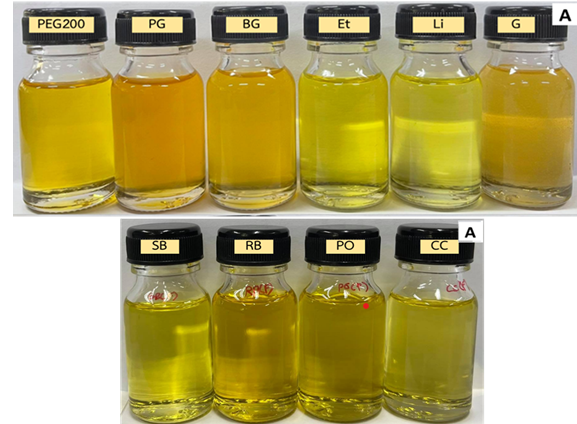
งานวิจัยนี้มีวัตถุประสงค์ศึกษาการสกัดสารเบต้าแคโรทีนจากเส้นใยและเปลือกผลตาลโตนด โดยใช้วิธีการสกัดด้วยคลื่นไมโครเวฟซึ่งเป็นวิธีการสกัดที่เป็นมิตรต่อสิ่งแวดล้อม และใช้ตัวทำละลายทางเลือกที่มีอยู่ในตำรับเครื่องสำอาง จากการศึกษาทำให้ได้สภาวะการสกัดที่เหมาะสมด้วยเครื่องไมโครเวฟ โดยใช้โพรพิลีนไกลคอลเป็นตัวทำละลายในการสกัด ใช้กำลังไฟฟ้าของเครื่องไมโครเวฟ 600 วัตต์ เปิดเครื่องเพื่อให้คลื่นไมโครเวฟ 3 รอบ โดยในหนึ่งรอบเปิดเครื่อง 30 วินาที และปิดเครื่อง 30 วินาที ที่อุณหภูมิในช่วง 75-80 องศาเซลเซียส การศึกษาฤทธิ์ต้านอนุมูลอิสระของสารสกัดด้วยวิธี DPPH พบว่าสารสกัดจากเปลือกผลตาลมีฤทธิ์ต้านอนุมูลอิสระดีกว่าสารสกัดจากเส้นใย โดยมีค่า IC50 เท่ากับ 0.0039 ± 0.98 และ 1.23 ± 0.85 มิลลิกรัมต่อมิลลิลิตร ตามลำดับ และหาปริมาณสารประกอบฟีนอลิกทั้งหมดด้วยวิธี Folin-Ciocalteu พบว่าในสารสกัดจากเปลือกผลและเส้นใยตาลโตนดมีปริมาณสารประกอบฟีนอลรวมเท่ากับ 50.26 ± 1.00 และ 6.67 ± 0.25 mg GAE/g ตามลำดับ ดังนั้นสารสกัดจากเปลือกผลตาลที่มีเบต้าแคโรทีนที่เตรียมได้จากสภาวะที่ดีที่สุดจึงมีศักยภาพที่จะนำไปใช้เป็นส่วนผสมในผลิตภัณฑ์เครื่องสำอางอาหารเสริมในระดับอุตสาหกรรมต่อไป
เอกสารอ้างอิง
Saranya K, Sivakumar G, Gopalasatheeskumar K, Arulkumaran G. An updated overview on phytochemical screening and pharmacological screening of Borassus flabellifer Linn. PharmaTutor. 2019; 7(5):15-19.
Vengaiah PC, Kaleemullah S, Madhava M, Mani A, Sreekanth B. Palmyrah fruit (Borassus flabellifer L.): Source of immunity and healthy food: A review. J. Pharm. Innov. 2021;10(11):1920-1925.
Black HS, Boehm F, Edge R, Truscott TG. The benefits and risks of certain dietary carotenoids that exhibit both anti-and pro-oxidative mechanisms-A comprehensive review. Antioxidants. 2020;9(3):264.
Baswan SM, Klosner AE, Weir C, Salter‐Venzon D, Gellenbeck KW, Leverett J, Krutmann J. Role of ingestible carotenoids in skin protection: A review of clinical evidence. Photodermatol Photoimmunol Photomed. 2021;37(6):490-504.
Lv QZ, Long JT, Gong ZF, Nong KY, Liang XM, Qin T, Yang L. Current state of knowledge on the antioxidant effects and mechanisms of action of polyphenolic compounds. Nat. Prod. Commun. 2021;16(7):1-13.
Armenta S, Garrigues S, Esteve-Turrillas FA, De la Guardia M. Green extraction techniques in green analytical chemistry. Trends Analyt Chem. 2019;116: 248-253.
Suryana MR, Haziman ML, Islamawan PA, Hariadi H, Yusuf D. (2023). Use of Beta-Carotene Pigment to Improve Food Product Chemical and Sensory Qualities: A Review. J. Funct. Foods. 2023;4(2);67-78.
Joshi DR, Adhikari N. An overview on common organic solvents and their toxicity. J. Pharm. Res. Int. 2019;28(3):1-18.
Arumugham T, Rambabu K, Hasan SW, Show PL, Rinklebe J, Banat F. Supercritical carbon dioxide extraction of plant phytochemicals for biological and environmental applications-A review. Chemosphere. 2021; 271:129525.
Chemat F, Abert-Vian M, Fabiano-Tixier A.S, Strube J, Uhlenbrock L, Gunjevic V, Cravotto G. Green extraction of natural products. Origins, status, and future challenges. TrAC, Trends Anal. Chem. 2019; 118:248-263.
Bagade SB, Patil M. Recent advances in microwave assisted extraction of bioactive compounds from complex herbal samples: a review. Crit. Rev. Anal. Chem. 2021;51(2);138-149.
Lateh L, Yuenyongsawad S, Chen H, Panichayupakaranant P. A green method for preparation of curcuminoid-rich Curcuma longa extract and evaluation of its anticancer activity. Pharmacogn. Mag. 2019;15(65):730-735.
Yadav N, Sharma S, Joys JS, Kumar S. Microwave assisted extraction of bioactive compounds: A brief review. J. Indian Chem. Soc. (2020;97(10a):1751-1756.
Hasan H, Mohamad A, Aldaaiek G. Extraction and Determination the of Beta carotene content in carrots and tomato samples collected from some markets at El-Beida City, Libya. EPH-Int. J. Appl. Sci. (2019);1(1):105-110.
Wabaidur SM, Obbed MS, Alothman ZA, Alfaris, NA, Badjah-Hadj-Ahmed AY, Siddiqui MR, Aldayel TS. Total phenolic acids and flavonoid contents determination in Yemeni honey of various floral sources: Folin-Ciocalteu and spectrophotometric approach. Food Sci. Technol. 2020; 40:647-652.
Sudiono J, Susanto GR. Antioxidant content of palm fruit (Borassus flabellifer L.) seed coat. Biomed. J. Sci. Tech. Res. 2021;34(3):26695-26699.
Valerio PP, Frias, JM, Cren EC. Thermal degradation kinetics of carotenoids: Acrocomia aculeata oil in the context of nutraceutical food and bioprocess technology. J. Therm. Anal. Calorim. 2021;143:2983-2994.
Pramod HJ, Yadav AV, Raje VN, Mohite M, Wadkar G. Antioxidant Activity of Borassus flabellifer (linn.) Fruits. Asian J. Pharm. Sci. Technol. 2013;3(1):16-19.
Elik A, Yanık DK, Göğüş F. Microwave-assisted extraction of carotenoids from carrot juice processing waste using flaxseed oil as a solvent. Lwt. 2020; 123:109100.
Kurian A, Thiripuranathar G, Paranagama PA. Determination of total phenolic content and antioxidant activity of Borassus flabeliffer Linn. fruit pulp collected from several parts of Sri Lanka. Int. J. Pharm. Sci. Res. 2017;8(6);2701-5.
Molole GJ, Gure A, Abdissa N. Determination of total phenolic content and antioxidant activity of Commiphora mollis (Oliv.) Engl. resin. BMC Chem. 2022;16(1): 48.
Zuo J, Geng S, Kong Y, Ma P, Fan Z, Zhang Y, Dong A. Current progress in natural deep eutectic solvents for the extraction of active components from plants. Crit. Rev. Anal. Chem. 2023;53(1):177-198.
ดาวน์โหลด
เผยแพร่แล้ว
รูปแบบการอ้างอิง
ฉบับ
ประเภทบทความ
สัญญาอนุญาต
ลิขสิทธิ์ (c) 2023 มหาวิทยาลัยพะเยา

อนุญาตภายใต้เงื่อนไข Creative Commons Attribution-NonCommercial-NoDerivatives 4.0 International License.
ผู้นิพนธ์ต้องรับผิดชอบข้อความในบทนิพนธ์ของตน มหาวิทยาลัยพะเยา ไม่จำเป็นต้องเห็นด้วยกับบทความที่ตีพิมพ์เสมอไป ผู้สนใจสามารถคัดลอก และนำไปใช้ได้ แต่จะต้องขออนุมัติเจ้าของ และได้รับการอนุมัติเป็นลายลักษณ์อักษรก่อน พร้อมกับมีการอ้างอิงและกล่าวคำขอบคุณให้ถูกต้องด้วย