Prevalence of sarcopenia and respiratory muscle strength in people: A survey preliminary study cross-sectional study
Keywords:
older adults, respiratory muscle strength, sarcopeniaAbstract
Older people are at significantly increased risk of health problems including musculoskeletal and respiratory problems. Recently, sarcopenia, which is loss of muscle mass and physical performance, is associated with a reduction in activities in daily life and poor quality of life later. In addition, poor respiratory performance leads to high risk of pulmonary complications in older adults such as dyspnea, pneumonia. Hence, the study aimed to explore the prevalence of sarcopenia and respiratory muscle strength in older people.
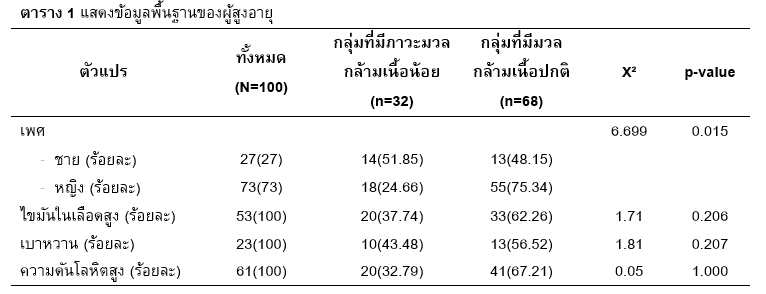
A survey preliminary study cross-sectional study was designed with 100 older people aged 65 years and over. All participants were diagnosed with sarcopenia in groups according to the Asian Working Group for Sarcopenia version 2019, consisting of handgrips strength, gait speed (6-meter walk test), and skeletal muscle mass (measured bioelectric impedance analysis). Maximum respiratory pressures were assessed. Descriptive analysis was used. To explore the difference in respiratory performance between sarcopenia and no sarcopenia, t-test and chi-square test was used; where appropriate. P-value was set at less than 0.05 and data was analyzed by SPSS program version 23.0. The results found that the prevalence of sarcopenia was 32 (76.84±7.33 years). Older adults were identified as having sarcopenia had advanced aged (76.84 ± 7.33 vs 71.15 ± 5.82 years, p<0.001), slow gait speed (0.82 ± 0.19 vs 1.05 ± 0.21 m/s, p<0.001), low skeletal muscle mass index (5.24 ± 0.90 vs 7.46 ± 2.16 kg/m2, p<0.001) and poor respiratory performance (i.e., weakness of inspiratory muscle strength 41.09 ± 23.08 vs 59.77 ± 24.07 cmH2O; p> .001). In this study, the prevalence of sarcopenia in older people aged 65 year was 32%. In addition, older people with sarcopenia shown a reduction in inspiratory muscle strength compared to older people with no sarcopenia.
References
Keller K. Sarcopenia. Wiener Medizinische Wochenschrift. 2019;169(7):157-72.
Larsson L, Degens H, Li M, Salviati L, Lee Yi, Thompson W, et al. Sarcopenia: Aging-Related Loss of Muscle Mass and Function. Physiological Reviews. 2018;99(1):427-511.
Nagano A, Wakabayashi H, Maeda K, Kokura Y, Miyazaki S, Mori T, et al. Respiratory Sarcopenia and Sarcopenic Respiratory Disability: Concepts, Diagnosis, and Treatment. The journal of nutrition, health & aging. 2021;25(4):507-15.
Shin HI, Kim D-K, Seo KM, Kang SH, Lee SY, Son S. Relation Between Respiratory Muscle Strength and Skeletal Muscle Mass and Hand Grip Strength in the Healthy Elderly. Ann Rehabil Med. 2017;41(4):686-92.
Lowery EM, Brubaker AL, Kuhlmann E, Kovacs EJ. The aging lung. Clinical interventions in aging. 2013;8:1489-96.
Bordoni B, Morabito B, Simonelli M. Ageing of the Diaphragm Muscle. Cureus. 2020;12(1):e6645.
Jones TE, Stephenson KW, King JG, Knight KR, Marshall TL, Scott WB. Sarcopenia--mechanisms and treatments. Journal of geriatric physical therapy (2001).
;32(2):83-9.
Waters DL, Mullins PG, Qualls CR, Raj DS, Gasparovic C, Baumgartner RN. Mitochondrial function in physically active elders with sarcopenia. Mechanisms of ageing and development. 2009;130(5):315-9.
Morisawa T, Kunieda Y, Koyama S, Suzuki M, Takahashi Y, Takakura T, et al. The Relationship between Sarcopenia and Respiratory Muscle Weakness in Community-Dwelling Older Adults. International journal of environmental research and public health. 2021;18(24).
Shafiee G, Keshtkar A, Soltani A, Ahadi Z, Larijani B, Heshmat R. Prevalence of sarcopenia in the world: a systematic review and meta- analysis of general population studies. Journal of Diabetes & Metabolic Disorders. 2017;16(1):21.
Petermann-Rocha F, Balntzi V, Gray SR, Lara J, Ho FK, Pell JP, et al. Global prevalence of sarcopenia and severe sarcopenia: a systematic review and meta-analysis. Journal of cachexia, sarcopenia and muscle. 2022;13(1):86-99.
Yuenyongchaiwat K, Boonsinsukh R. Sarcopenia and Its Relationships with Depression, Cognition, and Physical Activity in Thai Community-Dwelling Older Adults. Current Gerontology and Geriatrics Research. 2020;2020:8041489.
Chen LK, Woo J, Assantachai P, Auyeung TW, Chou MY, Iijima K, et al. Asian Working Group for Sarcopenia: 2019 Consensus Update on Sarcopenia Diagnosis and Treatment. Journal of the American Medical Directors Association. 2020;21(3):300-7.e2.
ATS/ERS Statement on respiratory muscle testing. Am J Respir Crit Care Med. 2002;166(4):518-624.
Makizako H, Nakai Y, Tomioka K, Taniguchi Y. Prevalence of sarcopenia defined using the Asia Working Group for Sarcopenia criteria in Japanese community-dwelling older adults: A systematic review and meta-analysis. Physical Therapy Research. 2019;22(2):53-7.
Ohara DG, Pegorari MS, Oliveira dos Santos NL, de Fátima Ribeiro Silva C, Monteiro RL, Matos AP, et al. Respiratory Muscle Strength as a Discriminator of Sarcopenia in Community-Dwelling Elderly: A Cross-Sectional Study. The journal of nutrition, health & aging. 2018;22(8):952-8.
Cruz-Jentoft AJ, Sayer AA. Sarcopenia. The Lancet. 2019;393(10191):2636-46.
Dhillon RJ, Hasni S. Pathogenesis and Management of Sarcopenia. Clinics in geriatric medicine. 2017;33(1):17-26.
Templeman L, Roberts F. Effectiveness of expiratory muscle strength training on expiratory strength, pulmonary function and cough in the adult population: a systematic review. Physiotherapy. 2020;106:43-51.
Kendall F, Oliveira J, Peleteiro B, Pinho P, Bastos PT. Inspiratory muscle training is effective to reduce postoperative pulmonary complications and length of hospital stay: a systematic review and meta-analysis. Disability and rehabilitation. 2018;40(8):864-82.
Nepomuceno BRV, Barreto MdS, Almeida NC, Guerreiro CF, Xavier-Souza E, Neto MG. Safety and efficacy of inspiratory muscle training for preventing adverse outcomes in patients at risk of prolonged hospitalisation. Trials. 2017;18(1):626.
Downloads
Published
How to Cite
Issue
Section
License
Copyright (c) 2023 University of Phayao

This work is licensed under a Creative Commons Attribution-NonCommercial-NoDerivatives 4.0 International License.
ผู้นิพนธ์ต้องรับผิดชอบข้อความในบทนิพนธ์ของตน มหาวิทยาลัยพะเยาไม่จำเป็นต้องเห็นด้วยกับบทความที่ตีพิมพ์เสมอไป ผู้สนใจสามารถคัดลอก และนำไปใช้ได้ แต่จะต้องขออนุมัติเจ้าของ และได้รับการอนุมัติเป็นลายลักษณ์อักษรก่อน พร้อมกับมีการอ้างอิงและกล่าวคำขอบคุณให้ถูกต้องด้วย
The authors are themselves responsible for their contents. Signed articles may not always reflect the opinion of University of Phayao. The articles can be reproduced and reprinted, provided that permission is given by the authors and acknowledgement must be given.