ผลของการใช้น้ำออกซิเจนไมโคร/นาโนบับเบิลต่อการเจริญเติบโตของผักกาดหอม เบบี้คอสพันธุ์ทวิตตี้ในระบบปลูกพืชแบบไฮโดรโปนิกส์
คำสำคัญ:
ผักกาดหอมเบบี้คอส, ไมโคร/นาโนบับเบิลส์, ไฮโดรโปนิกส์, สารละลายธาตุอาหารบทคัดย่อ
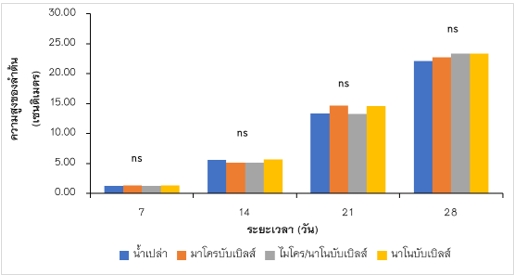
การศึกษาผลของการใช้น้ำออกซิเจนไมโคร/นาโนบับเบิลส์ต่อการเจริญเติบโตของผักกาดหอมเบบี้คอสพันธุ์ทวิตตี้ในการปลูกพืชแบบไฮโดรโปนิกส์ วางแผนการทดลองแบบสุ่มสมบูรณ์ (Completely Randomize Design : CRD) มี 4 กรรมวิธี จำนวน 4 ซ้ำ คือ 1) น้ำเปล่า (Control) 2) น้ำมาโครบับเบิลส์ (Macrobubbles ; MBs) 3) น้ำไมโคร/นาโนบับเบิลส์ (Micro/nanobubbles ; MNBs) และ 4) น้ำนาโนบับเบิลส์ (Nanobubbles ; NBs) ทำการทดลองระหว่างเดือนสิงหาคม - กันยายน 2566 โดยใช้ระยะเวลาในการปลูกพืช 28 วัน ผลการทดลองพบว่าการเจริญเติบโตด้านความสูงของลำต้น เส้นผ่านศูนย์กลางของลำต้น ความกว้างใบ ประสิทธิภาพการทำงานสูงสุดของระบบแสงที่สองของใบ ค่าไนเตรทของใบ น้ำหนักสดส่วนราก และน้ำหนักแห้งส่วนราก ไม่มีความแตกต่างกันทางสถิติ แต่การใช้น้ำมาโครบับเบิลส์ และน้ำไมโคร/นาโนบับเบิลส์ ทำให้ผักกาดหอมเบบี้คอสมีความกว้างทรงพุ่ม และความยาวของรากสูงกว่าการใช้น้ำเปล่าและการใช้น้ำนาโนบับเบิลส์ ส่วนการใช้น้ำนาโนบับเบิลส์ทำให้ผักกาดหอมเบบี้คอสมีความยาวใบ น้ำหนักสดส่วนใบ น้ำหนักแห้งส่วนใบ และน้ำหนักสดต่อต้นสูงที่สุด นอกจากนี้การใช้น้ำมาโครบับเบิลส์ น้ำไมโคร/นาโนบับเบิลส์ และน้ำนาโนบับเบิลส์ทำให้ผักกาดหอมเบบี้คอสมีจำนวนใบ น้ำหนักสดส่วนลำต้นสูงกว่าการใช้น้ำเปล่า ขณะที่การใช้น้ำไมโคร/นาโนบับเบิลส์ และการใช้น้ำโนบับเบิลส์ทำให้ผักกาดหอมเบบี้คอสมีดัชนีความเขียวของใบและน้ำหนักแห้งต่อต้นสูงกว่าการใช้น้ำเปล่าและการใช้น้ำมาโครบับเบิลส์
เอกสารอ้างอิง
Qgreengroup. Baby cos lettuce. [Internet]. 2021 [cited 2021 Jun 11]. Available from: https://qgreengroup.com/.html.
Sritontip C, Changeraja S, Khaosumain Y, Panthachode S, Sritontip P, Lesak S. 2017. Frugal soilless culture. Rajamangala University of Technology Lanna Printery, Chiang Mai.
Department of Agricultural Extension. Growing vegetables hydroponically. 2015. The Agricultural Cooperative Federation of Thailand., Limited.
Nuntagit, I. Automatic nutrient solution control in soilless culture. Faculty of Agricultural Technology, King Mongkut's Institute of Technology Ladkrabang. Bangkok. 1995:39-47.
Pongprasert N, Tatmala N, Srilaong, V. A Novel Postharvest Application of Carbon Dioxide Micro and Nano-Bubbles to Inactivate Total Bacteria and Improve the Quality of Fresh-Cut Lettuce. 2012. Esearch report. Faculty of Biological Resources and Technology; King Mongkut's University of Technology Thonburi.
Takahashi M, Chiba K, and Li P. Free-radical generation from collapsing microbubbles in the absence of a dynamic stimulus. 2007, Physical Chemistry B, 111, 1343-7.
Oshita S, S Liu, Nanobubble characteristics and its application to agriculture and foods. Proceedings of AFHW 2013. International Symposium on Agri-Foods for Health and Wealth. Golden Tulip Sovereign Hotel, Bangkok, Thailand. 2013, Aug 5-8.
Phaengkieo D, Chaoumead A, Wangngon B. The Application of NanoBubble Technology for DRFT Hydroponics. Journal of Innovative Technology Research. 2019;3(2):33-41.
Wang S, Liu Y, Lyu T, Pan G, Li, P. Aquatic macrophytes in morphological and physiological responses to the nanobubble technology application for water restoration. ACS ES&T Water, 2020;1(2):376-87.
Xue S, Gao J, Liu C, Marhaba T, Zhang W. Unveiling the potential of nanobubbles in water: Impacts on tomato's early growth and soil properties. Science of The Total Environment, 2023, 903, 166499.
Sritontip C, Dechthummarong C, Thonglek V, Khaosumain Y, Sritontip P. Stimulation of seed germination and physiological development in plants by high voltage plasma and fine bubbles. International Journal of Plasma Environmental Science & Technology 2019;12(2):74-8.
Samlitoemsiri T, Sritontip P, Khaosumain Y, Thonglek V, Sritontip C. Effects of nutrient solutions and micro/nanobubbles on melon growth in soilless cultivation. Phibunsongkhram Research National Academic Conference. Proceeding of the 6th Pibulsongkram Rajabhat University (Talay Kaew Garden); 2020 Feb 12; Phitsanulok. 777-86.
Kichawan P, Yindeeram N, Sritontip P, Changeraja S, Khaosumain Y, Thonglek V. Effects of micro/nanobubble nutrient solutions on celery growth in soilless cultivation. The report follows on from the report of the 5th Conference on Research and Creative Innovation (CRCI-2018); Rajamangala University of Technology Lanna Tak. 2018 Dec 6-8;812-21.
Pal P, Anantharaman H. CO2 nanobubbles utility for enhanced plant growth and productivity:Recent advances in agriculture. Journal of CO2 Utilization, 61, 102008. 2022.
ดาวน์โหลด
เผยแพร่แล้ว
รูปแบบการอ้างอิง
ฉบับ
ประเภทบทความ
สัญญาอนุญาต
ลิขสิทธิ์ (c) 2024 มหาวิทยาลัยพะเยา

อนุญาตภายใต้เงื่อนไข Creative Commons Attribution-NonCommercial-NoDerivatives 4.0 International License.
ผู้นิพนธ์ต้องรับผิดชอบข้อความในบทนิพนธ์ของตน มหาวิทยาลัยพะเยา ไม่จำเป็นต้องเห็นด้วยกับบทความที่ตีพิมพ์เสมอไป ผู้สนใจสามารถคัดลอก และนำไปใช้ได้ แต่จะต้องขออนุมัติเจ้าของ และได้รับการอนุมัติเป็นลายลักษณ์อักษรก่อน พร้อมกับมีการอ้างอิงและกล่าวคำขอบคุณให้ถูกต้องด้วย