การศึกษาเปรียบเทียบผลลัพธ์ของการจัดบริการการดูแลแบบประคับประคองของผู้ป่วยมะเร็งและผู้ป่วยที่ไม่ใช่มะเร็ง โรงพยาบาลมหาราชนครเชียงใหม่
คำสำคัญ:
ผู้ป่วยประคับประคอง, ผลลัพธ์การดูแลแบบประคับประคอง, ผู้ป่วยมะเร็ง, ผู้ป่วยไม่ใช่มะเร็งบทคัดย่อ
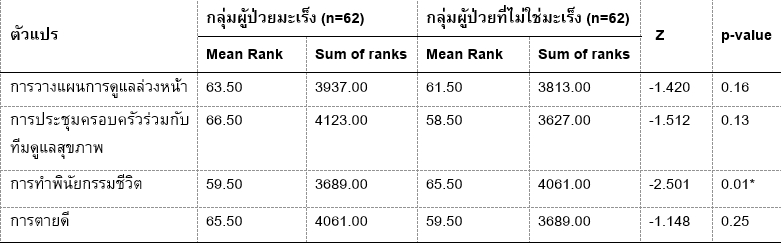
การวิจัยครั้งนี้ เป็นการศึกษาเชิงวิเคราะห์แบบย้อนหลัง (retrospective analytic study) ของหน่วยผู้จัดการรายกรณีด้านการดูแลผู้ป่วยแบบประคับประคอง ฝ่ายการพยาบาล โรงพยาบาลมหาราชนครเชียงใหม่ ตั้งแต่วันที่ 1 ตุลาคม 2564 ถึงวันที่ 31 สิงหาคม 2565 เพื่อศึกษาเปรียบเทียบผลลัพธ์ของการจัดบริการการดูแลแบบประคับประคองของผู้ป่วยมะเร็งและผู้ป่วยที่ไม่ใช่มะเร็ง อายุ 20 ปีขึ้นไป ที่มีความสามารถในการช่วยเหลือตัวเอง (PPs A Suandok) อยู่ในระดับ 10% - 30% กลุ่มละ 62 ราย โดยข้อมูลที่ใช้ศึกษาได้แก่ ข้อมูลทั่วไป ข้อมูลอาการความไม่สุขสบายของผู้ป่วยระยะสุดท้าย จากแบบประเมิน Edmonton Symptom Assessment System : ESAS ฉบับภาษาไทย การได้รับการทำการวางแผนการดูแลล่วงหน้า การประชุมครอบครัวร่วมกับทีมดูแลสุขภาพ การทำพินัยกรรมชีวิต และการตายดี ผลการวิจัย พบว่า คะแนนอาการความไม่สุขสบายทุกอาการของทั้ง 2 กลุ่ม หลังจากได้รับการดูแลจากทีมประคับประคอง มีคะแนนลดลงกว่าครั้งที่ 1 ส่วนผลลัพธ์ของการจัดบริการการดูแลแบบประคับประคองของทั้ง 2 กลุ่ม พบว่า การทำพินัยกรรมชีวิตมีความแตกต่างอย่างมีนัยสำคัญทางสถิติที่ .05 ส่วนการได้รับการทำการวางแผนการดูแลล่วงหน้า การประชุมครอบครัวร่วมกับทีมดูแลสุขภาพ และการตายดี ไม่แตกต่างกัน ควรนำผลการวิจัย ในด้านการทำการวางแผนการดูแลล่วงหน้า การประชุมครอบครัวร่วมกับทีมดูแลสุขภาพ การทำพินัยกรรมชีวิต และการจัดการอาการไม่สุขสบายต่างๆ เป็นแนวทางในการพัฒนาการจัดบริการแบบประคับประคองในประเทศไทย โดยมุ่งเน้นการบรรเทาความทุกข์ทรมานของผู้ป่วยในทุกด้าน โดยไม่คำนึงถึงประเภทของโรค เพื่อให้ผู้ป่วยและครอบครัวเข้าถึงบริการการดูแลแบบประคับประคองได้อย่างทั่วถึง
เอกสารอ้างอิง
Hui D, Bruera E. Models of palliative care delivery for patients with cancer. J Clin Oncol [Internet]. 2020;38(9):852–65. Available from: http://dx.doi.org/10.1200/JCO.18.02123.
Tanzi S, Peruselli C, Moroni M. Palliative care is a complex care. BMJ Support Palliat Care [Internet]. 2023;spcare-2023-004553. Available from: http://dx.doi.org/10.1136/spcare-2023-004553.
World Health Organization. Palliative care [Internet]. 2023 [cited 2023 Nov 28]. Available from: https://www.who.int/health-topics/palliative-care.
Henson LA, Maddocks M, Evans C, Davidson M, Hicks S, Higginson IJ. Palliative care and the management of common distressing symptoms in advanced cancer: Pain, breathlessness, nausea and vomiting, and fatigue. J Clin Oncol [Internet]. 2020;38(9):905–14. Available from: http://dx.doi.org/10.1200/JCO.19.00470.
Milazzo S, Hansen E, Carozza D, Case AA. How effective is palliative care in improving patient outcomes? Curr Treat Options Oncol [Internet]. 2020;21(2):12. Available from: http://dx.doi.org/10.1007/s11864-020-0702-x.
Xu S, Wang X, Wang R. The effects of integrated palliative care on quality of life and psychological distress in patients with advanced cancer: a systematic review and meta-analysis. Ann Palliat Med [Internet]. 2022;11(8):2586–99. Available from: http://dx.doi.org/10.21037/apm-22-162.
National Economic and Social Development Council (NESDC). Social Indicator Data [Internet]. 2021. Available from: https://www.nesdc.go.th/main.php?filename=PageSocial. (in Thai)
Chaiviboontham S, Pokpalagon P. Palliative care model in Thailand [Internet]. Int J Palliat Nurs. 2021;27(3):132-46. Available from: https://doi.org/10.12968/ijpn.2021.27.3.132. (in Thai)
Chinda M, Jaturapatporn D, Kirshen AJ, Udomsubpayakul U. Reliability and validity of a Thai version of the edmonton symptom assessment scale (ESAS-Thai) [Internet]. J Pain Symptom Manage. 2011;42(6):954-60. Available from: https://doi.org/10.1016/j.jpainsymman.2011.02.020.
The International Agency for Research on Cancer (IARC). Global Cancer Observatory [Internet]. Iarc.Fr. [cited 2023 Nov 28]. Available from: https://gco.iarc.fr/.
National cancer institue.(2017).Annual Report 2017. Department of Medical Sciences Ministry of Public Health.[Internet]. Available from:https://www.nci.go.th/th/File_download/filePlan/2560.pdf.
Wallace C.H. CHAN and I. Epstein, (2012) Researching “good death” in a Hong Kong palliative care program: A clinical data-mining study. Omega: Journal of Death and Dying, 64(3), 203–222.
NIH National Institute on Aging (NIA) (2022).Providing Care and Comfort at the End of Life. [Internet] Available from: https://www.nia.nih.gov/health/end-life/providing-care-and-comfort-end-life.
Cotogni P, De Luca A. Caring for patients in need of palliative care: Is this a mission for acute care hospitals? Key questions for healthcare professionals. Healthcare [Internet]. 2022;10(3):486. Available from: http://dx.doi.org/10.3390/healthcare100304861.
Romanò M, Oldani S, Reina V, Sofia M, Castiglioni C. Palliative care for patients with end-stage, non-oncologic diseases-A retrospective study in three public palliative care departments in northern Italy. Healthcare. 2022;10(6):1031. Available from: https://doi.org/10.3390/healthcare10061031.
Ruechuta Molek. Symptom intensity in persons with advanced cancer receiving palliative nursing care protocol and caregivers' satisfaction. Thesis Master of Nursing Science Program in Adult and Gerontological Nursing. 2014.
Schoenherr LA, Bischoff KE, Marks AK, O’Riordan DL, Pantilat SZ. Trends in Hospital-Based Specialty Palliative Care in the United States. JAMA Netw Open 2019; 2(12): 43-54.
Ramsbottom, K., & Kelley, M. L. Developing strategies to improve advance care planning in long term care homes: Giving voice toresidents and their family members.International Journal of Palliative Care, 2014: 1-8. doi: 10.1155/2014/3584572014.
Kim S, Koh S, Park K, Kim J. End-of-life care decisions using a Korean advance directive among cancer patient–caregiver dyads. Palliative and Supportive Care [Internet]. 2017 Feb 1 [cited 2024 July 20];15(1):77-87. Available from: https://research-ebsco-com.chula.idm.oclc.org/linkprocessor/ plink?id=b881655f-4569-3119-b87a-38f306cd6a1a.
ดาวน์โหลด
เผยแพร่แล้ว
รูปแบบการอ้างอิง
ฉบับ
ประเภทบทความ
สัญญาอนุญาต
ลิขสิทธิ์ (c) 2024 มหาวิทยาลัยพะเยา

อนุญาตภายใต้เงื่อนไข Creative Commons Attribution-NonCommercial-NoDerivatives 4.0 International License.
ผู้นิพนธ์ต้องรับผิดชอบข้อความในบทนิพนธ์ของตน มหาวิทยาลัยพะเยา ไม่จำเป็นต้องเห็นด้วยกับบทความที่ตีพิมพ์เสมอไป ผู้สนใจสามารถคัดลอก และนำไปใช้ได้ แต่จะต้องขออนุมัติเจ้าของ และได้รับการอนุมัติเป็นลายลักษณ์อักษรก่อน พร้อมกับมีการอ้างอิงและกล่าวคำขอบคุณให้ถูกต้องด้วย