ผลของโปรแกรมสื่อวีดีทัศน์ช่วยสอนต่อความรู้และการปฏิบัติตัวในการเตรียมตรวจสมรรถภาพปอดของผู้ป่วยที่มารับการตรวจเพื่อวินิจฉัยโรคระบบการหายใจ โรงพยาบาลตติยภูมิในเขตเมือง
คำสำคัญ:
โปรแกรมสื่อวีดีทัศน์ช่วยสอน, ความรู้, การปฏิบัติตัว, การตรวจสมรรถภาพปอด, ผู้ป่วยที่อยู่ระหว่างการวินิจฉัยโรคระบบการหายใจบทคัดย่อ
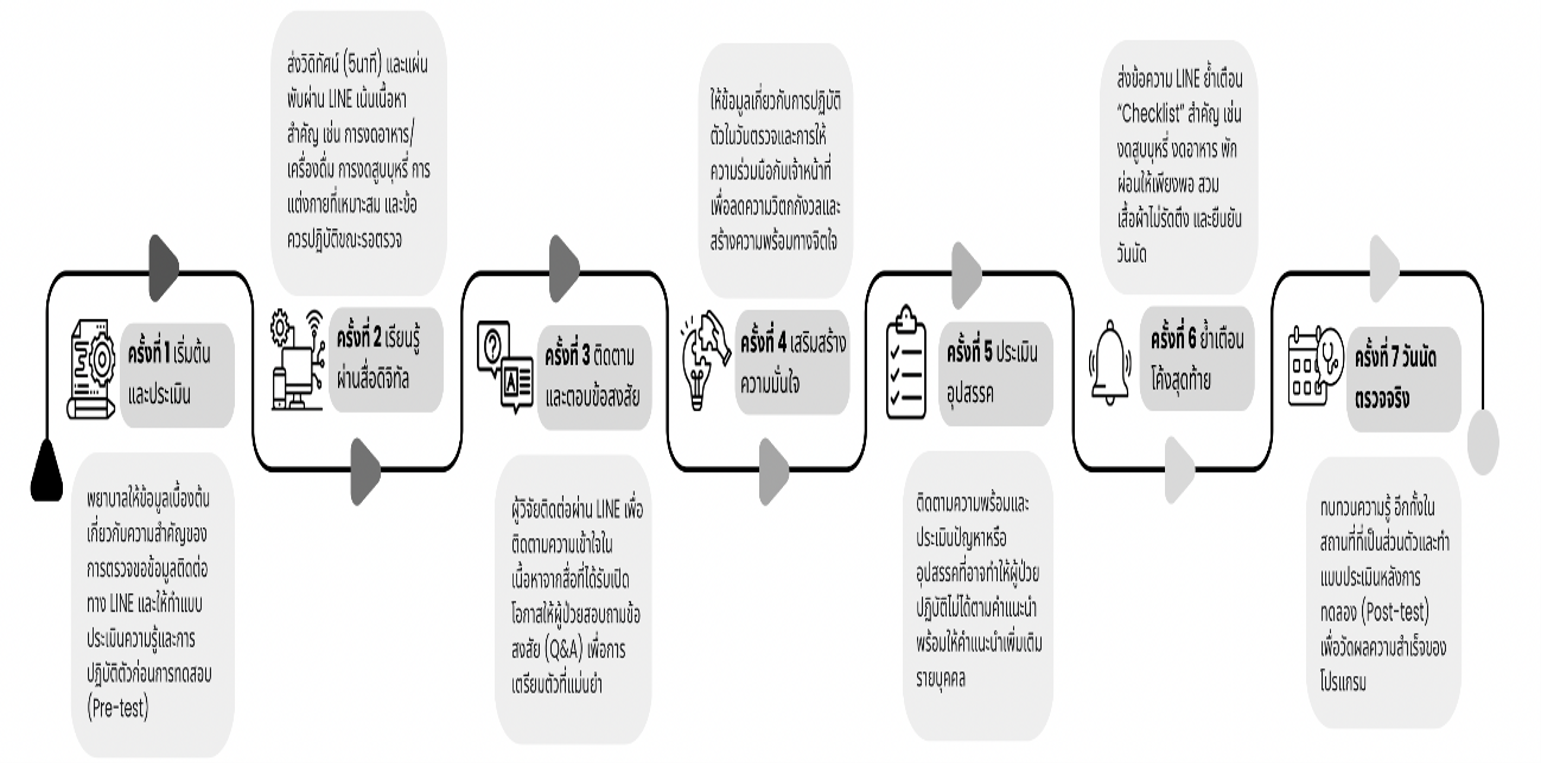
การวิจัยกึ่งทดลองแบบสองกลุ่มวัดก่อนและหลังการทดลอง มีวัตถุประสงค์เพื่อเปรียบเทียบคะแนนความรู้และการปฏิบัติตัวในการเตรียมตรวจสมรรถภาพปอดภายในกลุ่มและระหว่างกลุ่ม กลุ่มตัวอย่างเป็นผู้ป่วยที่อยู่ระหว่างการวินิจฉัยโรคระบบการหายใจ จำนวน 50 ราย คัดเลือกแบบเฉพาะเจาะจง แบ่งเป็นกลุ่มควบคุมและกลุ่มทดลอง กลุ่มละ 25 ราย กลุ่มทดลองได้รับโปรแกรมสื่อวีดีทัศน์ช่วยสอนผ่านแอปพลิเคชันไลน์เป็นเวลา 4 สัปดาห์ ส่วนกลุ่มควบคุมได้รับการดูแลตามมาตรฐาน เครื่องมือประกอบด้วยแบบสอบถามข้อมูลส่วนบุคคล แบบประเมินความรู้ และแบบประเมินการปฏิบัติตัว วิเคราะห์ข้อมูลด้วยสถิติพรรณนา เปรียบเทียบข้อมูลพื้นฐานระหว่างกลุ่มด้วย Chi-square test, Fisher’s exact test และ Independent t-test เปรียบเทียบคะแนนความรู้และการปฏิบัติตัวก่อนและหลังการทดลองภายในแต่ละกลุ่มด้วย Dependent t-test และเปรียบเทียบคะแนนระหว่างกลุ่มควบคุมและกลุ่มทดลองด้วย Independent t-test
ผลการวิจัยพบว่า การเปรียบเทียบภายในกลุ่ม กลุ่มทดลองมีคะแนนความรู้เพิ่มขึ้นจาก 12.60 (S.D. = 3.03) เป็น 15.60 (S.D. = 1.87) และคะแนนการปฏิบัติตัวเพิ่มขึ้นจาก 1.71 (S.D. = 0.29) เป็น 2.44 (S.D. = 0.26) อย่างมีนัยสำคัญทางสถิติ (t = -5.16 และ -7.53, p<0.001 ตามลำดับ) ขณะที่กลุ่มควบคุมมีคะแนนทั้งสองด้านก่อนและหลังการทดลองไม่แตกต่างกัน (p = 0.831 และ 0.606 ตามลำดับ) การเปรียบเทียบระหว่างกลุ่ม ก่อนการทดลองคะแนนทั้งสองด้านไม่แตกต่างกัน (p = 0.918 และ 0.849 ตามลำดับ) ภายหลังการทดลอง กลุ่มทดลองมีคะแนนความรู้เฉลี่ย 15.60 (S.D. = 1.87) สูงกว่ากลุ่มควบคุม 12.81 (S.D. = 3.00) (t = -3.90, p<0.001) และมีคะแนนการปฏิบัติตัวเฉลี่ย 2.44 (S.D. = 0.26) สูงกว่ากลุ่มควบคุม 1.75 (S.D. = 0.36) (t = -7.75, p<0.001) ผลการศึกษาสนับสนุนว่าโปรแกรมสื่อวีดีทัศน์ช่วยสอนสามารถส่งเสริมความรู้และการปฏิบัติตัวในการเตรียมตรวจสมรรถภาพปอดได้
เอกสารอ้างอิง
Saiphoklang N, Ruchiwit P, Kanitsap A, Tantiyavarong P, Vatcharavongvan P, Palungrit S, et al. Prevalence of chronic obstructive pulmonary disease and asthma in the community of Pathumthani, Thailand. Diseases. 2025;13(5):130. doi: 10.3390/diseases13050130.
Delavar MA, Jahani MA, Sepidarkish M, Alidoost S, Mehdinezhad H, Farhadi Z. Relationship between fine particulate matter (PM2.5) concentration and risk of hospitalization due to chronic obstructive pulmonary disease: a systematic review and meta-analysis. BMC Public Health. 2023;23(1):2229. doi: 10.1186/s12889-023-17093-6.
Chen P, Li Y, Wu D, Liu F, Cao C. Secondhand smoke exposure and the risk of chronic obstructive pulmonary disease: a systematic review and meta-analysis. Int J Chron Obstruct Pulmon Dis. 2023;18:1067-76. doi: 10.2147/COPD.S403158.
Sukhon D. The model for finding new tuberculosis patients in the community by X-Ray mobile with artificial intelligence; AI, Health Region 4. Journal of Medical and Public Health Region 4. 2025;15(2):154-66. (in Thai).
Barkous B, Briki C, Boubakri S, Abdesslem M, Ben Abbes N, Ben Hmid W, et al. Routine pulmonary lung function tests: interpretative strategies and challenges. Chron Respir Dis. 2024;21:14799731241307252. doi: 10.1177/14799731241307252.
Graham BL, Steenbruggen I, Miller MR, Barjaktarevic IZ, Cooper BG, Hall GL, et al. Standardization of spirometry 2019 update. An official American Thoracic Society and European Respiratory Society technical statement. Am J Respir Crit Care Med. 2019;200(8):e70-e88. doi: 10.1164/rccm.201908-1590ST.
Alavi Foumani A, Alavi Foumani SA, Attarchi M, Etemadi Deilami A, Majlesi B, Ildari S, et al. Quality of spirometry tests in the field of occupational health. BMC Res Notes. 2024;17(1):11. doi: 10.1186/s13104-023-06671-x.
Musalli AM, Alshehri WA, Alfawzan KMA, Aljizany MAM, Almalki AJD, Alqahtani DAD, et al. A review of respiratory system diseases: causes, symptoms, and treatments. Migration Letters. 2022;19(S8):103-13.
Campos-Rodríguez F, Chiner E, de la Rosa-Carrillo D, García-Cosío B, Hernádez-Hernández JR, Jiménez D, et al. Respiratory pathology and cardiovascular diseases: a scoping review. Open Respir Arch. 2025;7(1):100392. doi: 10.1016/j.opresp.2024.100392.
Haynes JM, Kaminsky DA, Ruppel GL. The role of pulmonary function testing in the diagnosis and management of COPD. Respir Care. 2023;68(7):889-913. doi: 10.4187/respcare.10757.
Agusti A, Ambrosino N, Blackstock F, Bourbeau J, Casaburi R, Celli B, et al. COPD: providing the right treatment for the right patient at the right time. Respir Med. 2023;207:107041. doi: 10.1016/j.rmed.2022.107041.
Dogru S, Aytac S, Al-Haithamy SAA, Ovayolu O, Sezgi C, Taylan M, et al. Impact of pre-test information on patient compliance with the spirometry protocol: a randomized controlled clinical trial. Eur Rev Med Pharmacol Sci. 2023;27(20):9754-61. doi: 10.26355/eurrev_202310_34147.
Kaewrat P, Chokbumrung K. A study of knowledge, attitudes, practices, and pulmonary function among patients with chronic obstructive pulmonary disease treated at Maharat Nakhon Ratchasima Hospital. Research and Development Health System Journal. 2021;14(3):13-28. (in Thai).
Laohavich C, Choothakan S, Tiparaj B. Effect of educational information with video compact disc on anxiety level of patients undergoing bronchoscopy. Nurs Res Inno J. 2017;23(2):195-207. (in Thai).
Tangsuppattakul U, Anantariyakul C. Effects of video media on preparation of patients receiving anesthesia for one-day surgery and minimally invasive surgery at the pre-anesthetic evaluation clinic, Phaholpolpayuhasena Hospital, Kanchanaburi Province. Phaholpolpayuhasena Hospital Journal. 2023;11(33):5-16. (in Thai).
Deelertpipatkul N, Boontham J. The effects of VDO media usage for pre and post-operative preparation on the knowledge and satisfaction of patients with cardiac implantable electronic devices. Vajira Nursing Journal. 2023;25(2):1-16. (in Thai).
Kurathong S. Urban medicine. Vajira Medical Journal: Journal of Urban Medicine. 2016;60(1):1-4. (in Thai).
Orem DE, Taylor SG, Renpenning KM. Nursing: concepts of practice. 6th ed. St. Louis, MO: Mosby; 2001.
Cohen J. Statistical power analysis for the behavioral sciences. 2nd ed. Hillsdale, NJ: Lawrence Erlbaum Associates; 1988.
Cohen J. A power primer. Psychol Bull. 1992;112(1):155-9. doi: 10.1037/0033-2909.112.1.155.
Burns N, Grove SK. The practice of nursing research: conduct, critique, and utilization. 5th ed. St. Louis, MO: Elsevier Saunders; 2005.
Polit DF, Hungler BP. Nursing research: principles and methods. 6th ed. Philadelphia: Lippincott; 1999.
Bloom BS, Hastings JT, Madaus GF. Handbook on formative and summative evaluation of student learning. New York: McGraw-Hill; 1971.
Best JW. Research in education. 3rd ed. Englewood Cliffs, NJ: Prentice-Hall; 1977.
Changsieng P, Pichayapinyo P, Lagampan S, Lapvongwatana P. Implementation of self-care deficits assessment and a nurse-led supportive education program in community hospitals for behavior change and HbA1c reduction: a cluster randomized controlled trial. J Prim Care Community Health. 2023;14:21501319231181106. doi: 10.1177/21501319231181106.
Kamkhiew R, Seemanee S. Effects of a self-management promotion program using the LINE application on knowledge and chronic kidney disease prevention behaviors among risked patients. Journal of Nursing and Education. 2025;18(2):e273006. (in Thai).
Tom K, Phang PT. Effectiveness of the video medium to supplement preoperative patient education: a systematic review of the literature. Patient Educ Couns. 2022;105(7):1878-87. doi: 10.2196/51573.
Wasim AS, Choudri MJ, Saidani Z, Khan AM, Siddiqui RS, Ridha A, et al. The effect of video-assisted learning on pre-operative knowledge and satisfaction for total knee arthroplasty surgery: a randomised-controlled study. J Orthop Surg Res. 2024;19(1):592. doi: 10.1186/s13018-024-04974-8.
Güçsav MO, Polat G, Serçe Unat D, Bayramiç E, Dikmentepe Yılmaz ES. Determining factors affecting the acceptability of spirometry: a survey study in a tertiary chest diseases center. Tuberk Toraks. 2023;71(3):273-80. doi: 10.5578/tt.20239708.
ดาวน์โหลด
เผยแพร่แล้ว
รูปแบบการอ้างอิง
ฉบับ
ประเภทบทความ
สัญญาอนุญาต
ลิขสิทธิ์ (c) 2026 มหาวิทยาลัยพะเยา

อนุญาตภายใต้เงื่อนไข Creative Commons Attribution-NonCommercial-NoDerivatives 4.0 International License.
ผู้นิพนธ์ต้องรับผิดชอบข้อความในบทนิพนธ์ของตน มหาวิทยาลัยพะเยา ไม่จำเป็นต้องเห็นด้วยกับบทความที่ตีพิมพ์เสมอไป ผู้สนใจสามารถคัดลอก และนำไปใช้ได้ แต่จะต้องขออนุมัติเจ้าของ และได้รับการอนุมัติเป็นลายลักษณ์อักษรก่อน พร้อมกับมีการอ้างอิงและกล่าวคำขอบคุณให้ถูกต้องด้วย