ผลของโปรแกรมการส่งเสริมการรับรู้สมรรถนะแห่งตนและการสนับสนุนทางสังคมต่อพฤติกรรมการจัดการครอบครัวในผู้ดูแลเด็กโรคหืดอายุ 1-5 ปี
คำสำคัญ:
การรับรู้สมรรถนะแห่งตน, การสนับสนุนทางสังคม, พฤติกรรมการจัดการครอบครัว, เด็กโรคหืดบทคัดย่อ
โรคหืดในเด็กเป็นโรคเรื้อรังที่ต้องการการดูแลอย่างต่อเนื่องเพื่อป้องกันอาการรุนแรงของโรคหรืออาการหอบกำเริบ ดังนั้นผู้ดูแลมีบทบาทสำคัญในการจัดการครอบครัวเพื่อดูแลเด็กโรคหืด การศึกษาวิจัยครั้งนี้เป็นแบบกึ่งทดลองชนิดสองกลุ่มวัดก่อน-หลังการทดลอง มีวัตถุประสงค์เพื่อศึกษาผลของโปรแกรมการส่งเสริมการรับรู้สมรรถนะแห่งตนและการสนับสนุนทางสังคมต่อพฤติกรรมการจัดการครอบครัวของผู้ดูแลเด็กโรคหืดอายุ 1-5 ปี กลุ่มตัวอย่างเป็นผู้ดูแลเด็กโรคหืดอายุ 1-5 ปี ที่เข้ารับการรักษาที่โรงพยาบาลระดับทุติยภูมิ ในภาคเหนือตอนบน จำนวน 48 ราย แบ่งเป็นกลุ่มทดลองและกลุ่มควบคุมกลุ่มละ 24 ราย ระยะเวลารวบรวมข้อมูลตั้งแต่เดือนสิงหาคม ถึงเดือนตุลาคม พ.ศ. 2568เครื่องมือที่ใช้ในการวิจัย ประกอบด้วยโปรแกรมการส่งเสริมการรับรู้สมรรถนะแห่งตนและการสนับสนุนทางสังคมแบบสอบถามพฤติกรรมการจัดการของครอบครัวเด็กโรคหืด วิเคราะห์ข้อมูลใช้สถิติเชิงพรรณนา และสถิติทดสอบค่าที
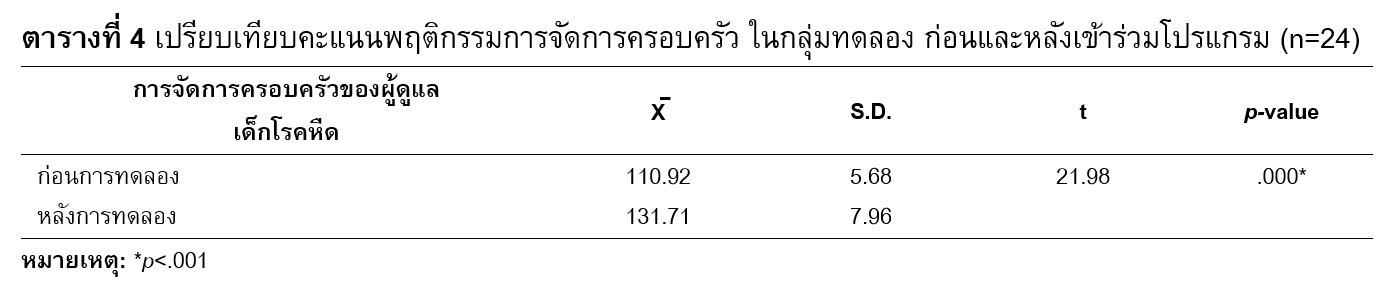
ผลการวิจัย พบว่า การจัดการครอบครัวของผู้ดูแลในกลุ่มทดลองสูงกว่ากลุ่มควบคุมอย่างมีนัยสำคัญทางสถิติที่ระดับ .001 (t = -8.30 p = .000) และสูงกว่าก่อนเข้าร่วมโปรแกรมอย่างมีนัยสำคัญทางสถิติที่ระดับ .001 (t = 21.98,
p = .000) ทดสอบขนาดอิทธิพล (effect size) ของโปรแกรม ได้เท่ากับ 1.69
ผลการศึกษานี้ชี้ให้เห็นว่า โปรแกรมส่งเสริมการรับรู้สมรรถนะแห่งตนและการสนับสนุนทางสังคมอาจช่วยส่งเสริมพฤติกรรมการจัดการของครอบครัวในผู้ดูแลเด็กโรคหืด ดังนั้น จึงอาจพิจารณานำโปรแกรมนี้ไปบูรณาการในการพยาบาล เพื่อสนับสนุนผู้ดูแลในการจัดการดูแลเด็กโรคหืดต่อไป
เอกสารอ้างอิง
Royal College of Pediatricians of Thailand. Thai National Guideline for diagnosis and Management of Childhood Asthma 2020-2021 [Internet]. Bangkok: Royal College of Pediatricians of Thailand. [cited 2025 Jan 23]. Available from: thaipedlung.org.
Ullmann N, Mirra V, Di Marco A, Pavone M, Porcaro F, Negro V, et al. Asthma: differential diagnosis and comorbidities. Front Pediatr. 2018;6:276. doi: 10.3389/fped.2018.00276.
Ducharme FM, Dell SD, Radhakrishnan D, Grad RM, Watson WT, Yang CL, et al. Diagnosis and management of asthma in preschoolers: A Canadian Thoracic Society and Canadian Pediatric Society position paper. Paediatr Child Health. 2015;20(7):353-61. doi: 10.1093/pch/20.7.353.
Kim TH, Kim H, Oh J, Kim S, Miligkos M, Yon DK, et al. Global burden of asthma among children and adolescents with projections to 2050: a comprehensive review and forecasted modeling study. Clin Exp Pediatr. 2025;68(5):329-343.
World Health Organization. Asthma [Internet]. Geneva: World Health Organization; 2024 [cited 2025 Jan 22]. Available from: https://www.who.int/news-room/fact-sheets/detail/asthma.
Centers for Disease Control and Prevention. Asthma surveillance data [Internet]. Atlanta (GA): CDC; 2024 [cited 2025 Jan 9]. Available from: cdc.gov.
Ministry of Public Health, Thailand. Annual Health Statistics Report 2022. Nonthaburi: Ministry of Public Health; 2022. (in Thai)
Uppala R, Sitthikarnkha P, Niamsanit S, Techasatian L, Saengnipanthkul S, Thepsuthammarat K, et al. In-Hospital Outcomes and Mortality of Pediatric Asthma Exacerbations in Thailand: A Nationwide Study (2015–2022). J Asthma Allergy. 2026;19:1-10. doi:org/10.2147/JAA.S603890.
Matyaboon N. Nursing care for children with respiratory disorders. In: Ngamsuay A, Sonkorgdang W, editors. Nursing care for children with health problems. Chiang Mai: Smart Coating and Service; 2020; p.50-52. (in Thai)
Alotaibi E, AlAteeq M. Knowledge and practice of parents and guardians about childhood asthma at King Abdulaziz Medical City for National Guard, Riyadh, Saudi Arabia. Risk Manag Healthc Policy. 2018;11:67-75. doi: 10.2147/RMHP.S143829.
Sutthisompohn S, Kusol K. Caregivers of Children with Chronic Illnesses: A Systematic Review on Family Management. J Southern Coll Nurs Public Health Netw. 2022;9(1):81-93.
Sutthisomporn S, Lamchang S, Jintrawet U. Factors predicting family management among caregivers of children with asthma. Nurs J CMU. 2020;47(4):27-38. (in Thai)
Chawsarn O, Jintrawet U, Lamchang S. Factors related to management behaviors among caregivers of children with asthma. Nurs J CMU. 2020;47(3):27-39. (in Thai)
Inthamat S, Yangam D, Raksapakdee W, Pongwongprasert S. Factors related to health care behaviors among caregivers of children with asthma. J Health Environ Educ. 2023;8(3):53-59. (in Thai)
Wattanachai P, Aree P, Lamchang S. Asthma severity, family management behaviors and asthma symptom control in children among family caregivers. Nurs J CMU. 2016;43(2):1-12. (in Thai)
Mahasaro P, Suwunnaroop N, Watthayu N. Factors predicting caring behaviors among caregivers of 1-6 years old asthmatic children. J Nurs Sci. 2017;35(2):64-73. (in Thai)
MuamgKaew O, Srichanchai J, Thana K. Effects of a competency enhancement program for caregivers of preschool children with asthma on care behaviors and disease exacerbation. Academic Journal of Nursing and Health Sciences. 2025;5(1):113-122. (in Thai)
Suksawat S, Lamchang S, Jintrawet U. Effects of coaching on care practices among parents fo children with asthma. Nurs J. 2012;39(4):1-14. (in Thai)
Manasathit S, Mesukko J, Jintrawet U. The effects of a group teaching program on parents’ knowledge and behavior in preventing asthmatic attacks in children. Nursing Journal CMU. 2025;49(3):299-310.
Danlee C, Sakdisthanont S. Effects of an interactive giving information program on perceived self-efficacy, caring behaviors of caregivers and disease control in children with asthma aged 3-5 years. J Nurs Ministry Public Health. 2022;32(2):145-58. (in Thai)
Ministry of Public Health (TH). Standard reports: Health status - Occupational and environmental diseases [Internet]. Nonthaburi: Strategy and Planning Division; 2024 [cited 2025 Mar 30]. Available from: moph.go.th.
Linda G. A study of the relationships among maternal caregiver family management behaviors childhood asthma morbidity and asthma control [master's thesis]. Tuscaloosa: The University of Alabama; 2011.
Global Initiative for Asthma. Global strategy for asthma management and prevention [Internet]. 2025 [cited 2025 Jan 22]. Available from: https://ginasthma.org.
Gray JR, Grove SK, Sutherland S. The practice of nursing research: Appraisal, synthesis, and generation of evidence. 8th ed. St. Louis: Elsevier; 2017.
Gupta KK, Attri JP, Singh A, Kaur H, Kaur G. Basic concepts for sample size calculation: critical step for any clinical trials. Saudi J Anaesth. 2016;10(3):328–31.
Wattana P. Effects of self-efficacy enhancement program on parents' behaviors toward asthma prevention in children [master's thesis]. Chiang Mai: Chiang Mai University; 2007. (in Thai)
Bandura A. Self-efficacy: the exercise of control. New York: WH Freeman; 1997.
Luo J, Wang M, Chen L. The effects of using a nature-sound mobile application on psychological well-being and cognitive performance among university students. Front Psychol. 2021;12:699908. doi: 10.3389/fpsyg.2021.699908.
Nammong J, Chivanon N, Wacharasin J. The effects of perceived self-efficacy promotion program on mother’s caring behaviors for toddler with acute lower respiratory infection. J Fac Nurs Burapha Univ. 2019;27(3):43-53. (in Thai)
Lin GQ, Ye ZQ, Song EL, Lin YN. Enhancing pediatric asthma management through multifaceted health education. World J Clin Cases. 2024;12(19):3708-16.
Rochmawati E, Putranto D. Mobile Application-Based Education to Improve Family Caregivers’ Readiness: Feasibility Study. The Journal for Nurse Practitioners. 2022, 18(10), 1097-1101.
Phongkamonkul C, Pongjaturawit Y, Chaimongkol N. Effects of maternal self-efficacy enhancement program using media through smartphone on maternal behavior in caring for children with pneumonia. Bamrasnaradura Infect Dis Inst J. 2021;15(1):37-48. (in Thai)
Ramirez A, Sanchez J, Delgado S. Caregiver training reduces emergency room visits in preschool children with asthma. Pediatr Pulmonol. 2019;54(3):345-51.
Peifer C, Schönfeld P, Wolters G, Aust F, Margraf J. Well done! Effects of positive feedback on perceived self-efficacy, flow and performance in a mental arithmetic task. Front Psychol. 2020;11:1008. doi: 10.3389/fpsyg.2020.01008.
Katiya S, Jaiboon S. Effect of a perceived self-efficacy enhancing program on knowledge and caring behaviors among caregivers of children with lower respiratory tract infections. Vajira Nurs J. 2024;26(1):26-41. (in Thai)
Boranmoon K, Imnamkhao S. Caregivers' experience in preschool children with uncontrolled asthma. J Health Syst Res Dev. 2023;16(3):88-111. (in Thai)
Singha T. Effect of the self-efficacy promoting program on parent participation in caring for children with pneumonia [master's thesis]. Chiang Mai: Chiang Mai University; 2023. (in Thai)
ดาวน์โหลด
เผยแพร่แล้ว
รูปแบบการอ้างอิง
ฉบับ
ประเภทบทความ
สัญญาอนุญาต
ลิขสิทธิ์ (c) 2026 มหาวิทยาลัยพะเยา

อนุญาตภายใต้เงื่อนไข Creative Commons Attribution-NonCommercial-NoDerivatives 4.0 International License.
ผู้นิพนธ์ต้องรับผิดชอบข้อความในบทนิพนธ์ของตน มหาวิทยาลัยพะเยา ไม่จำเป็นต้องเห็นด้วยกับบทความที่ตีพิมพ์เสมอไป ผู้สนใจสามารถคัดลอก และนำไปใช้ได้ แต่จะต้องขออนุมัติเจ้าของ และได้รับการอนุมัติเป็นลายลักษณ์อักษรก่อน พร้อมกับมีการอ้างอิงและกล่าวคำขอบคุณให้ถูกต้องด้วย