
Illness Perception and Self-care Behaviors of Thai Muslim Patients with Coronary Artery Disease in the Three Southernmost Provinces
Keywords:
Illness perception, Self-care behaviors, Thai Muslims, Coronary artery disease, The three southernmost provincesAbstract
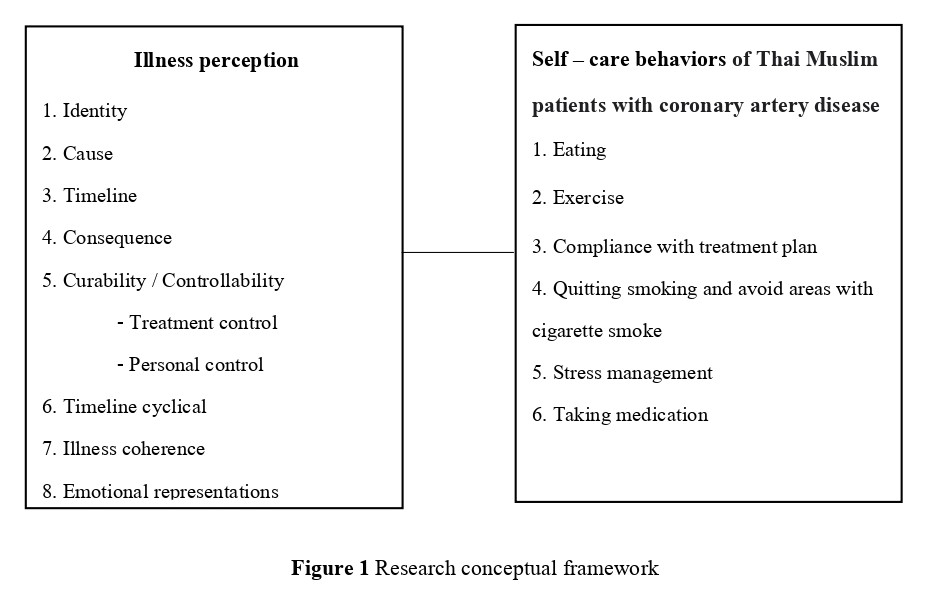
Background and Objective Coronary artery disease is one of the leading causes of death in Background and Objectives: Coronary artery disease was a leading cause of death overall. A significant issue was the recurrence of treatment due to self-care behaviors. The perception of illness affected self-care behaviors, influenced by external stimuli within the social and cultural context. The three southernmost provinces have a lifestyle that differs from other areas. This research aimed to study the relationship between illness perception and self-care behaviors of Thai Muslim patients with coronary artery disease in the three southernmost provinces.
Method A multi-stage random sampling method based on specified criteria, with a total of 112 participants. The research instruments included 1) a personal information and health condition questionnaire, 2) an illness perception questionnaire, and 3) a self-care behavior scale. Content validity was assessed by three experts, and the reliability of the illness perception questionnaire was tested using the test-retest method, yielding a coefficient of 0.93. The Cronbach’s alpha coefficients for disease causes, other illness perceptions, and self-care behaviors were 0.80, 0.80, and 0.82, respectively. Data collection was conducted from November 2024 to January 2025, and the data were analyzed using descriptive statistics and Pearson's product moment correlation coefficient.
Results
- The sample group perceived the symptoms related to the disease, with the most common being shortness of breath (93.80%). This was followed by chest pain lasting more than 20 minutes and palpitations (83.90% and 83.00%, respectively). In terms of the perceived causes of the disease, the most common belief was that it was the will of God (x̄ = 3.88, S.D. = 0.39), followed by smoking
(x̄ = 3.36, S.D. = 1.03) and aging or senescence (x̄ = 3.30, S.D. = 0.87). For the illness perception in
6 aspects, it was found that the perception of illness cure and controllability by treatment control and personal control, as well as the illness coherence, were at a high level (x̄ = 3.60, S.D. = 0.26; x̄ = 3.18, S.D. = 0.29; x̄ = 3.14, S.D. = 0.57, respectively). The perception of timeline, consequences, timeline cyclical, and emotional representations were at a moderate level (x̄ = 3.08, S.D. = 0.80; x̄ = 2.84,
S.D. = 0.50; x̄ = 2.78, S.D. = 0.63; and x̄ = 2.11, S.D. = 0.62, respectively). - Overall self-care behaviors were at a moderate level (x̄ = 2.87, S.D. = 0.40).
- The perception of the illness timeline had a negative correlation with exercise behavior
(r = -.187, p < .05). The perception of illness in terms of the cure and controllability by treatment control had a negative correlation with stress management behavior (r = -.195, p < .05), and the perception of illness in terms of emotional representations had a negative correlation with the treatment plan adherence (r = -.248, p < .01)
Conclusion and Recommendation From the research findings, it was found that the perception of illness in each area did not correlate with overall self-care behavior. However, there are negative correlations in specific areas, and the average scores for exercise and diet behaviors were low. Therefore, healthcare personnel teams should develop self-care models and programs that promote perception and self-care behaviors in patients with coronary artery disease according to the social and cultural contexts of the three southernmost provinces. This will help patients have a better understanding of their illness perception and adopt more appropriate self-care behaviors.
References
American Heart Association. (2024). Coronary Artery Disease. https://www.heart.org/en/health-topics/consumer-healthcare/what-is-cardiovascular- disease/coronary-artery-disease
Auman, U. (2018). Muslim Narrated, Narrating Muslim: Thai Muslim’s Identities in deep South in
the Documentary of real life. [Master, s thesis]. Thammasat University. https://digital.library. tu.ac.th/tu_dc/frontend/Info/item/dc:165471
Charintranont, K., Juntawises, U., & Kritpracha, J. (2023). Illness Perception in Predicting Smoking
Behaviors in Patients with Acute Coronary Syndrome after Percutaneous Coronary Intervention, Nursing Journal CMU,50(2), 1 - 13. https:// he02.tci -thaijo.org/index.php/cmunursingarticle/view/261493/179910
Chinphan, S., Sirisopon, N., Onsiri, S., & Wattanaburanon, A. (2019). Factors Correlated with Instent Restenosis in Coronary Heart Disease Patients. Journal of The Royal Thai Army Nurses, 20(3), 218 – 226.
http://he01.tci-thaijo.org/index.php/JRTAN/article/view/187485
Dumrongsin, S., Putwatana, P., & Khuwatsamrit, K. (2017). Self–Care Behaviors among Patients with Coronary In-stent Restenosis. Journal of The Royal Thai Army Nurses,18(2),220 - 227.
https://he01.tci-thaijo.org/index.php/JRTAN/article/view/96868/75524
Faul, F., Erdfelder, E., & Lang, A. G. (2009). Statistical power analyses using G* Power 3.1: Tests for correlation and regression analyses. Behavior Research Methods, 41(4), 1149 – 1160. https://link.springer.com/article/10.3758/BRM.41.4.1149
Gauro, P., Thaniwattananon, P., & Kritpracha, C. (2020). Illness Perception Predicting Cardiovascular Health Behaviors among Patients with Ischemic Heart Disease in Nepal: A Descriptive Cross sectional Study, Journal of the Nepal Medical Association, 58(231), 884 – 888. https://pmc.ncbi.nih.gov/article/PMC775004
Health Data Center. (2024). Health Data Center Dashboard. HDC. https://hdcservice.mop.go.th
Hirungerd, S., Lalun, A., & Kunkean, T. (2021). Factors Influencing Self-care Behavior of
Cardiovascular Clients at Kaengkraw Hospital, Chaiyaphum Province. Journal of Nursing and Health Care, 39(2), 97 – 106. https://he01.tci-thaijo.org/index.php/jnat-ned/article/view/249028
Khaegphong, C., Niyomdecha, R., Binzeng, A., & Pattanaprichawong, A. (2012). The Utilization of
Islamic Principle to Reduce Tobacco Consumption and Protect the Non-Smokers Health in Muslim community Mueang District, Narathiwat Province. Princess of Naradhiwas University Journal, 4(2), 59 – 72.
https://li01.tci-thaijo.org/index.php/pnujr/article/view/53734
Kongkaew, O., Naka, K., & Kritpracha, C. (2020). Illness Representation and Recurrence Prevention
Behavior in Elderly with Stroke. Songklanagarind Journal of Nursing, 40(1), 115 - 128. https://he02.tci- thaijo.org/index.php/nur-psu/article/view/240704
Krueaklat, S., Wannapomsiri, C., Tepsuriyanont, S., & Jittham, P. (2021). Effects of Social Supportbefore Cardiac Catheterization Program on Anxiety and Readiness Among Patients with Coronary Arterry Disease. Journal of Nursing and Health Sciences, 15(3), 52 - 63.
https://he01.tci-thaijo.org/index.php/NurseNu/article/view/251413/170251
Leventhal, H., Brissette, I., & Leventhal, E.A. (2003). The common-sense model of self-regulation of health and illness. In L. D. Cameron & H. Leventhal (Eds.), The Self- Regulation of Health and Illness Behaviour. (pp. 42 – 65). Routledge.
Lillahkul, N., & Supanakul, P. (2018). Way of Life of Muslim People in Thailand’s Southern Provinces, and Health Promoting Lifestyle. The Southern College Network Journal of Nursing and Public Health, 5(2), 302 – 312. https://he01.tci- thaijo.org/index.php/scnet/ article/view/130912/98182
Mosleh, S. M., & Almalik, M. (2016). Illness perception and adherence to healthy behaviour in Jordanian coronary heart disease patients. European Journal of cardiovascular nursing, 15(4), 223 – 230. https://doi.org/10.1177/1474515114563885
Moss – Morris, R., Weinman, J., Petrie, K., Horne, R., Cameron, L., & Buick, D. (2002) The revised illness perception questionnaire (IPQ-R). Psychology and Health, 17(1), 1 - 16. https://doi.org/10.1080208870440290001494
Nachai, L., Sriprasong, S., Sanecha, C., & Chantadansuwan, T. (2022). Factors Predicting Self-Care Behaviours in Patients with Coronary Artery Disease, Journal of Thailand Nursing and Midwifery Council, 37(3), 93 -108. https://he02.tci-thaijo.org/index.php/ TJONC/article/view/256882/176508
National Statistical Office. (2018). Population and Housing Census. http://statbbi.nso.go.th/staticreport/page/sector/th/01.aspx
Pallant, J. (2020). SPSS saurvival manual: A step-by-step guide analysis using IBM SPSS (7th ed.). Routledge. https://doi.org/10.4324/9781003117452
Polkot, P., Thanachirachot, P., & Rithimontri, P. (2018). Food consumption behavior of people, Asong Sub-district, Raman District, Yala Province. Chalermkanjana Academic Journal, 5(2), 68 – 80. https://cnu.ac.th/journal/JournalPDF/68-80_5_2.pdf
Prayadsap, P. (2018, February 23). Islam of Life. https://www.skthai.org/th/articles/112964- Islam of Life Rattanaprom, A., Srisuk, N., & Koson, N. (2023). Self-care behaviors among patients with coronary
heart disease after percutaneous coronary intervention. Nursing Science Journal of Thailand, 41(4), 56 - 72. https://he02.tci-thaijo.org/index.php/ns/article/view/260610/181046
Rosyidi, K., & Nur, M. (2018). Illness perception and cardiovascular health behaviour among persons with ischemic heart disease in Indonesia. International journal of nursing sciences, 8(1), 174 – 180. htps://www.sciencedirect.com/science/article/pii/S2352013217302600
Sanaklang, R., Silarat, M., & Ruaisungnoen, W. (2024). The Perception of Exercise in Patients with Acute Myocardial Infarction. Nursing Journal CMU, 51(2), 43 - 56. https://he02.tci-thaijo.org/index.php/cmunursing/article/view/267719/183856
Smuseneto, A., Tongsamsi, K., Benrit, P., & Useng, N. (2017). Sexuality in the Marital Life of Thai Muslims in Pattani Province. Thammasat Journal of History, 4(1), 271 - 323. https://so05.tci-thaijo.org/index.php/thammasat_history
Srisa-at, B. (2017). Preliminary research (8th ed). Suwiriyasan. https://elibrary.edupol.org/my/read/ebook67c00a850b4ce
Suphandee, A. (2020). Comparison of readmission rate within 28 days with previous disease without appointment before and after using the discharge planning program in patients with acute coronary syndrome. Singburi hospital medical journal, 29(1), 75 - 86. https:// he01.tci-thaijo.org/index.php/shj/article/view/248795/168445
Thagizadeh, A., Ghahramanian, A., Zamanzadeh, V., Aslanabadi, N., Onyeka, T.C., & Ramazanzadeh, N. (2022). Illness perception and cardiovascular risk factors in patients with myocardial infarction undergoing percutaneous coronary intervention in Iran. BMC Cardiovascular Disorders, 22(1), 245. https://doi.org/10.1186/s12872-022-02684-9
Youdkong S., Muensri, B., & Krtipracha, C. (2021). The Effect of Illness Perception Promoting Dietary Focus Program on Illness Perception and Dietary Behaviors in Muslim Patients with ischemic heart disease. Princess of Naradhiwas University Journal, 13(3), 153 - 172. https://digital.car.chula.ac.th/chulaetd/1565/
Downloads
Published
How to Cite
Issue
Section
License
Copyright (c) 2025 Princess of Naradhiwas University Journal

This work is licensed under a Creative Commons Attribution-NonCommercial-NoDerivatives 4.0 International License.