Effects of Learning Management Through the Challenges of Elderly Care in the 21st Century on Promoting Self-directed Learning and Knowledge Development in Nursing Students
Keywords:
Challenges in elderly care in the 21st century, Promotion of Self-directed learning, Knowledge development, Preparing nursing studentsAbstract
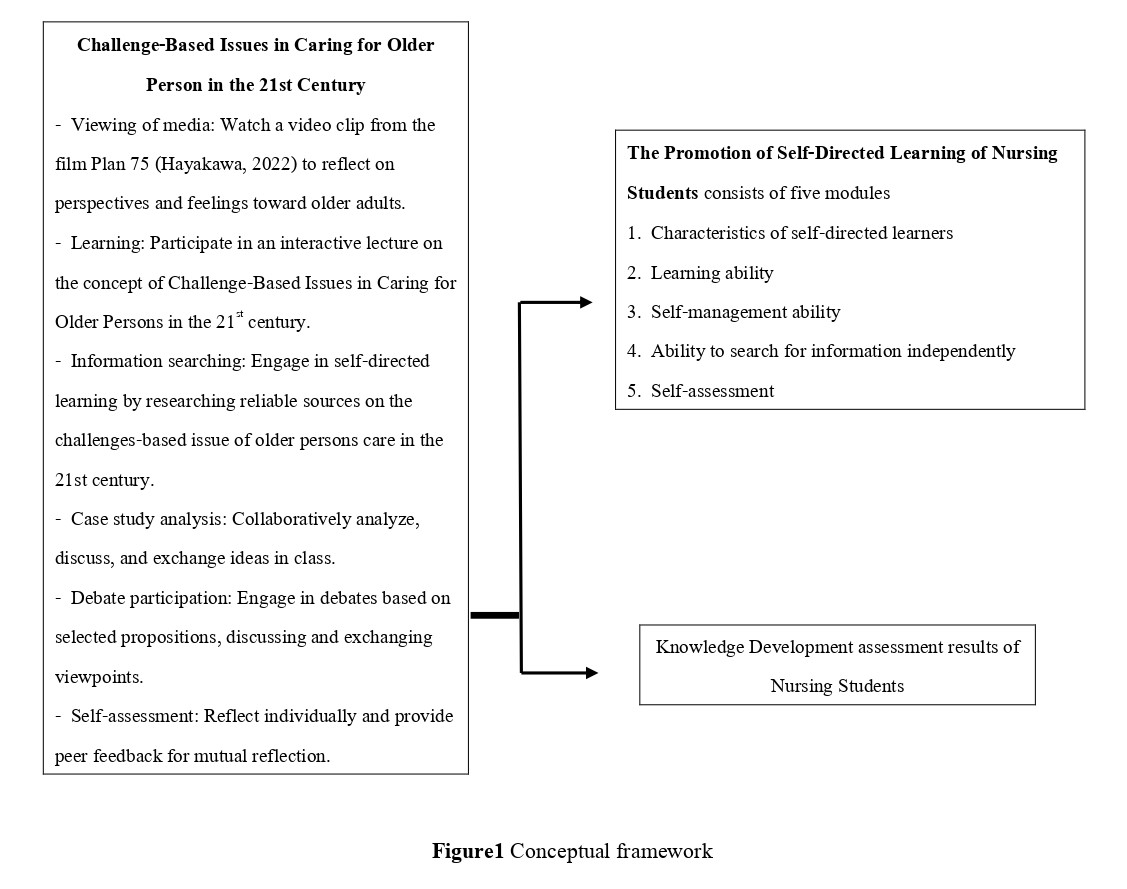
Background and Objectives The number of elderly population structures is continuously increasing in the 21st century, leading to challenges in providing complex care for the elderly, including illness, dependency, mental health issues, social, economic, technological, and other factors that impact the nursing profession in the current era. Learning management through challenging issues is learning through real-life situations and problems, providing opportunities independently through self-directed learning with learning behaviors, management skills, self-information retrieval, and assessment, which are then used for debate discussion on the chosen topic reasonably. This approach fosters analytical thinking, professional skills, and systematic problem-solving, as well as lifelong learning. This research is a single-group quasi-experimental study with pre- and post-test measurements. Its objectives were to compare the promotion of self-directed learning among nursing students before and after learning management through challenging issues in elderly care in the 21st century and to compare nursing students' knowledge scores before and after learning management through challenging issues in elderly care in the 21st century.
Methods The sample group consisted of 30 nursing students enrolled in the Geriatric nursing course in the second semester of the 2024 academic year. The research instruments used were lesson plans, teaching materials, case studies, and a debate on the challenges of caring for the elderly in the 21st century. The content validity index (CVI) was 0.92. The data collection instruments were a general information questionnaire, a self-directed learning promotion questionnaire for nursing students, and a nursing student knowledge test. The content validity indexes (CVI) for these instruments were 1, 0.97, and 0.97, respectively. The reliability of the self-directed learning promotion questionnaire for nursing students was tested, yielding a Cronbach's alpha coefficient of 0.95. The knowledge test for nursing students had a KR-20 value of 0.86. Data were analyzed using descriptive statistics and paired t-tests, as per the initial agreement.
Results 1) Self-directed learning promotion among Nursing students after participating in learning management through the challenges of elderly care in the 21st century statistically significantly increased both overall and in each aspect (p < .05). 2) The average knowledge score of nursing students statistically significantly increased from 53.37 to 55.97 (p < .05) after learning management through the challenges of caring for the elderly in the 21st century (p < .01).
Conclusion and Recommendation Learning management through the challenges of elderly care in the 21st century helps promote self-directed learning. The increasing knowledge scores of nursing students indicate that learners develop critical thinking skills, self-management, information retrieval, and self-assessment skills. Therefore, promoting self-directed learning should be applied in nursing education in complex elderly care situations.
References
Arpanantikul, M., Thanooruk, R., & Luecha, Y. (2008). Development of an Instrument to Measure Self-Directed Learning Readiness of Thai Undergraduate Nursing Students. Journal of the Nursing Council, 23(2), 52 - 69. https://he02.tcithaijo.org/index.php/TJONC/article/view/ 2482/2473
Arpanantikul, M., Thanoorak, R., & Luecha, Y. (2020). Promoting self-assessment in higher education. Journal of Learning and Teaching Development, 12(1), 60 – 72. https://so02.tci-thaijo.org/index.php/JLTK
Artsanthia, J., & Pomthong, R. (2018). Trends in elderly care in the 21st century: Nursing challenges. Royal Thai Army Nursing Journal, 19(1), 39 - 46. https://he01.tci-thaijo.org/index.php/JRTAN/article/view/121906/92866
Bloom, B. S. (1956). Taxonomy of educational objectives: The classification of educational goals. Longman.
Chantrawipak, P., Duangchan, S., & Chenjitpanich, J. (2022). Developing learners in the 21st century through the Active Learning process. Chiang Mai University Journal of Education, 23(1), 75 – 92. https://so01.tci-thaijo.org/index.php/cmsj/article/view/256347
Chiradechakul, S. (2021). Development of situational intelligence in health professional students. Prince of Songkla University Library and Information Science Journal, 35(3), 58 – 67. https://so03.tci-thaijo.org/index.php/slsj/article/view/256212
Faculty of Nursing, Narathiwat Rajanagarindra University. (2021). Bachelor of Nursing Science Program (Revised Curriculum 2021). Author.
Guglielmino, L. M. (1978). Development of the Self-Directed Learning Readiness Scale. Dissertation Abstracts International Section A. Humanities and Social Sciences, 38(11-A), 6467. https://psycnet.apa.org/record/1979-14573-001
Guglielmino, L. M. (2013). The case for promoting self-directed learning in formal educational institutions. SA-eDUC Journal, 10(2), 1- 18. http://doi.org/10.10520/ EJC146333
Hanucharumkul, S. (2021). Challenge-based learning in nursing education: A new paradigm for aging care [Master’s thesis]. Mahidol University.
Hayakawa, C. (Director). (2022). Plan 75 [Film]. Happinet Phantom Studios; Dongyu Club; Urban Factory.
International Council of Nurses. (2023). Nursing care for older adults: Ensuring quality, dignity, and respect. International Council of Nurses. https://www.icn.ch/system/files/2023-07/ICN_ OlderAdults_Report_EN.pdf
Johnson, K., & Smith, P. (2023). Nursing students' experiences of learning through real-world challenges in geriatric care: A qualitative study. Journal of Nursing Education, 62(4), 178 - 186. https://journals.healio.com/journal/jne
Kao, H.F., Ye, M., & Chen, L. (2021). Effects of simulation-based learning on nursing students' learning outcomes of a gerontology course. Innovation in Aging, 5(Supplement_1), 486. https://doi.org/10.1093/geroni/igab046.1880
Knowles, M. S. (1975). Self-directed learning: A guide for learners and teachers. Association Press.
Knowles, M. S. (2015). The adult learner: The definitive classic in adult education and human resource development (8th ed.). Routledge.
Ministry of Education. (2015). Guidelines for organizing 21st-century learning skills focusing on professional competencies. https://secondary.obec.go.th/newweb/wp-content/uploads/2017/ 12/E-CEN21book.pdf
Noh, G.O., & Kim, D. H. (2019). Effectiveness of a self-directed learning program using blended coaching among nursing students in clinical practice: A quasi-experimental research design. BMC edical Education, 19, 225. https://doi.org/10.1186/s12909-019-1672-1
National Statistical Office. (2021). The situation of Thai elderly in spatial dimensions 2021.
https://www.nso.go.th/nsoweb/storage/ebook/2023/20230506145038_72776.pdf
Niamsuwan, P. (2021). The concept of self-directed learning in the 21st century. Journal of Education, 49(4), 95 – 110. https://archive.cm.mahidol.ac.th/handle/123456789/4237
Nilniyom, S. (2021). The effect of problem-based learning on self-directed learning readiness of nursing students. Royal Thai Army Nursing Journal, 22(2), 34 – 42. https://he01.tci-thaijo.org/index.php/RTAFNAJ
Oumtanee, A. (2019). Teaching in Geriatric Nursing: From Theory to Practice. Chulalongkorn University Press.
Phatwang, B., & Udomlak, S. (2013). A Study of the Self – Directed Learning Readiness of Nursing Students at Boromarajonani College of Nursing, Nakorn Lampang. Nursing Journal of the Ministry of Public Health, 31(2), 42 – 55. https://he02.tcithaijo.org/index.php/tnaph/article/view/4874/4204
Phulsawat, N. (2021). Characteristics of learners in the 21st century and the development of self- directed learning skills. Journal of Education, 19(2), 98 – 110. https://so06.tci-thaijo.org/index.php/edujournal/article/view/252470
Pornpojthanamas, W. (2022). Qualitative research in gerontological nursing education. [Master’s thesis]. Mahidol University.
Ratchapakdee, P., & Iniam, P. (2020). Effects of Padlet-based instruction on nursing students’ self-learning ability and interaction skills in Adult Nursing II. Udon Thani Hospital Medical Journal, 28(1), 52 – 60. https://he02.tci-thaijo.org/index.php/udhhosmj/article/view/241455
Sriboonpimsuay, W. (2014). Factors influencing self-directed learning of nursing students. Boromarajonani College of Nursing Udon Thani Journal of Nursing and Education, 7(4), 78 – 91. https://he01.tci-thaijo.org/index.php/JNAE/article/view/29776/25642
Sungsri, S. (2023). Enabling Students in Higher Education Institutions to be Lifelong Learners. Journal of Humanities & Social Sciences, 21(1), 211 - 233. https://so03.tci-thaijo.org/ index.php/jhusoc/article/download/266761/177551
Sudjai, J. (2022). Learning from real situations to develop nursing students’ analytical thinking skills. Journal of Public Health Nursing, 36(1), 15 – 26. https://he01.tci-thaijo.org/index.php/phn
Thongcharoen, W. (2020). Physical changes in the elderly. [Master’s thesis]. Mahidol University. http://www.ns.mahidol.ac.th/programs/
Thongkamdee, S., Srisawat, N., & Phulphon, T. (2022). Effects of problem-based learning on analytical thinking and decision-making of nursing students. Ministry of Public Health Nursing Journal, 32(1), 25 – 38. https://kb.psu.ac.th/psukb/bitstream/2016/10631/1/ TC1225.pdf
Turner, K., Leungratanamart, L., Reunreang, T., & Rakkwamsuk, S., (2017). Development of a pedagogical model to promote 21st century skills of nursing. Nursing Journal of the Ministry of Public Health, 27(3), 127-138. http://he02.tcithaijo.org/index.php/tnaph/article/download/121758/92782
Wiratchai, N. (2020). Self-assessment of students: A case study in Thai higher education institutions. Journal of Education, 31(2), 78 – 92. https://so02.tci-thaijo.org/index.php/ EDUCU/article/view/247526
Wongchaiya, P (2022). Effects of using complex case studies on the development of higher-orderthinking skills in nursing students. Nursing Journal, 49(1), 89 – 102. https://he01.tci-thaijo.org/index.php/cmunursing/article/view/256520
World Health Organization. (2022). Competency Framework for Health Workers in the 21st Century. Geneva.
World Health Organization. (2023). World report on ageing and health. Author.
Downloads
Published
How to Cite
Issue
Section
License
Copyright (c) 2025 Princess of Naradhiwas University Journal

This work is licensed under a Creative Commons Attribution-NonCommercial-NoDerivatives 4.0 International License.