
Effects of Model Development for Preventing Early Postpartum Hemorrhage Combined with Lower Uterine Segment Compression and Cold Massage in Mothers Receiving Labor Services Rangae Hospital, Narathiwat Province
Keywords:
Prevention of early postpartum hemorrhage, Lower uterine segment compression, Cold uterine massage, Postpartum nursing careAbstract
Background and Objectives Postpartum hemorrhage is a major cause of maternal death. Health Service Area 12 had the highest maternal mortality rate at 72.6 % (Ministry of Public Health, 2022). Rangae Hospital has seen a rise in postpartum hemorrhage in the first two hours from 2021 to 2023, with rates of 0.37 %, 0.4 %, and 0.97%, respectively. The most common causes were uterine atony and retained placenta. To develop a model for preventing early postpartum hemorrhage and compare the total blood loss between the experimental group using the developed model and the control group receiving standard care.
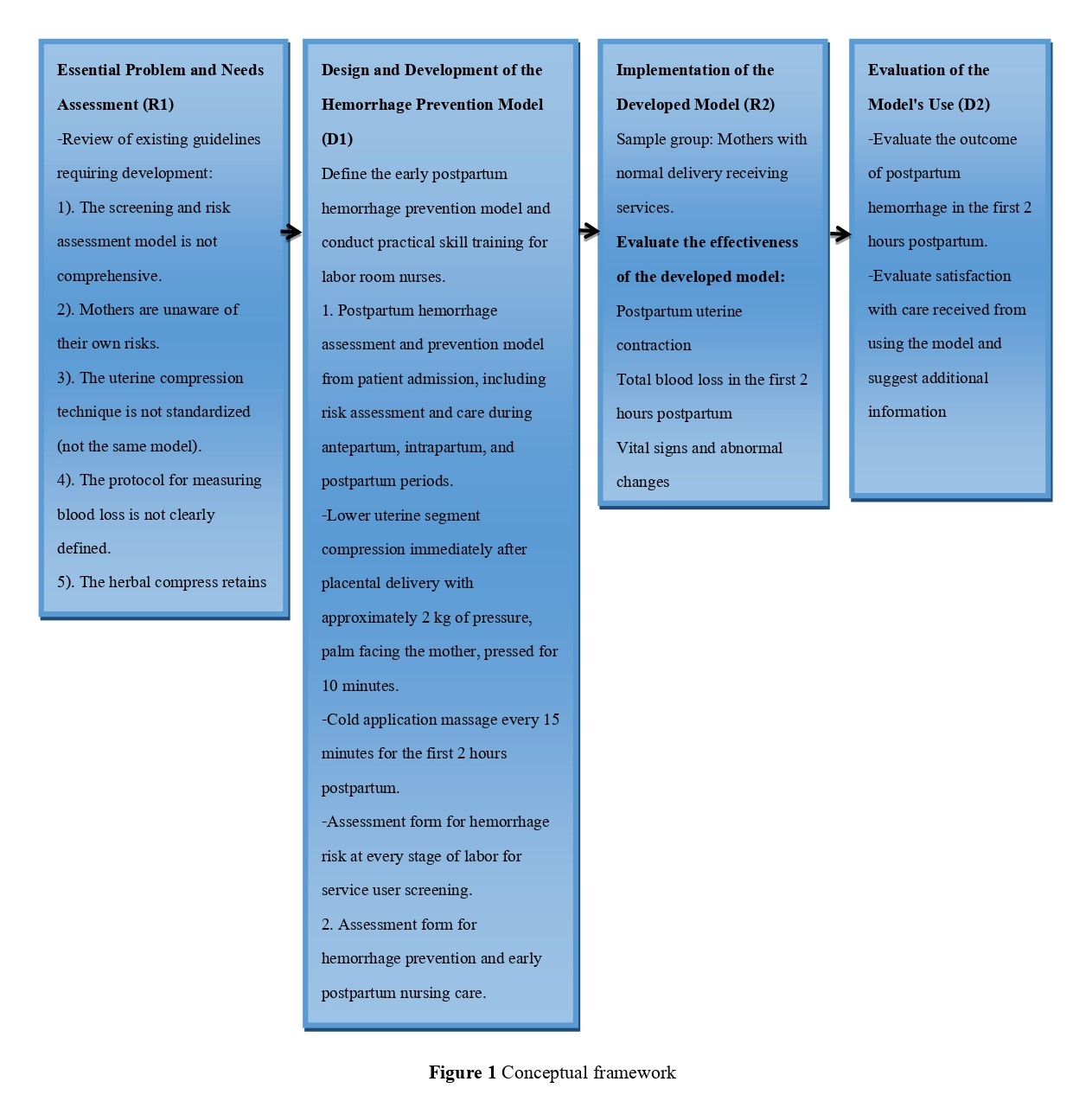
Methods The research and development model consisted of 4 steps: 1) Problem and needs analysis (R1): Data providers were mothers with a history of postpartum hemorrhage and professional nurses working in the labor room; 2) Model design and development (D1): Researchers drafted the model and had experts review its quality; 3) Model testing and effectiveness evaluation (R2): The study population consisted of women giving birth at Rangae Hospital. The sample consisted of 50 women who delivered normally, divided into 25 in the experimental group and 25 in the control group. The tools used were the early postpartum hemorrhage prevention model, the lower uterine segment compression model, and the cold massage model, including a personal information questionnaire and a record of blood loss volume within 2 hours postpartum. Data were analyzed using descriptive statistics (t-test); 4) Evaluation of the developed model (D2): Data providers were 25 women who used the developed model.
Results The early postpartum hemorrhage prevention model included professional standard labor care combined with lower uterine segment compression and uterine massage for 10 minutes, as well as uterine massage with cold compresses. The amount of blood loss in the first 2 hours after delivery in the experimental group using the postpartum hemorrhage prevention model was 119.60 milliliters on average (S.D. = 18.82). The control group receiving standard care had an average of 206 milliliters (S.D. = 36.74). The amount of blood loss in the experimental group was significantly statistically less than in the control group (t = 10.46, p < 0.000).
Conclusion and Recommendation The study results show that the early postpartum hemorrhage prevention model combined with lower uterine segment compression and cold massage effectively reduces postpartum hemorrhage. This provides guidance for nurses in caring for mothers receiving labor services, leading to rapid diagnosis and treatment and ensuring safe delivery.
References
Banditchanicha, P. (2017). Prevention of postpartum hemorrhage in an interdisciplinary hospital team. Nursing Division Journal, 44(2), 10-19. https://he02.tci-thaijo.org/index.php/MJSSBH/article/view/116895
Banditpanichcha, P., Phonsaen, N., & Lueangkhwan, S. (2018). The development of nursing care system for prevention postpartum hemorrhage. Sisaket Surin Buriram Hospital Medical Journal, 32(2), 131 – 144. https://he02.tcithaijo.org/index.php/MJSSBH/article/view/116895
Buakam, O. (2019). The development of a lower uterine segment compression model combined with a preparatory-alert innovation for uterine massage on the quality of monitoring for earlypostpartum hemorrhage at Chanuman Hospital, Amnat Charoen Province.
Journal of Environmental Health and Community Health, 4(3), 58 - 70. https://he03.tci-thaijo.org/ index.php/ech/article/view/722/357
Chaiyatap, S. (2017). Developing research, creating Thai higher education, moving towards Thailand 4.0 [Management for preventing shock from postpartum hemorrhage: The midwife's role]. In Nakhon Pathom Thailand. The 9th National Academic Conference. (pp. 612-619). Nakhon Pathom Rajabhat University.
Chookhampaeng, C. (2018). Curriculum Research and Development Concept and Process [Master’s thesis]. Chulalongkorn University Press.
Hill, J. S., & Jones, G. R. (2018). The history of SWOT analysis: From military strategy to business planning. Journal of Management History, 24(2), 154 - 171. http://doi.org/10.1108/JMH-07-2017-0038
Hongranai, S. (2020). The effect of the duration of uterine compression immediately after placental delivery on the amount of blood loss in normal labor. Thai Red Cross Nursing Journal, 10(2), 56 - 67. https://thaidj.org/index.php/jpph/article/view/16387/13094
Hongranai, S., Sopajaree, C., Ruangrit, P., & Doungnit, W. (2019). Effect of Duration of Lower Uterine Segment Compression Immediately after Placental Delivery on Amount of Blood Loss in Normal Delivery. Thai Red Cross Nursing Journal, 12(2), 179 – 192. https://he02.tci-thaijo.org/index.php/trcnj/article/download/239958/163605
Kunsete, P. (2021). Development of a clinical nursing practice guideline to prevent early postpartum hemorrhage for vaginal delivery in a labor room, Songkhla Hospital, Journal of Nursing and Public Health Research, 1(2) 83 – 99. https://he03.tci-thaijo.org/index.php/ech/article/ view/2571
Ministry of Public Health. (2022). Maternal mortality ratio. https://hp.anamai.moph.go.th/th/ maternal-ortalityratio/download?id=79052&mid=30954& mkey=m_document& lang=th&did=24018 Nursing Council of Thailand. (2022). IP Voice, 21(Issues 14). Author.
Promma, S. (2021). The results of using nursing practice guidelines to prevent early postpartum hemorrhage in the labor room at Bangpakong Hospital. Journal of Environmental Health and Community Health, 6(2), 125 - 134. https://he03.tcithaijo.org/index.php/ech/article/ download/886/481
Ragae Hospital. (2023). Annual Performance Report. Author.
Royal Thai College of Obstetricians and Gynaecologists. (2020). Prevention and management of postpartum hemorrhage (Clinical practice guideline OB 63-020). Royal Thai College of Obstetricians and Gynaecologists. https://www.rtcog.or.th
Tewapitak, P., & Phonphok, P. (2022). The effects of lower uterine segment compression after Modified Crede' maneuver on blood loss in postpartum period [Research Report]. Rangsit University. https://rsuir-library.rsu.ac.th/handle/123456789/2386
The Royal Thai College of Obstetricians and Gynaecologists. (2022). Clinical practice guideline of The Royal Thai College of Obstetricians and Gynaecologists (50th anniversary edition). Author.
World Health Organization. (2024). Second global call for data on postpartum haemorrhage. Author
Downloads
Published
How to Cite
Issue
Section
License
Copyright (c) 2025 Princess of Naradhiwas University Journal

This work is licensed under a Creative Commons Attribution-NonCommercial-NoDerivatives 4.0 International License.