
Effects of Injectable Medication Label Development on Medication Errors, Adverse Drug Events, and Medication Wastage Costs at Sungaikolok Hospital
Keywords:
Injectable medication labels, Medication errors, Human factors engineeringAbstract
Background and Objectives Medication errors and adverse drug events associated with injectable medications are important patient safety concerns, particularly during medication compounding, preparation, and administration. Labels that do not adequately support clinical workflows may increase the risk of errors. This study aimed to evaluate the effects of redesigning injectable medication labels based on Human Factors Engineering (HFE) principles on medication errors, adverse drug events, and medication wastage costs at Sungaikolok Hospital.
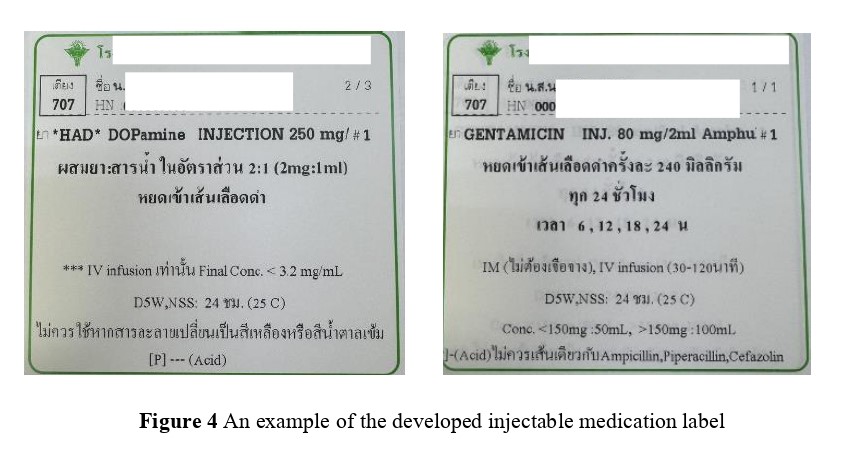
Methods A quasi-experimental study with an uncontrolled before-and-after design was conducted. Incident reports from the HRMS were compared between the pre-intervention period (May 1, 2024, to February 28, 2025) and the post-intervention period (March 1 to December 31, 2025). Eligible incident reports involving medication errors or adverse drug events associated with injectable medications were included. The labels were redesigned to support nursing workflows and provide information on routes of administration, drug stability, compatibility, pH, and osmolarity, together with safety warning symbols.
Results The number of reported incidents was lower in the post-intervention period than in the pre-intervention period. The distribution of incident severity levels differed significantly between the two periods (p = 0.025). No level C incidents were reported after the intervention, and the number of level D incident reports decreased from 12 to 8. Reported errors involving medication compounding and preparation, as well as the handling of multiple-dose medications, also decreased. Medication wastage costs decreased from THB 2,662.01 to THB 806.00.
Conclusions and Recommendations Implementation of injectable medication labels development using HFE principles was associated with fewer reported incidents and lower medication wastage costs. These findings suggest that user-centered label design may support medication safety. However, the absence of a control group precludes attributing the observed changes solely to the redesigned labels.
References
Abbasi, S., Sharafat, M.A., & Khan, F. (2025). Medication errors and adverse drug events in peri-operative pediatric anesthetic care over twenty years: A retrospective observational study. BMC Anesthesiology, 25, 247. https://doi.org/10.1186/s12871-025-03109-8
Aceves-Gonzalez, C., Caro-Rojas, A., Rey-Galindo, J.A., Aristizabal-Ruiz, L., & Hernández-Cruz, K. (2024). Estimating the impact of label design on reducing the risk of medication errors by applying HEART in drug administration. European Journal of Clinical Pharmacology, 80, 575 – 588. https://doi.org/10.1007/s00228-024-03619-3
Bauer, D.T., & Guerlain, S. (2011). Improving the usability of intravenous medication labels to support safe medication delivery. International Journal of Industrial Ergonomics, 41(4), 394 – 399. https://doi.org/10.1016/j.ergon.2011.02.005
Dieckmann, P., Clemmensen, M. H., Sørensen, T. K., Kunstek, P., & Hellebek, A. (2016). Identifying facilitators and barriers for patient safety in a medicine label design system using patient simulation and interviews. Journal of Patient Safety, 12(4), 210 – 222. https://doi.org/10. 1097/PTS.0000000000000109
Groll, D., Davies, B., MacDonald, J., Nelson, S., & Virani, T. (2010). Evaluation of the psychometric properties of the phlebitis and infiltration scales for the assessment of complications of peripheral vascular access devices. Journal of Infusion Nursing, 33(6), 385 – 390. https://doi.org/10.1097/NAN.0b013e3181f85a73
Healthcare Accreditation Institute. (2021). Quality tips (2018–2021). Author.
Healthcare Accreditation Institute. (2022). Hospital and healthcare standards. Author.
Healthcare Accreditation Institute. (2023). Top 10 patient safety issues Thailand 2023 (Research Report). Author.
Naseralallah, L., Stewart, D., Ali, R. A., & Paudyal, V. (2022). An umbrella review of systematic reviews on contributory factors to medication errors in health-care settings. Expert Opinion on Drug Safety, 21(11), 1379 – 1399. https://doi.org/10.1080/14740338.2022.2147921
Ngamkitpramote, P., Kanjananantawong, C., Thapia, W., Piempreecha, T., & Piempreecha, S. (2020). Improvement of access to information on injectable high alert drugs among nurses with QR code. Thai Journal of Pharmacy Practice, 12(3), 633 – 641. https://he01.tci-thaijo.org/index. php/TJPP/article/view/177147
Nochod, P. (2025). Efficiency of human factor engineering to the reporting report of Lamphun Hospital laboratory. Journal of Environmental and Community Health, 10(1), 587 – 591. https://he03.tci-thaijo.org/index.php/ech/article/view/3894
Normkusol, J., Uppahat, W., & Prasertsang, P. (2023). The effect of nursing practice guideline for prevention of Amiodarone/vasopressors-induced phlebitis in coronary care unit Khon Kaen Hospital. Academic Journal of Nursing and Health Sciences, 3(2), 18 – 29. https://he04.tci-thaijo.org/index.php/AJNHS/article/view/409
Pathomjaruwat, T. (2016). Impact of a nursing care guideline on prevention and management of extravasation. Thai Journal of Nursing Council, 31(2), 81 – 95. https://he02.tci-thaijo.org/index.php/TJONC/article/view/47539
Pathomjaruwat, T. (2017). Prevention and management of extravasation in infusion therapy. Songklanagarind Journal of Nursing, 37(2), 169 – 181. https://he02.tci-thaijo.org/index.php/nur-psu/article/view/91366
Phianthum, C., Ploylearmsang, C., & Anusornsangiam, W. (2018). Outcome of medication errors reduction procedure in Phukieo Health Promoting Hospitals, Chaiyaphum Province. Isan Journal of Pharmaceutical Sciences, 14(3), 116 – 129. https://doi.org/10.14456/ijps.2018.30
Piempreecha, S. (2019). Effect of change on drug name labeling using Thai language for drugs with similar names on pre-dispensing errors. Thai Journal of Pharmacy Practice, 11(1), 119 – 127. https://he01.tci-thaijo.org/index.php/TJPP/article/view/171391
Piraly, T. (Ed.). (2019). HA update 2019. Healthcare Accreditation Institute.
R Core Team. (2024). R: A language and environment for statistical computing. R Foundation for Statistical Computing.
Reason, J. (2000). Human error: Models and management. BMJ, 320, 768. https://doi.org/10.1136/bmj.320.7237.768
Schroers, G., Ross, J. G., & Moriarty, H. (2021). Nurses’ perceived causes of medication administration errors: A qualitative systematic review. The Joint Commission Journal on Quality and Patient Safety, 47(1), 38 – 53. https://doi.org/10.1016/j.jcjq.2020.09.010
Sirilak, T. (2024, June 18–19). Human factor engineering and medication error management [Poster presentation]. HA Regional Forum Chiang Mai 2024: Growth Mindset for Better Healthcare System, Asawin Grand Convention Hotel, Bangkok, Thailand.
Tewthanom, K., & Tananonniwas, S. (2009). Medication error and prevention guide for patient’s safety. Veridian E-Journal, Silpakorn University, 2(1), 195 – 217. https://he02.tci-thaijo.org/index.php/Veridian-E-Journal/article/view/6937
The Joint Commission. (2024). National Patient Safety Goals® effective January 2025 for the ospital program. Author.
UC Davis PSNet Editorial Team. (2024). Human factors engineering. PSNet.
Wiwattanaset, P. (2018). The role of pharmaceutical packaging [Master’s thesis]. University of Phayao.
World Health Organization. (2023). Medication without harm: Policy brief. Author.
Downloads
Published
How to Cite
Issue
Section
License
Copyright (c) 2026 Princess of Naradhiwas University Journal

This work is licensed under a Creative Commons Attribution-NonCommercial-NoDerivatives 4.0 International License.