Development of Self-Management Support Program Integrated with a Mobile Application for Patients with Uncontrolled Hypertension
Keywords:
Uncontrolled hypertension, Self-management support program with mobile application, Keywords: uncontrolled hypertension, self-management support program with mobile application, self-managementAbstract
Background and Objectives The World Health Organization (WHO) identifies cardiovascular disease as the leading cause of death worldwide, with hypertension being a major risk factor. In Thailand, the prevalence of hypertension has risen from 25.4% to 29.5%, escalating patients' risk of life-threatening complications, including stroke, ischemic heart disease, heart failure, chronic kidney disease, cognitive impairment, and dementia. Although lifestyle modification is a cornerstone of long-term management, Pattani Province consistently fails to meet hypertension control targets. This challenge is primarily driven by self-management support models and health policies that lack effective health data-recording systems to stimulate patient self-management behaviors actively. This study, therefore, aims to develop and evaluate the effectiveness of a mobile application-based self-management support program for patients with uncontrolled hypertension
Methods This research and development (R&D) study was conducted in two phases: Phase 1 focused on developing the program model, and Phase 2 involved quality validation and pilot testing. The sample consisted of 5 registered nurses from the outpatient chronic disease clinic and 25 purposively selected patients with hypertension. The research instruments included the newly developed self-management support program combined with a mobile application, a hypertension knowledge assessment, an appropriate health behaviors questionnaire, a perceived self-management self-efficacy scale, a feasibility evaluation form, and a user satisfaction questionnaire. Data were analyzed using descriptive statistics and paired t-tests.
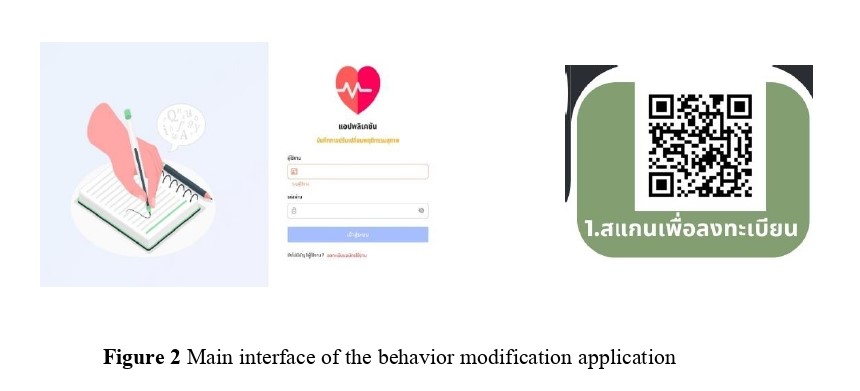
Results The program consisted of three components: 1) a program implementation manual, 2) a self-management support activity plan, and 3) a mobile application user guide for logging health behavior modifications. Following the pilot testing with patients, the post-test mean scores for hypertension knowledge, appropriate health behaviors knowledge, and perceived self-management self-efficacy were significantly higher than the pre-test scores (p < .001). Regarding program feasibility, the registered nurses unanimously agreed that the program was user-friendly and practical. For the patient group, the post-test mean score for feasibility was at a moderate level (48%, M=41.44, SD=3.15), while their mean satisfaction score was at a high level (40 %, M = 21.16, S.D. = 2.15)
Conclusion and Recommendations The developed program effectively increased the mean scores for hypertension knowledge, appropriate health behaviors knowledge, and perceived self-management self-efficacy, with statistically significant improvements at the .001 level. Therefore, future studies should evaluate the effectiveness of the program using a quasi-experimental research design with a larger sample size.
References
Patanavanich, R., & Aekplakorn, W. (2025, November). The 7th Thai national health examination survey 2024 – 2025. Health Systems Research Institute. https://kb.hsri.or.th/dspace/handle/11228/6360
Almasi, S., Hosseini, A., Emami, H., & Sabahi, A. (2020). Mobile health technology for hypertension management: A systematic review. Acta Medica Iranica, 58(6), 249 – 259. https://doi.org/10. 18502/acta. v58i6.4050
Borg, W.R., & Gall, M.D. (1989). Educational research: An introduction (5th ed.). Longman.
Boocha, P., & Seangduang, N. (2021). Research and development: Process and application. Journal of Phrae PublicHealth for Development, 1(1), 77 – 89. https://www.thaidj.org/index.php/ jpphd/article/view/11645/10038
Bozorgi, A., Hosseini, H., Eftekhar, H., Majdzadeh, R., Yoonessi, A., Ramezankhani, A., Mansouri, M., & Ashoorkhani, M. (2021). The effect of the mobile “blood pressure management application” on hypertension self-management enhancement: a randomized controlled trial. Trials, 22(1), 413. http://doi.org/10.1186/s13063-021-05270-0
Chotipiboonsub, P. (2024). Factors affecting the use of health applications. Journal of Information Systems in Business JISB, 10(1), 43 – 55. https://doi.org/10.14456/jisb.2024.3
Creer, T.L. (2000). Self-management of chronic illness. In Boekaerts, M., Pintrich, P.R., & Zeidner, M. (Eds.), Handbook of self-regulation (pp. 601 – 629). Academic Press. https://doi.org/10.1016/ B978-012109890-2/50047-0
Creswell, J.W., & Guetterman, T.C. (2025). Educational research: Planning, conducting, and evaluating quantitative and qualitative research (7th ed.). Pearson Education.
Division of NonCommunicable Diseases. (2023). National plan for the prevention and control of non-communicable diseases (2023-2027), Thailand. Author.
Ekachampaka, P., Sripryoon, P., Thammamachat, S., Phothieng, J., Suksoot, P., Chanasarn, S., & Thammawongsa, Y. (2021). An evaluation report on the status of health application usage for health communication, Ministry of Public Health.Strategy and Planning Division, Office of the Permanent Secretary of the Ministry of Public Health. https://spd.moph.go.th/wp-content/uploads/2023/01/HealthApplication.pdf
Health Data Center, Pattani Provincial Public Health Office. (2025). Standard report system: Indicators for well-controlled hypertensive patients. Author.
Inthawong, A. (2022). Factors affecting the decision to use video streaming [master’s thesis]. Thammasat University.
Julious, S.A. (2005). Sample size of 12 per group rule of thumb for a pilot study. Pharmaceutical Statistics, 4(4), 287 – 291. https://doi.org/10.1002/pst.185
Joanna Briggs Institute. (2024). JBI Manual for Evidence Synthesis. Author. https://jbi-global-wiki.refined.site/space/MANUAL
Ministry of Public Health. (2021). Digital health strategy, Ministry of Public Health (2021 – 2025). Author.
Naboon, S., Krainara, K., & Chuabkhamsuk, A. (2024). The effects of a self-management program on blood pressure control behaviors and blood pressure level among patients with uncontrolled hypertension in Thung Yai Hospital, Nakhon Si Thammarat Province. Journal of Public Health Research and Innovation, 1(2), 1 – 13. https://doi.org/10.55164/jphri.v1i2.261940
Page, M.J., McKenzie, J.E., Bossuyt, P.M., Boutron, I., Hoffmann, T.C., Mulrow, C.D., Shamseer, L., Tetzlaff, J.M., Akl, E.A., Brennan, S.E., Chou, R., Glanville, J., Grimshaw, J.M., Hróbjartsson, A., Lalu, M.M., Li, T., Loder, E.W., Mayo-Wilson, E., McDonald, S., ... Moher, D. (2021). The PRISMA 2020 statement: an updated guideline for reporting systematic reviews. BMJ, 372(n71), 1 – 9. https://doi.org/10.1136/bmj.n71
Richardson, W.S., Wilson, M.C., Nishikawa, J., & Hayward, R.S.A. (1995). The well-built clinical question: a key to evidence-based decisions. ACP Journal Club, 123(3), A12 – A13. https://doi.org/10.7326/ACPJC-1995-123-3-A12
Siraprapasiri, P., Lapbenjakul, S., Sriyakul, D., Wongpiromsanti, Y., & Kongprasert, J. (2020). Handbook of integrated, people-centered health services in new normal diabetes and hypertension clinics (for healthcare workers). Division of Medical Technical and Academic Affairs, Department of Medical Services, Ministry of Public Health.
Siri, P., Kraiwanit, T., Keawngam, T., & Ponsri, R. (2025). The Social impacts of health applications: Transforming self-care and patient support. Sarasas Journal of Humanities and Socail Science, 11(2), 213 – 225. https://so04.tcithaijo.org/index.php/svittj/article/view/277401
Sukadecha, R., & Panthonglang, W. (2021). The Effects of Self-Management Program and Family Participation Enhancing on Health Behaviors and Blood Pressure in Patientswith Uncontrolled Hypertension. Journal of Vongchavalitkul University, 34(2), 71 – 86. https://ph01.tci-thaijo.org/index.php/vujournal/article/view/245806/168037
Srisatidnarakul, B. (2010). Rabiapwithi kanwichai thang phayabansat (Research Report). Faculty of Nursing, Chulalongkorn University.
Thai Hypertension Society. (2024). 2024 Thai guidelines on the treatment of hypertension. Enlighten Communication.
Watthana, P., Jantacumma, N., & Pantaewan, P. (2022). Effects of a self-management program with Chan Chana mobile application for cerebrovascular disese prevention in risk group Sukhothai Province.Journal of the Police Nurses, 14(1), 92 – 104. https://he01.tci-thaijo.org/index.php/policenurse/article/view/255631
Wiyathus, D., Siripakmanont, T., & Synlapakitkosol, U. (2023). Development of a home blood pressure monitoring-based self-management model in patients with hypertension and uncontrolled blood pressure. Journal of Thailand Nursing and Midwifery Council, 38(4), 387 – 399. https://he02.tci-thaijo.org/index.php/TJONC/article/view/265506
World Health Organization (2023). Global report on hypertension: The race against a silent killer. Author. https://www.who.int/publications/i/item/9789240081062
Downloads
Published
How to Cite
Issue
Section
License
Copyright (c) 2026 Princess of Naradhiwas University Journal

This work is licensed under a Creative Commons Attribution-NonCommercial-NoDerivatives 4.0 International License.