
Utilization of rice by-products as substitutes for potatoes in culture media for the cultivation of Fusarium fujikuroi and Fusarium oxysporum
Article Sidebar
Main Article Content
Abstract
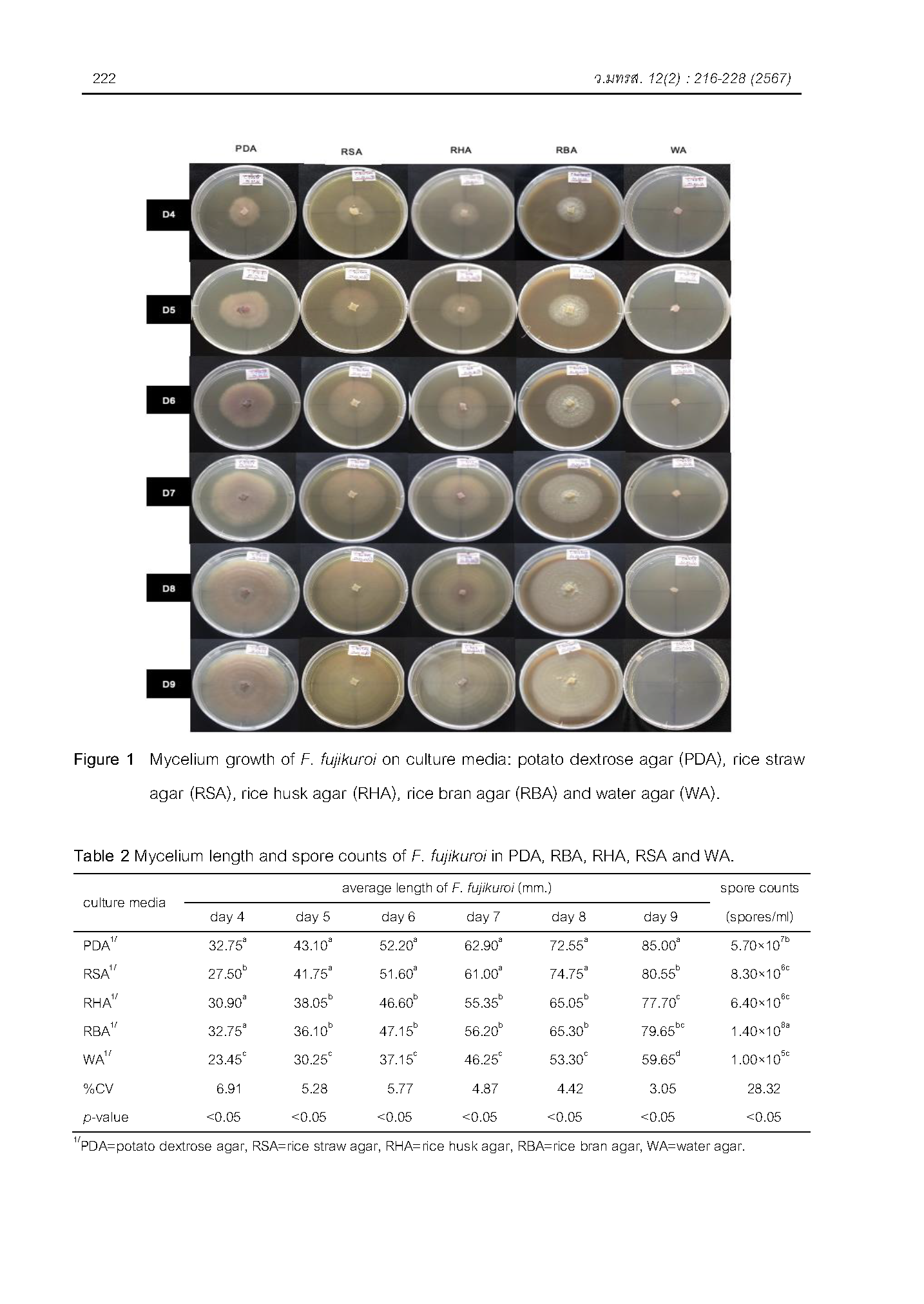
This research aimed to investigate the utilization of rice by-products, namely rice bran, rice straw, and rice husk, as substitutes for potatoes in potato dextrose agar (PDA) media in the laboratory. Five different culture media formulations were prepared: potato dextrose agar (PDA), rice straw agar (RSA), rice husk agar (RHA), rice bran agar (RBA), and water agar (WA). The study evaluated the mycelial growth and spore production of the fungal strains Fusarium fujikuroi and Fusarium oxysporum. The experimental results revealed that F. fujikuroi exhibited optimal growth on the RSA medium, with an average mycelial length of 74.75 mm, which was not statistically significantly different from the PDA medium (p<0.05). Conversely, F. oxysporum exhibited the best growth on the RHA medium, with an average mycelial length of 78.50 mm, which was not statistically significantly different from the PDA medium (p<0.05). Regarding spore production, the RBA medium yielded the highest number of spores for both F. fujikuroi and F. oxysporum (p<0.05), with average counts of 1.4×10⁸ and 6.3×10⁶ spores/ml, respectively. The findings demonstrate that rice bran, rice straw, and rice husk can be effectively utilized as substitutes for potatoes in culture media for the laboratory cultivation of F. fujikuroi and F. oxysporum.
Article Details

This work is licensed under a Creative Commons Attribution-NonCommercial-NoDerivatives 4.0 International License.
Published manuscript are the rights of their original owners and RMUTSB Academic Journal. The manuscript content belongs to the authors' idea, it is not the opinion of the journal's committee and not the responsibility of Rajamangala University of Technology Suvarnabhumi
References
Adesemoye, A. O., & Adedire, C. O. (2005). Use of cereals as basal medium for the formulation of alternative culture media for fungi. World Journal of Microbiology and Biotechnology, 21(3), 329-336.
Desjardins, A. E., Manandhar, H. K., Plattner, R. D., Manandhar, G. G., Poling S. M., & Maragos, C. M. (2000). Fusarium species from Nepalese rice and production of mycotoxins and gibberellic acid by selected species. Applied and Environmental Microbiology, 66(3), 1020-1025.
Elamawi, R. M., Tahoon, A. M., Elsharnoby, D. E., & El-Shafey, R. A. (2020). Bio-production of silica nanoparticles from rice husk and their impact on rice bakanae disease and grain yield. Archives of Phytopathology and Plant Protection, 53(9-10), 459-478.
Gupta, A. K., Solanki, I. S., Bashyal, B. M., Singh, Y., & Srivastava, K. (2015). Bakanae of rice-an emerging disease in Asia. The Journal Animal & Plant Sciences, 25(6), 1499-1514.
Hangtrakul, S., Sommartya, P., Soytong, K., & Poeaim, S. (2008). Diversity analysis of entomopathogenic fungi, Beauveria sp. by restriction fragment length polymorphism of the ITS regions. In Proceeding of 46th Kasetsart University Annual Conference, Subject Science (pp. 594-602). Bangkok: Kasetsart University. (in Thai)
Khejornsart, P., & Juntanam, T. (2016). Effects of forage sorghum silage and Napier silage on production performance in meat goat. Khon Kaen Agriculture Journal, 44(Suppl.1), 517-522. (in Thai)
Liu, Y., Zhang, H., Yi, C., Quan, K., & Lin, B. (2021). Chemical composition, structure, physicochemical and functional properties of rice bran dietary fiber modified by cellulase treatment. Food Chemistry, 342, 128352.
Maneenil, N., & Pengnoo, A. (2022). Effect of rice bran and broken rice on the efficacy of Bacillus subtilis antagonist bacteria in controlling Rigidoporus microporus, the causing white root rot disease on para rubber. Songklanakarin Journal of Plant Science, 9(2), 51-58. (in Thai)
Nonaka, K., Todaka, N., Omura, S., & Masuma, R. (2014). Combination cellulose plate (non-agar solid support) and agar plate method improves isolation of fungi from soil. The Journal of Antibiotics, 67, 755-761.
Pajareon, S. (2019). Stability of anthocyanin extract from rice berry rice bran encapsulated with rice bran protein concentrate under different pH and heating conditions. RMUTSB Academic Journal, 7(2), 205-215. (in Thai)
Pradeep, F. S., Begam, M. S., Palaniswamy, M., & Pradeep, B. V. (2013). Influence of culture media on growth and pigment production by Fusarium moniliforme KUMBF1201 isolated from paddy field soil. World Applied Sciences Journal, 22(1), 70-77.
Punyaupapat, P., & Punyaupapat, S. (2017). Study of soybean extracted media formulation for the growth of Lentinus polychrous and Lentinus squarrosulus mushroom. In L. Patcharasak (Ed.), Proceedings of the 9th NPRU National Academic Conference Achieving Thailand 4.0 through Research Development in Higher Education
(pp. 2-9). Nakhon Pathom: Rajabhat University Nakhon Pathom. (in Thai)
Rambey, R., Simbolon, F. M., & Siregar, E. B. M. (2020). Growth and productivity of oyster mushrooms (Pleurotus ostreatus) on media rice straw mixed with sawdust. IOP Conference Series: Earth and Environmental Science, 454, 012082.
Ruttanasutja, P., & Thongdee, U. (2020). The isolation of cellulase producing bacteria from paddy field soil samples in Phra Nakhon Si Ayutthaya province. RMUTSB Academic Journal, 8(2), 165-175. (in Thai)
Samerpitak, K., Kongthaworn, A., Trakarathai, K., & Chaicumpar, K. (2007). Development of fungal media for using in laboratory learning. Srinagarind Medical Journal, 22(4), 394-400. (in Thai)
Sharma, G., & Pandey, R. R. (2010). Influence of culture media on growth colony character and sporulation of fungi isolated from decaying vegetable wastes. Journal of Yeast and Fungal Research, 1(8), 157-164.
Thuankul, N. (2019). Using of some fruits as substitute of potato in potato dextrose agar media. PSRU Journal of Science and Technology, 4(3), 27-36. (in Thai)
Ullimaz, A., Nindarwi, D. D., & Mubarak, A. S. (2020). Different concentration of rice bran suspension on fecundity and offspring production of each Moina macrocopa broodstock. IOP Conference Series Earth and Environmental Science, 441, 012096.
Uthayasooriyan, M., Pathmanathan, S., Ravimannan, N., & Sathyaruban, S. (2016). Formulation of alternative culture media for bacterial and fungal growth. Der Pharmacia Lettre, 8(1), 431-436.
Wang, Z., Li, J., Barford, J. P., Hellgradt, K., & McKay, G. (2016). A comparison of chemical treatment methods for the preparation of rice husk cellulosic fibers. International Journal of Environmental & Agriculture Research, 2(1), 67-77.
Wet-o-sot, S. (2020). Efficiency of some mushroom mycelium development from use sweet potato, saba banana and baby corn to substitute potato in culture media. YRU Journal of Science and Technology, 5(2), 85-94. (in Thai)
Wongcharoen, A. (2014). Screening of endophytic fungi from rice (Oryza sativa L.) against rice pathogenic fungi. Khon Kaen Agriculture Journal, 42(3), 385-396. (in Thai)
