
Synthesis of Pt–Fe core–shell nanocatalysts supported on TiO2 via sequential dry impregnation and electroless deposition
Article Sidebar
Main Article Content
Abstract
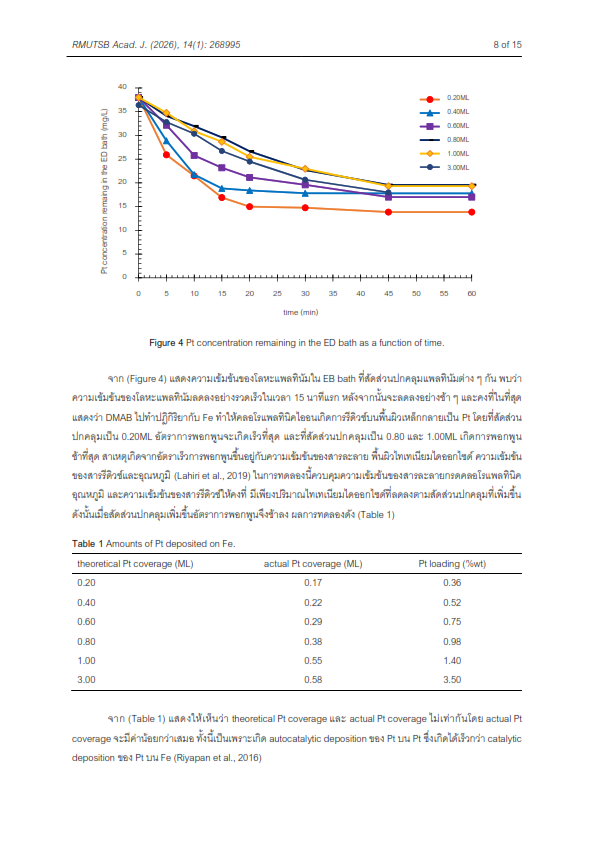
This study investigates the preparation of bimetallic core–shell catalysts, in which Fe serves as the core and Pt forms the shell on a titanium dioxide (TiO2) support. Fe was deposited onto TiO2 via the dry impregnation method with a fixed loading of 1.50wt%. Pt was subsequently deposited onto the iron surface using electroless deposition (ED). In the ED process, chloroplatinic acid (H2PtCl6) was employed as the Pt precursor, dimethylaminobenzaldehyde (DMAB) was used as the reducing agent at a molar ratio of 1:20, and ethylenediamine was added as a stabilizer at a molar ratio of 1:4. The deposition was carried out at pH 11.0-11.5 and 50°C. The experiments were designed to achieve Pt coverages of 0.20, 0.40, 0.60, 0.80, 1.00, and 3.00monolayers. Results showed that both the concentration of the Pt precursor and the pH of the solution decreased rapidly within the first 10minutes and stabilized after 30minutes. The corresponding Pt loadings obtained were 0.36, 0.57, 0.75, 0.92, 1.40, and 3.50wt%, respectively. N2 adsorption-desorption analysis indicated that Pt deposition did not significantly affect the specific surface area of the Fe/TiO2 catalysts. X-ray diffraction (XRD) revealed the presence of the anatase phase of TiO2, with Pt peaks detected, while Fe peaks were absent. To further confirm elemental distribution, TEM–EDS mapping was employed, verifying the presence of both Pt and Fe, and confirming the core–shell arrangement of Pt and Fe supported on TiO2.
Article Details

This work is licensed under a Creative Commons Attribution-NonCommercial-NoDerivatives 4.0 International License.
Published manuscript are the rights of their original owners and RMUTSB Academic Journal. The manuscript content belongs to the authors' idea, it is not the opinion of the journal's committee and not the responsibility of Rajamangala University of Technology Suvarnabhumi
References
Almquist, C. B., & Biswas, P. (2002). Role of synthesis method and particle size of nanostructured TiO2 on its photoactivity. Journal of Catalysis, 212(2), 145-156. https://doi.org/10.1006/jcat.2002.3783
Beard, K. D., Schaal, M. T., Zee J. W. V., & Monnier, J. R. (2007). Preparation of highly dispersed PEM fuel cell catalysts using electroless deposition methods. Applied Catalysis B: Environmental, 7(3-4), 262-271. https://doi.org/10.1016/j.apcatb.2006.11.006
Besora, M., & Maseras, F. (2021). Metal-catalyzed asymmetric hydrogenation: Evolution and prospect. Advances in Catalysis: Computational Insights into Catalytic Transformations, 68, 385-426. https://doi.org/10.1016/bs.acat.2021.08.006
Boudjemaa, A., Daniel, C., Mirodatos, C., Trari, M., Auroux, A., & Bouarab, R. (2011). In situ DRIFTS studies of high-temperature water-gas shift reaction on chromium-free iron oxide catalysts. Comptes Rendus Chimie, 14(6), 534-538. https://doi.org/10.1016/j.crci.2010.11.007
Byun, M. Y., Kim, Y. E., Baek, J. H., Jae, J., & Lee, M. S. (2022). Effect of surface properties of TiO2 on the performance of Pt/TiO2 catalysts for furfural hydrogenation. RSC Advances, 12, 860-868. https://doi.org/10.1039/D1RA07220J
Chen, A., & Holt-Hindle, P. (2010). Platinum-based nanostructured materials: Synthesis, properties, and applications. Chemical Reviews, 110, 3767-3804. https://doi.org/10.1021/cr9003902
Hu, X., Xu, D., & Jiang, J. (2025). Strong metal-support interaction between Pt and TiO2 over high-temperature CO2 hydrogenation. Angewandte Chemie International Edition, 64(7), e202419103. https://doi.org/10.1002/anie.202419103
Lahiri, A., Pulletikurthi, G., & Endres, F. (2019). A review on the electroless deposition of functional materials in ionic liquids for batteries and catalysis. Frontiers in Chemistry, 7, 85. https://doi.org/10.3389/fchem.2019.00085
Li, W., Wang, H., Jiang, X., Zhu, J., Liu, Z., Guo, X., & Song, C. (2018). A short review of recent advances in CO2 hydrogenation to hydrocarbons over heterogeneous catalysts. RSC Advances, 8, 7651-7669. https://doi.org/10.1039/c7ra13546g
Li, X., Zhang, C., Qing, M., Chen, D., Wang, X. H., Li, R., Li, B. L., Luo, H. Q., Li, N. B., & Liu, W. (2022). Efficient electrocatalysts with strong core-shell interaction for water splitting: The modulation of selectivity and activity. Journal of Alloys and Compounds, 929, 167247. https://doi.org/10.1016/j.jallcom.2022.167247
Loosli, F., Coustumer, P. L., & Stoll, S. (2015). Impact of alginate concentration on the stability of agglomerates made of TiO2 engineered nanoparticles: Water hardness and pH effects. Journal of Nanoparticle Research, 17, 44. https://doi.org/10.1007/s11051-015-2863-2
Moradi, H., Eshaghi, A., Hosseini, S. R., & Ghani, K. (2016). Fabrication of Fe-doped TiO2 nanoparticles and investigation of photocatalytic decolorization of reactive red 198 under visible light irradiation. Ultrasonics Sonochemistry, 32, 314-319. https://doi.org/10.1016/j.ultsonch.2016.03.025
Plana, P., & Dryfe, R. A. W. (2011). The electro-oxidation of dimethylamine borane: Part 1, polycrystalline substrates. Electrochim Acta, 56(11), 3835-3844. https://doi.org/10.1016/j.electacta.2011.02.041
Rebelli, J., Detwiler, M., Ma, S., Williams, C. T., & Monnier, J. R. (2010). Synthesis and characterization of Au–Pd/SiO2 bimetallic catalysts prepared by electroless deposition. Journal of Catalysis, 270(2), 224-233. https://doi.org/10.1016/j.jcat.2009.12.024
Riyapan, S., Zhang, Y., Wongkaew, A., Pongthawornsakun, B., Monnier, J. R., & Panpranot, J. (2016). Preparation of improved Ag–Pd/TiO2 catalysts using the combined strong electrostatic adsorption and electroless deposition methods for the selective hydrogenation of acetylene. Catalysis Science & Technology, 6, 5608-5617. https://doi.org/10.1039/C6CY00121A
Roebuck, L., Hu, M., Daly, H., Warsahartana, H., Natrajan, L. S., Garforth, A., D’Agostino, C., Falkowska, M., & Hardacre, C. (2025). H2 production from photocatalytic reforming of PET over Pt/TiO2: The role of terephthalic acid. Catalysis Today, 452, 115242. https://doi.org/10.1016/j.cattod.2025.115242
Sapkota, P., Lim, S., & Aguey-Zinsou, K. F. (2023). Platinum–tin as a superior catalyst for proton exchange membrane fuel cells. RSC Sustainability, 1, 368-377. https://doi.org/10.1039/D2SU00129B
Toncón-Leal, C. F., Villarroel-Rocha, J., Silva, M. T. P., Braga, T. P., & Sapag, K. (2021). Characterization of mesoporous region by the scanning of the hysteresis loop in adsorption–desorption isotherms. Adsorption, 27, 1109-1122. https://doi.org/10.1007/s10450-021-00342-8
Venkatesan, P. N., & Dharmalingam, S. (2016). Synthesis and characterization of Pt, Pt–Fe/TiO2 cathode catalysts and its evaluation in microbial fuel cell. Materials for Renewable and Sustainable Energy, 5, 11. https://doi.org/10.1007/s40243-016-0074-0
Wongkaew, A., Kaewwongkruea, N., & Sopradit, P. (2025). Photocatalytic degradation of Patent Blue V dye on iron (Fe) supported titanium dioxide. RMUTSB Academic Journal, 13(1), 1-12. https://li01.tci-thaijo.org/index.php/rmutsb-sci/article/view/264509 (in thai)
Wongkaew, A., Zhang, Y, Tengco, J. M. M., Blomb, D. A., Sivasubramanian P., Fanson P. T., Regalbuto, J. R., & Monnier, J. R. (2016). Characterization and evaluation of Pt-Pd electrocatalysts prepared by electroless deposition. Applied Catalysis B: Environmental, 188, 367-375. https://doi.org/10.1016/j.apcatb.2016.02.022
Zhou, M., Yu, J., & Cheng, B. (2006). Effects of Fe-doping on the photocatalytic activity of mesoporous TiO2 powders prepared by an ultrasonic method. Journal of Hazardous Materials, 137(3), 1838-1847. https://doi.org/10.1016/j.jhazmat.2006.05.028
