Efficacy of ant repellent herbal chalk from galangal extract
Article Sidebar
Main Article Content
Abstract
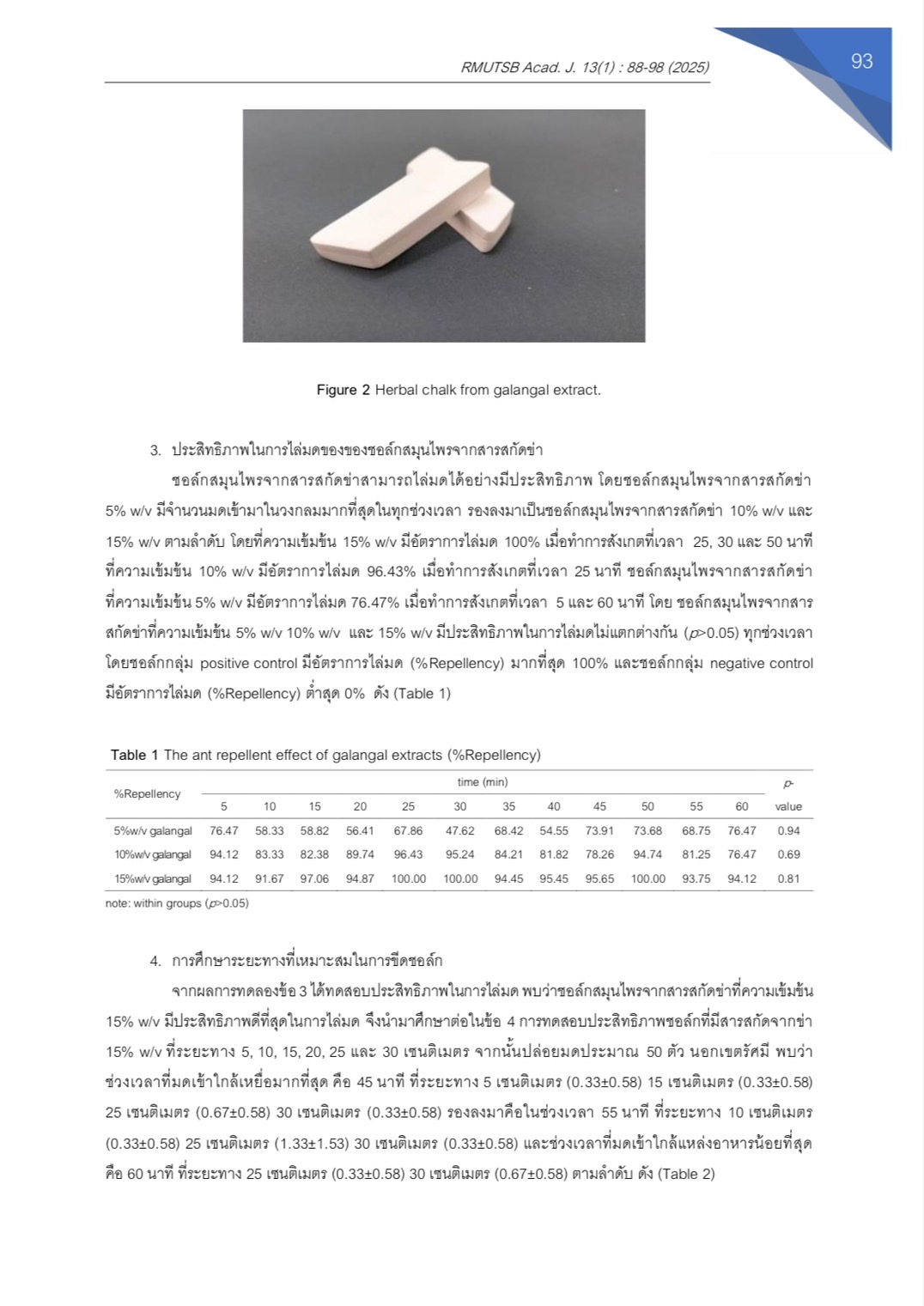
This study aimed to evaluate the efficacy of herbal chalk containing galangal extract for repelling Monomorium pharaonic (pharaoh ants) and to determine the optimal distance for chalk application. The herbal chalk with concentrations of 5% w/v, 10% w/v, and 15% w/v was tested and compared with a positive control containing 12% w/w DEET and a negative control containing distilled water. The results indicated that the positive control chalk exhibited a repellent efficacy of 100% (%Repellency=100), while the negative control exhibited failure to repel ant (%Repellency=0). The 15% w/v concentration of galangal extract demonstrated the highest efficacy in repelling ants (%Repellency=100) among the herbal chalk formulations with the optimal distance for chalk application of 5 cm and 10 cm from the bait, respectively. For the 15% w/v concentration, the average distance and time at which ants approached the bait most frequently were observed at a distance of 5 cm and at 45 minutes. A field test was conducted in Bang Phli District, Samut Prakan Province, and found that when the herbal chalk was applied across ant trails, there was no ants crossed the chalk line within 60 minutes. A satisfaction survey among 82 users of the herbal chalk revealed that the top three satisfactions were repellent efficacy (7.83±1.16), overall product satisfaction (7.62±1.32), and ease of use (7.62±1.17), respectively.
Article Details

This work is licensed under a Creative Commons Attribution-NonCommercial-NoDerivatives 4.0 International License.
Published manuscript are the rights of their original owners and RMUTSB Academic Journal. The manuscript content belongs to the authors' idea, it is not the opinion of the journal's committee and not the responsibility of Rajamangala University of Technology Suvarnabhumi
References
Abdullah, F., Subramanian, P., Ibrahim, H., Malek, S. N. A., Lee, G. S., & Hong, S. L. (2015). Chemical composition, antifeedant, repellent, and toxicity activities of the rhizomes of galangal, Alpinia galanga against Asian subterranean termites, Coptotermes gestroi and Coptotermes curvignathus (Isoptera: Rhinotermitidae). Journal of Insect Science, 15(1), 175. https://doi.org/10.1093/jisesa/ieu175
Butimal, P., Isaramalai, S., & Thaniwattananon, P. (2018). Development of nursing practice guideline for preventing complications in bed-bound elders at home. Songklanagarind Journal of Nursing, 38(3), 79-91. https://www.nur.psu.ac.th/researchdb/file_warasarn/14307journal2.pdf (in Thai)
Chanburee, S., Kitpot, T., Promjeen, K., & Likittrakulwong, W. (2020). Development of insect repellent spray containing herb extracts using nanoencapsulation technology. Khon Kaen Agriculture Journal, 48(Suppl 1), 353-360. https://ag2.kku.ac.th/kaj/PDF.cfm?filename=53_Ent01.pdf&id=4024&keeptrack=4 (in Thai)
Chutaen, C., Lauprasert, P., & Tawatsin, A. (2011). Efficacy of turmeric, ginger, galangal and fingerroot for controlling head louse infestation. KKU Journal for Public Health Research. 4(3), 41-50. https://he01.tci-thaijo.org/index.php/kkujphr/article/view/118847/91087 (in Thai)
Fu, J. T., Tang, L., Li, W. S., Wang, K., Cheng, D. M., & Zhang, Z. X. (2015). Fumigant toxicity and repellence activity of camphor essential oil from Cinnamonum camphora Siebold against Solenopsis invicta Workers (Hymenoptera:Formicidae). Journal of Insect Science, 15(1), 129. https://doi.org/10.1093/jisesa/iev112
Ieamsuwan, I., Suttirat, S., Horata, N., & Phunpanich, T. (2022). Effect of crude ethanol extracts from seven herbs on ant repellent. RMUTP Research Journal Sciences and Technology, 16(2), 187-197. https://doi.org/10.14456/jrmutp.2022.32 (in Thai)
Ieamsuwan I., Phunpanich T., Suttirat S., & Horata N. (2024). Development of ant repellent chalk from galangal. Proceedings of the 11th HCU National and International Conference (pp.79-87). Huachiew Chalermprakiet University, Samutprakarn, Thailand. https://has.hcu.ac.th/jspui/handle/123456789/3297 (in Thai)
Jaitrong., W. (2011). Classification of ant genus in Thailand. Beetle Enterprise. (in Thai)
Klakong, M., Vanichpakorn, Y., & Vanichpakorn, P. (2019). Repellent activity of essential oils from Alpinia galanga rhizome and Citrus grandis Peel against rice weevil, Sitophilus oryzae. Khon Kaen Agriculture Journal, 47(Suppl 1), 345-350. https://ag2.kku.ac.th/kaj/PDF.cfm?filename=53_Ent07.pdf&id=3442&keepntrack=1 (in Thai)
Muangrat, R., Tomtong, P., & Luangpan, J., (2016). Total phenolic compounds extraction from Kluai Hom Thong peels using subcritical solvent extraction technique. Srinakharinwirot University (Journal of Sciences and Technology), 8(15), 54-65. https://ph02.tci-thaijo.org/index.php/swujournal/article/view/56096/46823 (in Thai)
Nagal, R. K. (2019). Development of chalk from selected herbs as cockroach (Periplaneta americana) repellents. JPAIR Multidisciplinary Research, 35(1), 128-143. https://doi.org/10.7719/jpair.v35i1.654
Office of the Health Promotion Fund. (2017). Replacement in the Elderly. https://www.thaihealth.or.th/?p=229273 (in Thai)
Office of the Health Promotion Fund. (2017). Bedridden Elderly Care. https://www.thaihealth.or.th/?p=240498 (in Thai)
Rassami, W., Sawasdikarn, J., Piamporm, A., Sanguan-Hong., M. (2016). Larvicidal activity of five medicinal plants of Zingiberaceae on cabbage moth, Crocidolomia paponana (F.) in laboratory condition. International Journal of Agricultural Technology, 12(7.1), 1201-1208.
Ruttanaphan, T., De Sousa, G., Pengsook, A., Pluempanupat, W., Huditz, H. I., Bullangpoti, V., & Le Goff, G. (2020). A novel insecticidal molecule extracted from Alpinia galanga with potential to control the pest insect Spodoptera frugiperda. Insects, 11(10), 686. https://doi.org/10.3390/insects11100686
Sangkaew, D., Muhammadsalam, N., & Theanworrakant, N. (2019). The efficacy of ant prevention herbal chalks. Maejo Journal of Agricultural Production, 1(2), 31-38. https://li01.tci-thaijo.org/index.php/japmju/article/view/210009/145360 (in Thai)
Singtong, P. (2023). Nursing care of type 2 diabetic patients with foot ulcers: Comparative case study. Journal of Faculty of Science and Technology RMUTSB. https://drive.google.com/file/d/1yy0rDunlA0bg_IAvSZpVCFKbtL05g9on/view (in Thai)
Thai Institute of Aging Research and Development Foundation. (2024). The Status of the Elderly in Thailand in 2023. Institute of Population and Social Research. https://thaitgri.org/?wpdmpro=aging-focus-april-2024 (in thai)
Wagan, T. A., Chakira, H., He, Y. P., Zhao, J., Long, M., & Hua, H. X. (2016). Repellency of two essential oils to Monomorium pharaonis (Hymenoptera: Formicidae). Florida Entomologist, 99(4), 608-615. https://doi.org/10.1653/024.099.0404
Wu, Y., Wang, Y., Li, Z. H., Wang, C. F., Wei, J. Y., Li, X. L., Wang, P. J., Zhou, Z. F., Du, S. S., Huang, D. Y., & Deng, Z. W. (2014). Composition of the essential oil from Alpinia galanga rhizomes and its bioactivity on Lasioderma serricorne. Bulletin of Insectology, 67(2), 247-254. https://www.researchgate.net/publication/286071708_Composition_of_the_essential_oil_from_Alpinia_galanga_rhizomes_and_its_bioactivity_on_Lasioderma_serricorne
Yoon, J. K., Kim, K. C., Cho, Y. D., Cho, H. S., Lee, Y. W., Choi, B. K., Oh, Y. K., & Kim, Y. B. (2014). Development and evaluation of a semifield test for repellent efficacy testing. Journal of medical entomology, 51(1), 182-188.
Zhang, N., Tang, L., Hu, W., Wang, K., Zhou, Y., Li, H., Huang, C. L., Chun, J., & Zhang, Z. X. (2014). Insecticidal, fumigant, and repellent activities of sweet wormwood oil and its individual components against red imported fire ant workers (Hymenoptera: Formicidae). Journal of insect science, 14(1), 241. https://doi.org/10.1093/jisesa/ieu103
