
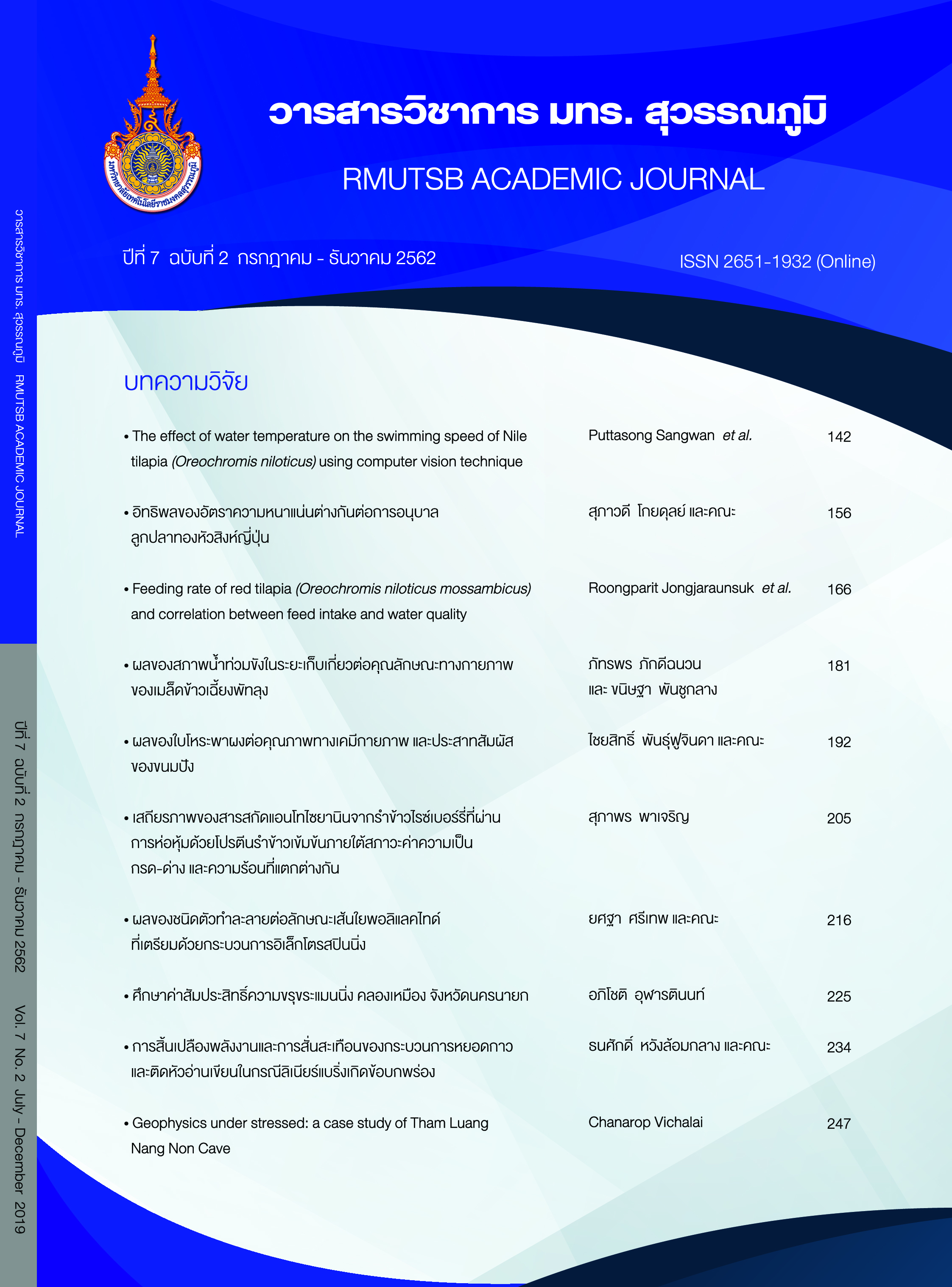
เสถียรภาพของสารสกัดแอนโทไซยานินจากรำข้าวไรซ์เบอร์รี่ที่ผ่านการห่อหุ้มด้วยโปรตีนรำข้าวเข้มข้นภายใต้สภาวะค่าความเป็นกรด-ด่างและความร้อนที่แตกต่างกัน
Article Sidebar
Main Article Content
บทคัดย่อ
งานวิจัยนี้มีวัตถุประสงค์เพื่อศึกษาเสถียรภาพของสารสกัดแอนโทไซยานินจากสารสกัดรำข้าวไรซ์เบอร์รี่ (RRBE) สารสกัดแอนโทไซยานินจากรำข้าวไรซ์เบอร์รี่ที่ห่อหุ้มด้วยมอลโทเด็กซ์ทริน (RRBE กับ MD) และสารสกัดแอนโทไซยานินจากรำข้าวไรซ์เบอร์รี่ที่ห่อหุ้มด้วยโปรตีนรำข้าวเข้มข้นผสมมอลโทเด็กซ์ทรินที่อัตราส่วน 80 ต่อ 20 โดยน้ำหนัก (RRBE กับ RBPc:MD) ภายใต้สภาวะของค่าความเป็นกรด-ด่าง (pH) และความร้อนที่แตกต่างกัน พบว่าค่า pH มีผลต่อความคงตัวของแอนโทไซยานินในทุกตัวอย่างอย่างมีนัยสำคัญทางสถิติ (p<0.05) โดย pH ที่แอนโทไซยานินมีความคงตัวคือที่ค่า pH เท่ากับ 1 และ 4 แต่ไม่คงตัว ที่ค่า pH เท่ากับ 9 โดยที่ค่า pH เท่ากับ 9 ในตัวอย่าง RRBE และตัวอย่าง RRBE กับ RBPc:MD ในมีการลดลงของแอนโทไซยานินเท่ากับ 42.58 และ 22.57 เปอร์เซ็นต์ ตามลำดับ นอกจากนั้นอุณหภูมิหรือความร้อน ก็มีผลต่อความคงตัวของแอนโทไซยานิน
อย่างมีนัยสำคัญทางสถิติ (p<0.05) จากการให้ความร้อนกับตัวอย่างที่อุณหภูมิ 70, 80 และ 90 องศาเซลเซียส พบว่าที่อุณหภูมิ 90 องศาเซลเซียส มีผลทำให้แอนโทไซยานินสลายตัวอย่างมีนัยสำคัญทางสถิติ (p<0.05) โดยแอนโทไซยานินใน RRBE ที่ไม่ห่อหุ้มมีความคงตัวน้อยกว่าใน ตัวอย่าง RRBE กับ RBPc:MD โดยภาพรวมจากผลการวิจัยชี้ให้เห็นว่าการห่อหุ้มสารสกัดจาก
รำข้าวไรซ์เบอร์รี่ด้วยโปรตีนรำข้าวเข้มข้นและมอลโทเด็กซ์ทริน ช่วยลดการสูญเสียของแอนโทไซยานินจากผลของค่าความเป็นกรด-ด่างและความร้อนได้
Article Details
ต้นฉบับที่ได้รับการตีพิมพ์ถือเป็นสิทธิของเจ้าของต้นฉบับและของวารสารวิชาการ มทร.สุวรรณภูมิ เนื้อหาบทความในวารสารเป็นแนวคิดของผู้แต่ง มิใช่เป็นความคิดเห็นของคณะกรรมการการจัดทำวารสาร และมิใช่ความรับผิดชอบของมหาวิทยาลัยเทคโนโลยีราชมงคลสุวรรณภูมิ
เอกสารอ้างอิง
Betz, M., & Kulozik, U. (2011). Whey protein gels for the entrapment of bioactive anthocyanins from bilberry extract. International Dairy Journal, 21(9), 703-710.
Devi, P. S., Saravanakumar, M., & Mohandas, S. (2012). The effects of temperature and pH on stability of anthocyanins from red sorghum (Sorghum bicolor) bran. African Journal of Food Science, 6(24), 567-573.
Esmaeili, M., Rafe, A., Shahidi, S. A., & Hasan-Saraei, A. G. (2016). Functional properties of rice bran protein isolate at different pH levels. J. Cereal Sci. 93(1), 58-63.
Ferreira, C. D., Da Conceição, E. J. L., Machado, B. A. S., Hermes, V. S., De Oliveira Rios, A., Druzian, J. I., & Nunes, I. L. (2016). Physicochemical characterization and oxidative stability of microencapsulated crude palm oil by spray drying. Food and Bioprocess Technology, 9(1), 124-136.
Floegel, A., Kim, D., Chung, S., Koo, S. I., & Chun, O. K. (2011). Comparison of ABTS/DPPH assays to measure antioxidant capacity in popular antioxidant-rich US foods. J. Food Compos. Anal. 24, 1043-1048.
Giusti, M. M., & Jing, P. (2008). Analysis of pigments and colorants. In C. Sosaciu, (Ed.), Food colorants: chemical and functional properties (pp. 479-506). Boca Raton, Fla: CRC Press.
Hou, Z., Qin, P., Zhang, Y., Cui, S., & Ren, G. (2013). Identification of anthocyanins isolated from black rice (Oryza sativa L.) and their degradation kinetics. Food Research International, 50(2), 691-697.
Jiang, T., Mao, Y., Sui, L., Yang, N., Li, S., Zhu, Z., Wang, C. ,Yin, S., He, J., & He, Y. (2019). Degradation of anthocyanins and polymeric color formation during heat treatment of purple sweet potato extract at different pH. Food Chemistry, 274, 460-470.
Kaewka, K., Therakulkait, C., & Cadwallader, K. R. (2009). Effect of preparation conditions on composition and sensory aroma characteristics of acid hydrolyzed rice bran protein concentrate. J. Cereal Sci, 50, 56-60.
Kong, S., & Junsoo, L. (2010). Antioxidants in milling fractions of black rice cultivars. Food Chemistry, 120, 278-281.
Martynenko, A., & Chen, Y. (2016). Degradation kinetics of total anthocyanins and formation of polymeric color in blueberry hydrothermodynamic (HTD) processing. Journal of Food Engineering, 171, 44-51.
Nuzhet, T., & Erdogdu, F. (2006). Effects of pH and temperature of extraction medium on effective diffusion coefficient of anthocyanin pigments of black carrot (Daucus carotavar. L.). Journal of food Engineering, 76, 579-583.
Palakajornsak, Y. (2004). Extraction and stability of anthocyanins from mangosteen peel (Master’s thesis). Silpakorn University, Bangkok.
Rafe, A., & Sadeghian, A. (2017). Stabilization of Tarom and Domesiah cultivars rice bran: Physicochemical, functional and nutritional properties. Journal of Cereal Science, 74, 64-71.
Roobha, J. J., Saravanakumar, M., Aravindhan, K. M., & Devi, P. S. (2011). The effect of light, temperature, pH on stability of anthocyanin pigments in Musa acuminata bract. Res. Plant Biol, 1, 5-12.
Wang, L., Zhao, Y., Zhou, Q., Luo, C. L., Deng, A. P., Zhang, Z. C., & Zhang, J. L. (2017). Characterization and hepatoprotective activity of anthocyanins from purple sweet potato (Ipomoea batatas L. cultivar Eshu No. 8). Journal of Food and Drug Analysis, 25(3), 607-618.
Worsltad, R. E., Durst, R. W., & Lee, J. (2005). Tracking color and pigment changes in anthocyanin products. Trends Food Sci. Technol. 16, 423-428.
