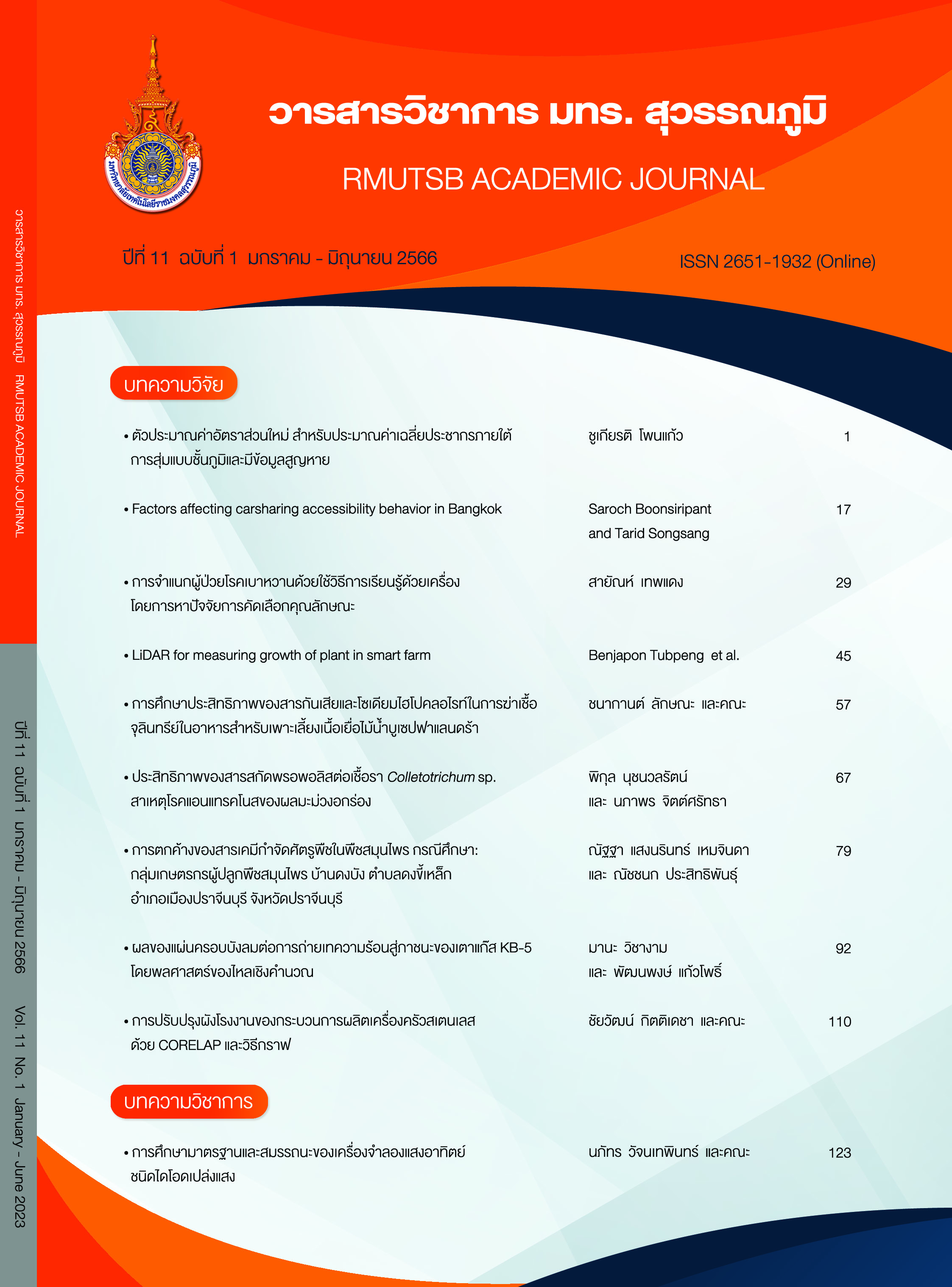
การจำแนกผู้ป่วยโรคเบาหวานด้วยใช้วิธีการเรียนรู้ด้วยเครื่อง โดยการหาปัจจัยการคัดเลือกคุณลักษณะ
Article Sidebar
Main Article Content
บทคัดย่อ
การจำแนกผู้ป่วยโรคเบาหวาน เป็นเรื่องที่ยากในการจำแนกเนื่องจากไม่มีปัจจัยที่แน่นอนและต้องใช้หลากหลายปัจจัยในการวินิจฉัยโรคเบาหวาน บทความวิจัยนี้มีวัตถุประสงค์ในการจำแนกผู้ป่วยว่าเป็นโรคเบาหวาน หรือไม่เป็นโรคเบาหวาน ด้วยการใช้วิธีการเรียนรู้ด้วยเครื่อง (machine learning) โดยการหาปัจจัยการคัดเลือกคุณลักษณะ (feature selection) และได้ใช้ข้อมูลการจำแนกโรคเบาหวานจากเว็บไซต์ www.kaggle.com จำนวน 536 คน ซึ่งมีการเก็บข้อมูลทั้งหมด จำนวน 8 ปัจจัย ได้แก่ จำนวนครั้งที่ตั้งครรภ์ (pregnant), กลูโคสในเลือด (glucose), การวัดความดันโลหิต (blood pressure), ความหนาของผิวหนัง (skin thickness), ระดับอินซูลินในเลือด (insulin) และดัชนีมวลกาย (BMI) พันธุกรรมที่เป็นเปอร์เซ็นต์การเป็นโรคเบาหวาน (diabetes pedigree function) และอายุ (age) ในการเกิดโรคเบาหวาน โดยใช้การเรียนรู้และการทดสอบในอัตรา 90:10, 80:20, 70:30, 60:40, 50:50 เปอร์เซ็นต์ และใช้วิธีแบ่งข้อมูลแบบ 10-fold cross validation ผลการวิจัยพบว่าวิธีที่ดีที่สุด คือ gradient boosted trees มีประสิทธิภาพอยู่ที่ 87.14 เปอร์เซ็นต์ และค่าเบี่ยงเบนมาตรฐาน (SD) อยู่ที่ 0.80 และพบว่าการหาปัจจัยการคัดเลือกคุณลักษณะ ด้วยวิธีการคัดเลือกปัจจัยโดยใช้ค่าน้ำหนักของข้อมูล (filter approach) ตามวิธีโครงสร้างต้นไม้ (decision tree) ใช้ปัจจัยจำนวนเพียง 4 ปัจจัย ได้แก่ ระดับค่ากลูโคสในเลือด อายุ จำนวนครั้งที่ตั้งครรภ์ และสุดท้ายระดับค่าอินซูลิน ซึ่งถ้ามีการจำแนกผู้ป่วยโรคเบาหวานได้อย่างดีมีประสิทธิภาพ ก็สามารถรักษาได้อย่างรวดเร็ว และทำให้ผู้ป่วยโรคเบาหวานหายป่วยและมีอายุยืนยาวมากยิ่งขึ้น
Article Details

อนุญาตภายใต้เงื่อนไข Creative Commons Attribution-NonCommercial-NoDerivatives 4.0 International License.
ต้นฉบับที่ได้รับการตีพิมพ์ถือเป็นสิทธิของเจ้าของต้นฉบับและของวารสารวิชาการ มทร.สุวรรณภูมิ เนื้อหาบทความในวารสารเป็นแนวคิดของผู้แต่ง มิใช่เป็นความคิดเห็นของคณะกรรมการการจัดทำวารสาร และมิใช่ความรับผิดชอบของมหาวิทยาลัยเทคโนโลยีราชมงคลสุวรรณภูมิ
เอกสารอ้างอิง
ABB. (2023). Deep learning. Retrieved 14 January 2023, from https://new.abb.com/news/detail/58004/deep-learning (in Thai)
Bureau of Information Office of the Permanent Secretary. (2020). Diabetes mellitus. Retrieved 14 December 2022, from https://pr.moph.go.th/?url=pr/detail/2/02/181256/ (in Thai)
Butt, U. M., Letchmunan, S., Ali, M., Hassan, F. H., Baqir, A., & Sherazi, H. H. R. (2021). Machine learning based diabetes classification and prediction for healthcare applications. Journal of Healthcare Engineering, 2021, 9930985.
Dataset. (2023). Ddiabetes mellitus. Retrieved 14 December 2022, from https://www.kaggle.com/datasets/akshaydattatraykhare/diabetes-dataset
Dhurakij Pundit University. (2023). Gradient boosted trees. Retrieved 14 January 2023, from https://grad.dpu.ac.th/upload/content/ files/year9-3/9-30.pdf (in Thai)
Glurgeek. (2023). Support vector machine (SVM). Retrieved 14 January 2023, from https://www.glurgeek.com/education/support-vector-machine/ (in Thai)
Kasetsart University. (2018). Logistic regression. Retrieved 14 January 2023, from https://forest-admin.forest.ku.ac.th/304xxx/?q=system/files/book/5%282018%29%20Logistic%20Regression.pdf (in Thai)
Lai, H., Huang, H., Keshavjee, K., Guergachi, A., & Gao, X. (2019). Predictive models for diabetes mellitus using machine learning techniques. BMC Endocrine Disorders, 19, 101.
Medium. (2023). Naïve Bayes classification. Retrieved 14 January 2023, from https://peachapong-poolpol.medium.com/na%C3%AFve-bayes-classification-cb6cf905505d (in Thai)
Nagaraj, P., Deepalakshmi, P., Mansour, R. F., & Almazroa, A. (2021). Artificial flora algorithm-based feature selection with gradient boosted tree model for diabetes classification. Diabetes, Metabolic Syndrome and Obesity, 14, 2789-2806.
Nonsiri, N., Chaichitwanidchakol, P., & Somkantha, K. (2022). Data classification for diabetes risk diagnosis using majority voting ensemble method and forward feature selection method. Udon thani Rajabhat University Journal of Sciences and Technoogy, 10(2), 107-122.
Phuket Hospital. (2022). Diabetes mellitus. Retrieved 14 December 2022, from https://www.phukethospital.com/th/news-events/diabetes/ (in Thai)
Rawat, V., & Suryakant, S. (2019). A classification system for diabetic patients with machine learning techniques. International Journal of Mathematical, Engineering and Management Sciences, 4(3), 729-744.
Rubaiat, S. Y., Rahman, M. M., & Hasan, M. K. (2018). Important feature selection & accuracy comparisons of different machine learning models for early diabetes detection. International Conference on Innovation in Engineering and Technology (pp.1-6). Dhaka, Bangladesh: IEEE.
Saxena, R., Sharma, S. K., Gupta, M., & Sampada, G. C. (2022). A novel approach for feature selection and classification of diabetes mellitus: Machine learning methods. Computational Intelligence and Neuroscience, 2022(Special issue), 3820360.
Selvi, R. T., & Muthulakshmi, I. (2021). Modelling the map reduce based optimal gradient boosted tree classification algorithm for diabetes mellitus diagnosis system. Journal of Ambient Intelligence and Humanized Computing, 12, 1717-1730.
Sidong, W., Xuejiao, Z., & Chunyan, M. (2018). A comprehensive exploration to the machine learning techniques for diabetes identification. 2018 IEEE 4th World Forum on Internet of Things (WF-IoT) (pp. 291-295). Singapore: IEEE.
Tepdang, S., & Ponprasert, R. (2022). Forecasting and clustering of cassava price by machine learning (A study of Cassava prices in Thailand). Indonesian Journal of Electrical Engineering and Informatics, 10(4), 825-836.
Thai Programmer Association. (2023). Deep learning Retrieved 14 December 2022, from https://www.thaiprogrammer.org/2018/12/deep-learning
Thatoom Hospital. (2014). Diabetes mellitus. Retrieved 14 December 2022, from http://www.thatoomhsp.com/ (in Thai)
Th.LinkedIn. (2023). Feature selection. Retrieved 14 January 2023, from https://th.linkedin.com/pulse/ (in Thai)
Th.Wikipedia. (2021). Decision tree. Retrieved 14 December 2022, from https://th.wikipedia.org/wiki/
