
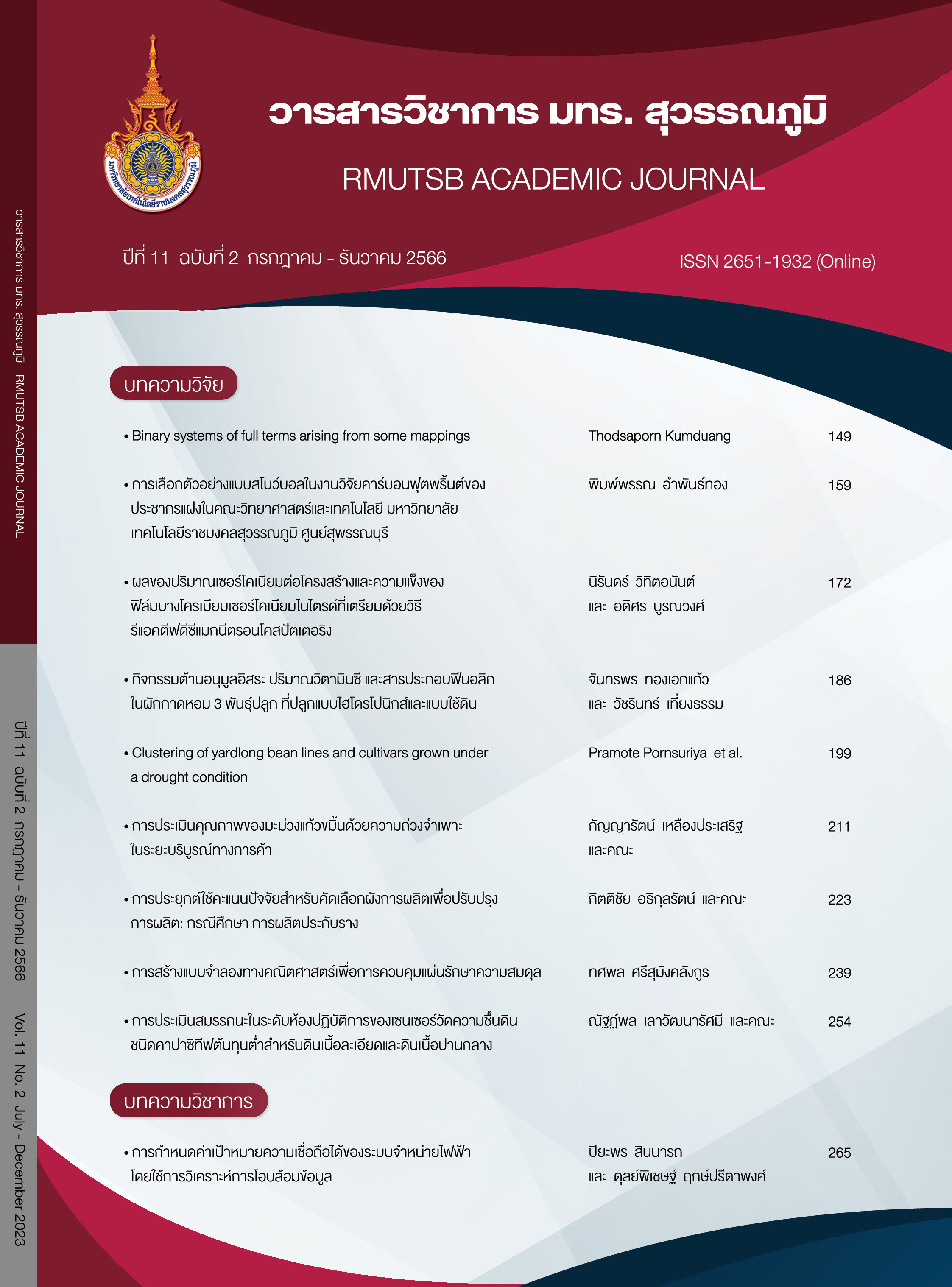
การประเมินสมรรถนะในระดับห้องปฏิบัติการของเซนเซอร์วัดความชื้นดิน ชนิดคาปาซิทีฟต้นทุนต่ำสำหรับดินเนื้อละเอียดและดินเนื้อปานกลาง
Article Sidebar
Main Article Content
บทคัดย่อ
เซนเซอร์วัดความชื้นในดินแบบ IoT โดยเฉพาะชนิดคาปาซิทีฟเป็นเครื่องมือสำคัญที่นิยมใช้งานในงานด้านการชลประทานแม่นยำ เนื่องจากมีราคาถูกและตอบสนองต่อการเปลี่ยนแปลงความชื้นในดินได้รวดเร็ว อย่างไรก็ตามเซนเซอร์ชนิดคาปาซิทีฟต้นทุนต่ำส่วนมากจำเป็นต้องได้รับการเทียบมาตรฐานที่ถูกต้องให้เป็นค่าความชื้นในดิน ซึ่งจะมีความจำเพาะเจาะจงต่อเนื้อดินในพื้นที่เกษตรกรรม งานวิจัยนี้เลือกใช้เซนเซอร์ Soil Stick ซึ่งเป็นเซนเซอร์ที่มีจำหน่ายในประเทศไทย ทำการเทียบมาตรฐานกับดินเนื้อละเอียดและดินเนื้อปานกลางจากพื้นที่เกษตรกรรมในจังหวัดเพชรบุรี โดยสมการเทียบมาตรฐานจะเป็นความสัมพันธ์ระหว่างค่าแรงดันไฟฟ้าจากเซนเซอร์ที่เชื่อมต่อกับบอร์ด NodeMCU ESP32 กับค่าความชื้นในดินโดยปริมาตร ผลการวิจัยพบว่า สมการเทียบมาตรฐานอยู่ในรูปสมการพหุนามดีกรีที่ 3 โดยมีค่า RMSE เท่ากับ 0.07 cm3.cm-3 จากนั้นประเมินสมรรถนะการตรวจวัดความชื้นในดินด้วยเซนเซอร์ Soil Stick ที่เทียบมาตรฐานแล้ว เปรียบเทียบกับเซนเซอร์ SM100 ซึ่งเป็นเซนเซอร์ที่ได้รับการเทียบมาตรฐานในเนื้อดินหลายกลุ่มจากโรงงานผลิต พบว่า ค่า RMSE ของเซนเซอร์ Soil Stick เท่ากับ 0.07 cm3.cm-3 ซึ่งต่ำกว่ากับเซนเซอร์ SM100 ที่มีค่า RMSE เท่ากับ 0.08 cm3.cm-3 นอกจากนี้ จากค่าดัชนีความเชื่อมั่นของการตรวจวัดพบว่า เซนเซอร์ Soil Stick มีค่า 0.78 แปลผลได้ว่ามีสมรรถนะในการตรวจวัดอยู่ในเกณฑ์ดีมาก ในขณะที่เซนเซอร์ SM100 มีค่าดัชนีความเชื่อมั่นของการตรวจวัด 0.66 แปลผลได้ว่ามีสมรรถนะในการตรวจวัดอยู่ในเกณฑ์ดี ผลจากการปรับเทียบมาตรฐานทำให้เซนเซอร์มีความแม่นยำในการตรวจวัดความชื้นดินและสามารถนำเซนเซอร์ไปใช้งานเพื่อควบคุมปริมาณการให้น้ำชลประทานได้อย่างมีประสิทธิภาพ
Article Details

อนุญาตภายใต้เงื่อนไข Creative Commons Attribution-NonCommercial-NoDerivatives 4.0 International License.
ต้นฉบับที่ได้รับการตีพิมพ์ถือเป็นสิทธิของเจ้าของต้นฉบับและของวารสารวิชาการ มทร.สุวรรณภูมิ เนื้อหาบทความในวารสารเป็นแนวคิดของผู้แต่ง มิใช่เป็นความคิดเห็นของคณะกรรมการการจัดทำวารสาร และมิใช่ความรับผิดชอบของมหาวิทยาลัยเทคโนโลยีราชมงคลสุวรรณภูมิ
เอกสารอ้างอิง
Bitella, G., Rossi, R., Bochicchio, R., Perniola, M., & Amato, M. (2014). A novel low-cost open-hardware platform for monitoring soil water content and multiple soil-air-vegetation parameters. Sensors, 14(10), 19639-19659.
Burt, R. (2011). Soil survey laboratory information manual: Soil survey investigations report No. 45, Version 2.0. Lincoln: United States Department of Agriculture, Natural Resources Conservation Service.
Chen, D., Chen, N., Zhang, X., Ma, H., & Chen, Z. (2021). Next-generation soil moisture sensor web: High-density in situ observation over NB-IoT. IEEE Internet of Things Journal, 8(17), 13367-13383.
Dong, Y., Miller, S., & Kelley, L. (2020). Performance evaluation of soil moisture sensors in coarse- and fine-textured Michigan agricultural soils. Agriculture, 10(12), 598.
FAO. (2023). Standard operating procedure for soil moisture content by gravimetric method. Rome: Food and Agriculture Organization of the United Nations.
González-Teruel, J. D., Torres-Sánchez, R., Blaya-Ros, P. J., Toledo-Moreo, A. B., Jiménez-Buendía, M., & Soto-Valles, F. (2019). Design and calibration of a low-cost SDI-12 soil moisture sensor. Sensors, 19(3), 491.
Jiménez, A. Á. C., Almeida, C. D. G. C. de, Santos Júnior, J. A., Morais, J. E. F. de, Almeida, B. G. de, & Andrade, F. H. N. de. (2019). Accuracy of capacitive sensors for estimating soil moisture in northeastern Brazil. Soil and Tillage Research, 195, 104413.
Kulmány, I. M., Bede-Fazekas, Á., Beslin, A., Giczi, Z., Milics, G., Kovács, B., Kovács, M., Ambrus, B., Bede, L., & Vona, V. (2022). Calibration of an Arduino-based low-cost capacitive soil moisture sensor for smart agriculture. Journal of Hydrology and Hydromechanics, 70(3), 330-340.
Liang, Z., Liu, X., Xiong, J., & Xiao, J. (2020). Water allocation and integrative management of precision irrigation: A systematic review. Water, 12(11), 3135.
Pahuja, R. (2022). Development of semi-automatic recalibration system and curve-fit models for smart soil moisture sensor. Measurement, 203, 111907.
Pramanik, M., Khanna, M., Singh, M., Singh, D. K., Sudhishri, S., Bhatia, A., & Ranjan, R. (2022). Automation of soil moisture sensor-based basin irrigation system. Smart Agricultural Technology, 2, 100032.
Saxton, K. E., Rawls, W. J., Romberger, J. S., & Papendick, R. I. (1986). Estimating generalized soil-water characteristics from texture. Soil Science Society of America Journal, 50(4), 1031-1036.
Shah, N. G., & Das, I. (2012). Precision irrigation: Sensor network based irrigation. In M. Kumar (Ed.), Problems, Perspectives and Challenges of Agricultural Water Management (pp. 217-232). Rijeka: IntechOpen.
Songara, J. C., & Patel, J. N. (2022). Calibration and comparison of various sensors for soil moisture measurement. Measurement, 197, 111301.
Schwartz, M., Li, Z., Sakaki, T., Moradi, A., & Smits, K. (2019). Accounting for temperature effects on the performance of soil moisture sensors in sandy soils. Soil Science Society of America Journal, 83(5), 1319-1323.
Togneri, R., Kamienski, C., Dantas, R., Prati, R., Toscano, A., Soininen, J. P., & Cinotti, T. S. (2019). Advancing IoT-based smart irrigation. IEEE Internet of Things Magazine, 2(4), 20-25.
Yu, L., Gao, W., Shamshiri, R. R., Tao, S., Ren, Y., Zhang, Y., & Su, G. (2021). Review of research progress on soil moisture sensor technology. International Journal of Agricultural and Biological Engineering, 14(4), 32-42.
