สภาวะที่เหมาะสมในการสกัดสารประกอบฟีนอลิกด้วยคลื่นไมโครเวฟจากเปลือกสละฤทธิ์ต้านอนุมูลอิสระและการพัฒนาตำรับครีมกันแดดแบบแท่ง
Article Sidebar
Main Article Content
บทคัดย่อ
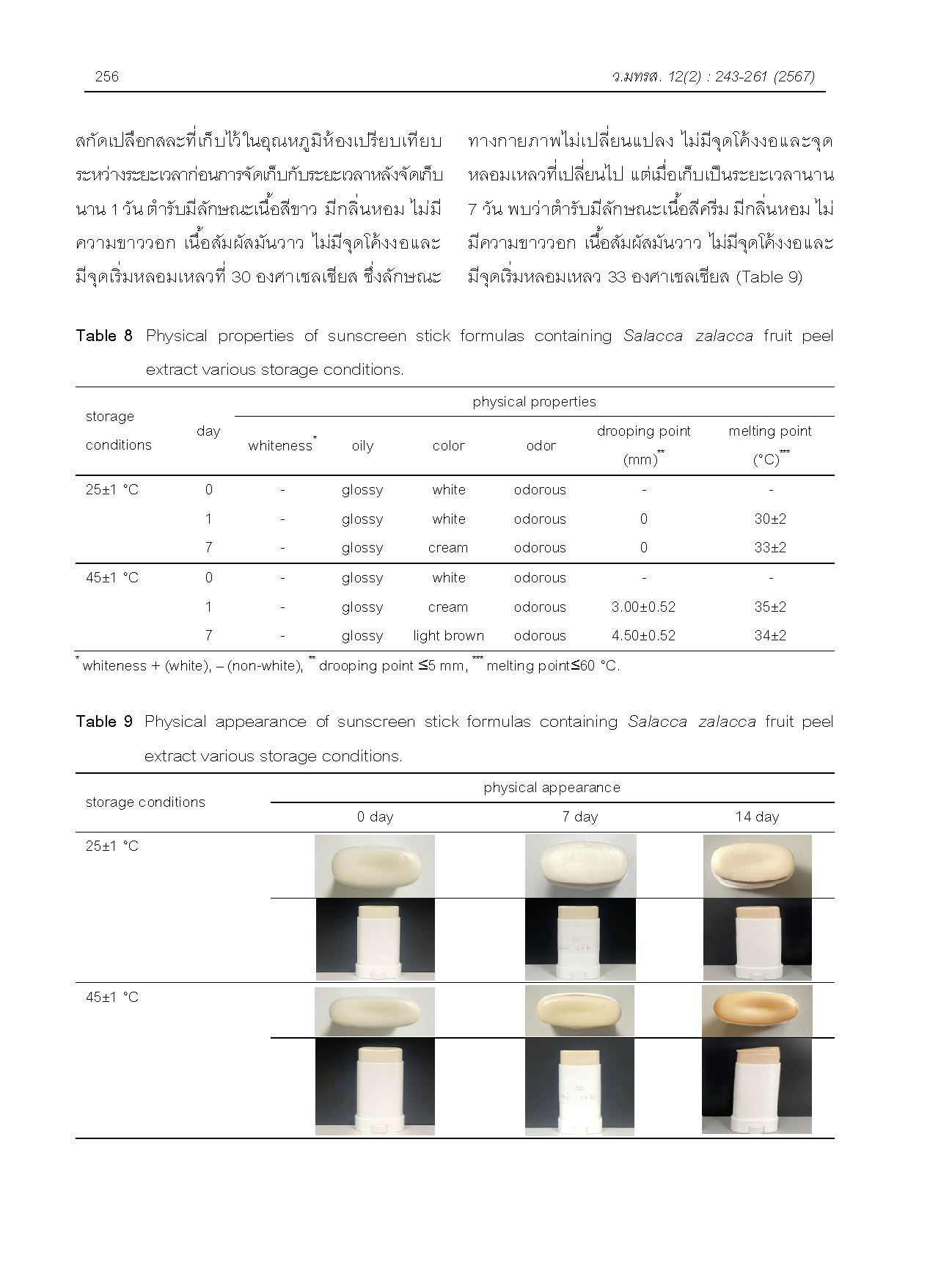
งานวิจัยนี้มีวัตถุประสงค์เพื่อศึกษาสภาวะที่เหมาะสมในการสกัดสารประกอบฟีนอลิกจากเปลือกของผลสละ Salacca zalacca โดยใช้คลื่นไมโครเวฟและศึกษาฤทธิ์ต้านอนุมูลอิสระของสารสกัดรวมถึงความคงตัวของครีมกันแดดแบบแท่งหลังจากนำสารสกัดที่ได้เป็นส่วนผสมสำคัญ สภาวะที่ศึกษาได้แก่อัตราส่วนของวัตถุดิบต่อตัวทำละลาย (4:40, 8:40, 12:40 และ 16:40 กรัมต่อมิลลิลิตร) กำลังไมโครเวฟ (200, 400, 600 และ 800 วัตต์) จำนวนรอบที่เวลา 30 วินาทีต่อรอบ ผลการศึกษาพบว่าอัตราส่วนที่เหมาะสมในการสกัดอยู่ที่อัตราส่วนผงเปลือกสละ 4 กรัมต่อตัวทำละลายเอทานอล 40 มิลลิลิตร จำนวนรอบที่เหมาะสมคือ 3 รอบ กำลังไมโครเวฟเท่ากับ 600 วัตต์ ผลการวิเคราะห์ปริมาณสารประกอบฟีนอลิกทั้งหมดด้วยวิธี Folin-Ciocâlteu และประเมินฤทธิ์ต้านอนุมูลอิสระของสารสกัดด้วยวิธี DPPH พบว่าสารสกัดเปลือกสละที่เตรียมได้จากการขยายขนาดการสกัดมีสารประกอบฟีนอลิกทั้งหมดเท่ากับ 86.25 mg GAE/g extract มีค่าความสามารถยับยั้งการเกิดอนุมูลอิสระที่ 50 เปอร์เซ็นต์ เท่ากับ 19.17 µg TAE/mL โดยมีผลผลิตร้อยละเท่ากับ 68 เปอร์เซ็นต์ ผลการวิจัยชี้ให้เห็นถึงศักยภาพของสารสกัดจากเปลือกของผลสละ S. zalacca ในการพัฒนาตำรับครีมกันแดดแบบแท่ง เนื่องจากมีคุณสมบัติต้านอนุมูลอิสระที่ดี เมื่อนำสารสกัดเปลือกผลสละมาผสมในตำรับครีมกันแดดแบบแท่งพบว่าสามารถคงความเป็นเนื้อเดียวกันได้ดีหลังจากผ่านไป 7 วัน ที่อุณหภูมิ 25 และ 45 องศาเซลเซียส ทั้งนี้จำเป็นต้องมีการศึกษาเพิ่มเติมเพื่อทำการทดสอบความเสถียรและประสิทธิภาพของครีมกันแดดแบบแท่งที่ผสมสารสกัดจากเปลือกของผลสละ
S. zalacca ภายใต้สภาพแวดล้อมที่แตกต่างกันต่อไป
Article Details

อนุญาตภายใต้เงื่อนไข Creative Commons Attribution-NonCommercial-NoDerivatives 4.0 International License.
ต้นฉบับที่ได้รับการตีพิมพ์ถือเป็นสิทธิของเจ้าของต้นฉบับและของวารสารวิชาการ มทร.สุวรรณภูมิ เนื้อหาบทความในวารสารเป็นแนวคิดของผู้แต่ง มิใช่เป็นความคิดเห็นของคณะกรรมการการจัดทำวารสาร และมิใช่ความรับผิดชอบของมหาวิทยาลัยเทคโนโลยีราชมงคลสุวรรณภูมิ
เอกสารอ้างอิง
Aralas, S., Mohamed, M., & Bakar, M. F. A. (2009). Antioxidant properties of selected salak (Salacca zalacca) varieties in Sabah, Malaysia. Nutrition & Food Science, 39(3), 243-250.
Bhattacharya, S., & Sherje, A. P. (2020). Development of resveratrol and green tea sunscreen formulation for combined photoprotective and antioxidant properties. Journal of Drug Delivery Science and Technology, 60, 102000.
Buso, P., Radice, M., Baldisserotto, A., Manfredini, S., & Vertuani, S. (2017). Guidelines for the development of herbal-based sunscreen. In P. F. Builders (Eds.), Herbal Medicine. London, UK: IntechOpen Limited, doi: 10.5772/intechopen.72712
Chemat, F., Vian, M. A., & Cravotto, G. (2012). Green extraction of natural products: concept and principles. International journal of molecular sciences, 13(7), 8615-8627.
Chiari, B. G., Trovatti, E., Pecoraro, É., Correa, M. A., Cicarelli, R. M. B., Ribeiro, S. J. L., & Isaac, V. L. B. (2014). Synergistic effect of green coffee oil and synthetic sunscreen for health care application. Industrial Crops and Products, 52, 389-393.
Geoffrey, K., Mwangi, A. N., & Maru, S. M. (2019). Sunscreen products: rationale for use, formulation development and regulatory considerations. Saudi Pharmaceutical Journal, 27(7), 1009-1018.
Girsang, E., Lister, I. N. E., Ginting, C. N., Khu, A., Samin, B., Widowati, W., & Rizal, R. (2019). Chemical constituents of snake fruit (Salacca zalacca (Gaert.) Voss) peel and in silico anti-aging analysis. Molecular and Cellular Biomedical Sciences, 3(2), 122-128.
Girsang, E., Lister, I. N. E., Ginting, C. N., Sholihah, I. A., Raif, M. A., Kunardi, S., & Widowati, W. (2020). Antioxidant and antiaging activity of rutin and caffeic acid. Pharmaciana, 10(2), 147-156.
Hubner, A., Sobreira, F., Neto, A. V., Pinto, C. A. S. D. O., Dario, M. F., Díaz, I. E. C., & Bacchi, E. M. (2019). The synergistic behavior of antioxidant phenolic compounds obtained from winemaking waste’s valorization, increased the efficacy of a sunscreen system. Antioxidants, 8(11), 530.
Kanlayavattanakul, M., Lourith, N., Ospondpant, D., Ruktanonchai, U., Pongpunyayuen, S., & Chansriniyom, C. (2013). Salak plum peel extract as a safe and efficient antioxidant appraisal for cosmetics. Bioscience, Biotechnology, and Biochemistry, 77(5), 1068-1074.
Jha, A. K., & Sit, N. (2022). Extraction of bioactive compounds from plant materials using combination of various novel methods: a review. Trends in Food Science & Technology, 119, 579-591.
Lateh, L., Yuenyongsawad, S., Chen, H., & Panichayupakaranant, P. (2019). A green method for preparation of curcuminoid-rich Curcuma longa extract and evaluation of its anticancer activity. Pharmacognosy Magazine, 15(65), 730-735.
Thongekkaew, J., & Teangtam, W. (2023). Antioxidant activity, vitamin C and total phenolic contents in three types of lettuce grown in hydroponics and soil-based. RMUTSB Academic Journal, 11(2), 186-198. (in Thai)
Matthayom, W., Nochai, K., KoKaew, K., Pisapak, K., & Robmuang, D. (2020). Investigation of antioxidant capacity and antioxidant activity of Ma-huad (Lepisanthes rubiginosa (Roxb.) Leenh.) juice. RMUTSB Academic Journal, 8(2), 187-198. (in Thai)
Momchev, P., Ciganovic, P., Jug, M., Marguí, E., Jablan, J., & Zovko Koncic, M. (2020). Comparison of maceration and ultrasonication for green extraction of phenolic acids from Echinacea purpurea aerial parts. Molecules, 25(21), 5142
Ng, S. Y., Gew, L. T., & Eh Suk, V. R. (2022). Plant polyphenols as green sunscreen ingredients: a systematic review. Journal of Cosmetic Dermatology, 21(11), 5409-5444.
Opris, O., Soran, M. L., Lung, I., Stegarescu, A., Gutoiu, S., Podea, R., & Podea, P. (2021). Optimization of extraction conditions of polyphenols, antioxidant capacity and sun protection factor from Prunus spinosa fruits. Application in sunscreen formulation. Journal of the Iranian Chemical Society, 18, 2625-2636.
Osorio-Tobón, J. F. (2020). Recent advances and comparisons of conventional and alternative extraction techniques of phenolic compounds. Journal of Food Science and Technology, 57, 4299-4315.
Pham, T. N., Le, X. T., Pham, V. T., & Le, H. T. (2022). Effects of process parameters in microwave-assisted extraction on the anthocyanin-enriched extract from Rhodomyrtus tomentosa (Ait.) Hassk and its storage conditions on the kinetic degradation of anthocyanins in the extract. Heliyon, 8(6), e09518.
Prathumtet, J., Surasorn, C., & Paopa, T. (2019). Total phenolic content and antioxidant activity of three flower infusion tea in Sakon Nakhon province. Journal of Health Science of Thailand, 28(6), 1110-1115. (in Thai)
Picot-Allain, C., Mahomoodally, M. F., Ak, G., & Zengin, G. (2021). Conventional versus green extraction techniques-a comparative perspective. Current Opinion in Food Science, 40, 144-156.
Purintraphiban, S., & Poonpaerdchon, S. (2020). Effect of tea processing on quality and antioxidant properties of gac fruit peel tea. RMUTSB Academic Journal, 8(1), 28-38. (in Thai)
Rosa, G. S., Vanga, S. K., Gariepy, Y., & Raghavan, V. (2019). Comparison of microwave, ultrasonic and conventional techniques for extraction of bioactive compounds from olive leaves (Olea europaea L.). Innovative Food Science & Emerging Technologies, 58, 102234.
Sanchez-Reinoso, Z., Mora-Adames, W. I., Fuenmayor, C. A., Darghan-Contreras, A. E., Gardana, C., & Gutiérrez, L. F. (2020). Microwave-assisted extraction of phenolic compounds from Sacha Inchi shell: Optimization, physicochemical properties and evaluation of their antioxidant activity. Chemical Engineering and Processing-Process Intensification, 153, 107922.
Sudiono, J., & Susanto, G. R. (2021). Antioxidant content of palm fruit (Borassus flabellifer L.) seed coat. Biomedical Journal of Scientific & Technical Research, 34(3), 26695-26699.
Suwancharoen, S., Kasemsuk, T., Moonrungsee, N., Kurewan, U., Mekprayoon, S., Oebsapap, J., & Boonmee, A. (2022). Antioxidant activity of Salak and soap product development. The Journal of King Mongkut's University of Technology North Bangkok, 32(4), 1033-1043. (in Thai)
Thai Industrial Standards Institute. (2018). Thai SMEs standard: herbal lip treatment. Retrieved 25 December 2023, from https://www.tisi.go.th/assets/website/pdf/tiss/17-2561.pdf
Tilaar, A., Ranti, A., & Mun’im, A. (2017). The efficacy study of snake fruit (Salacca edulis Reinw Var. Bongkok) extract as skin lightening agent. Pharmacognosy Journal, 9(2), 235-238.
Wabaidur, S. M., Obbed, M. S., Alothman, Z. A., Alfaris, N. A., Badjah-Hadj-Ahmed, A. Y., Siddiqui, M. R., Altamimi, J., Z., & Aldayel, T. S. (2020). Total phenolic acids and flavonoid contents determination in Yemeni honey of various floral sources: Folin-Ciocâlteu and spectrophotometric approach. Food Science and Technology, 40(Suppl. 2), 647-652.
