
การวิเคราะห์ยีนในไมโทคอนเดรียโดยใช้ยีน D-loop, Phe-tRNA, 12S-rRNA (bar2) ในไก่กระดูกดำเปรียบเทียบกับพันธุ์ไก่จากธนาคารยีน
Article Sidebar
Main Article Content
บทคัดย่อ
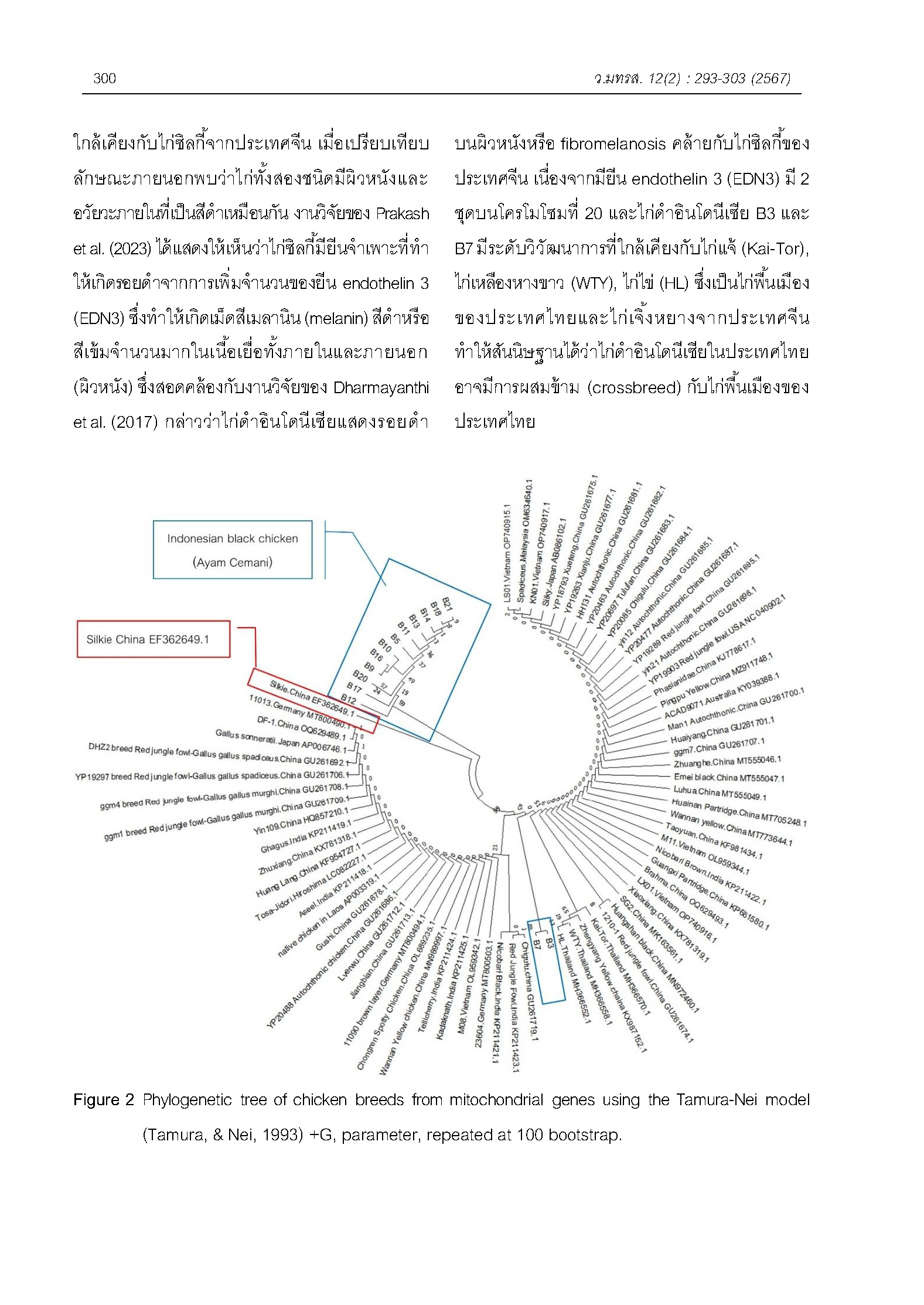
ไก่ดำเป็นสัตว์เศรษฐกิจสายพันธุ์หนึ่งที่ได้รับความนิยมเลี้ยงกันอย่างแพร่หลายและมีคุณค่าทางโภชนาการสูง มีสรรพคุณทางยา ทำหน้าที่เป็นสารต้านอนุมูลอิสระและเกี่ยวข้องกับการทำงานของภูมิคุ้มกัน ไก่ดำจึงเป็นที่นิยมบริโภคในกลุ่มของคนที่ใส่ใจสุขภาพ ไก่กระดูกดำมีความหลากหลายทางสายพันธุ์ของไก่ที่เพาะเลี้ยงในประเทศไทยในขณะที่ไก่ดำมีราคาที่สูงเมื่อเทียบกับไก่สายพันธุ์อื่นโดยเฉพาะไก่ดำอินโดนีเซียที่เป็นไก่ที่มีสีดำตลอดทั้งตัวจนถึงขน กระดูกและเนื้อที่มีสีดำจึงมีความต้องการไก่ดำอินโดนีเซียที่เป็นสายพันธุ์แท้ แต่ในประเทศไทยขาดข้อมูลทางความหลากหลายทางพันธุกรรมของไก่กระดูกดำที่เพาะเลี้ยงในประเทศไทย การศึกษานี้จึงมีวัตถุประสงค์หาความหลากหลายทางพันธุกรรมของยีน D-loop, Phe-tRNA และ 12S-rRNA (bar2) ซึ่งเป็นยีนในไมโทคอนเดรีย เพื่อหาเครื่องหมายพันธุกรรม (genetic maker) ที่แตกต่างกันในไก่สายพันธุ์ต่าง ๆ โดยใช้ไก่ดำอินโดนีเซียที่เลี้ยงในประเทศไทยจำนวน 14 ตัว เปรียบเทียบกับข้อมูลไก่จากฐานข้อมูล GenBank จำนวน 70 ตัวอย่าง โดยทำการวิเคราะห์โดยใช้ PCR และนำ PCR product ไปวิเคราะห์หาลำดับเบส ทำการหา haplotype โดยใช้ DnaSP6 และสร้างต้นไม้วิวัฒนาการโดยใช้ MEGA 11 ผลการวิเคราะห์พบว่า ไก่ดำอินโดนีเซียส่วนใหญ่มีลำดับนิวคลีโอไทป์ในส่วนของยีนเป้าหมายมีความแตกต่างอย่างจำเพาะจากไก่ชนิดอื่น (outgroup) แต่มีลำดับนิวคลีโอไทป์ใกล้เคียงกับไก่ซิลกี้ที่สุดโดยดูจากผลที่แสดงใน phylogenetic tree ผลของ haplotype พบว่าในไก่ดำอินโดนีเซียถูกแบ่งออกเป็น 7 haplotypes จึงสามารถบ่งบอกถึงความหลากหลายทางพันธุกรรมที่มีสูงของไก่ดำอินโดนีเซียในประเทศไทยได้ และพบว่าลำดับเบสตรงตำแหน่งที่ 812 bp มีลำดับเบสจำเพาะใน haplotypes 1-7 ของไก่ดำอินโดนีเซียโดยมีเบสเป็น T ทั้งหมด ในขณะที่ haplotypes 8-14 ของไก่จากฐานข้อมูล GenBank มีเบสเป็น C ทั้งหมด ดังนั้น ในงานวิจัยต่อไปสามารถนำลำดับนิวคลีโอไทป์ของไก่ดำอินโดนีเซียในตำแหน่ง 812 bp ที่เป็นตำแหน่งสนิปส์ (SNPs) สามารถพัฒนาเป็น molecular maker ใช้ในการคัดเลือกไก่ดำได้ในอนาคต
Article Details

อนุญาตภายใต้เงื่อนไข Creative Commons Attribution-NonCommercial-NoDerivatives 4.0 International License.
ต้นฉบับที่ได้รับการตีพิมพ์ถือเป็นสิทธิของเจ้าของต้นฉบับและของวารสารวิชาการ มทร.สุวรรณภูมิ เนื้อหาบทความในวารสารเป็นแนวคิดของผู้แต่ง มิใช่เป็นความคิดเห็นของคณะกรรมการการจัดทำวารสาร และมิใช่ความรับผิดชอบของมหาวิทยาลัยเทคโนโลยีราชมงคลสุวรรณภูมิ
เอกสารอ้างอิง
Arif, I. A., Khan, H. A., Bahkali, A. H., Al Homaidan, A. A., Al Farhan, A. H., Al Sadoon, M., & Shobrak, M. (2011). DNA marker technology for wildlife conservation. Saudi Journal of Biological Sciences, 18(3), 219-225.
Bao, H., Zhao, C., Li, J., & Wu, C. (2008). Sequencing and alignment of mitochondrial genomes of Tibetan chicken and two lowland chicken breeds. Science in China Series C: Life Sciences, 51, 47-51.
Cui, H., Ibtisham, F., Xu, C., Huang, H., & Su, Y. (2017). DNA barcoding of Chinese native chicken breeds through COI gene. The Thai Journal of Veterinary Medicine, 47(1), 123-129.
Daetwyler, H. D., Villanueva B., Bijma P., & Woolliams J. A. (2007). Inbreeding in genome-wide selection. Journal of Animal Breeding and Genetics, 124(6), 369-376.
Desjardins, P., & Morais, R. (1990). Sequence and gene organization of the chicken mitochondrial genome:
a novel gene order in higher vertebrates. Journal of Molecular Biology, 212(4), 599-634.
Dharmayanthi, A. B., Terai, Y., Sulandari, S., Zein, M. S. A., Akiyama, T., & Satta, Y. (2017). The origin and evolution of fibromelanosis in domesticated chickens: genomic comparison of Indonesian cemani and Chinese silkie breeds. PLOS ONE, 12(4), e0173147.
Di Lorenzo, P., Ceccobelli, S., Panella, F., Attard, G., & Lasagna, E. (2015). The role of mitochondrial DNA to determine the origin of domestic chicken. World's Poultry Science Journal, 71(2), 311-318.
Dorshorst, B., Okimoto, R., & Ashwell, C. (2010). Genomic regions associated with dermal hyperpigmentation, polydactyly and other morphological traits in the Silkie chicken. Journal of Heredity, 101(3), 339-350.
Groeneveld, L. F., Lenstra, J. A., Eding, H., Toro, M. A., Scherf, B., Pilling, D., Negrini, R., Finlay, E. K., Jianlin, H., Groeneveld, E., Weigend, S., & The GLOBALDIV Consortium. (2010). Genetic diversity in farm animals--a review. Animal Genetics, 41(s1), 6-31.
Habsari, I. K., Nugroho, B. A., & Azizah, S. (2018). Supply chain analysis of cemani chickens in Temanggung, Central Java, Indonesia. IOSR Journal of Economics and Finance, 9(4), 44-49.
Kostaman, T., Sopiyana, S., Isbandi, & Pasaribu, T. (2021). Ex-situ exploration of cemani chicken in Balai Penelitian Ternak (Balitnak), Bogor-West Java. BIO Web of Conferences, 33, 01001.
Lan, D., Hu, Y., Zhu, Q., & Liu, Y. (2017). Mitochondrial DNA study in domestic chicken. DNA Mapping, Sequencing, and Analysis, 28(1), 25-29.
Likittrakulwong, W., Poolprasert, P., & Roytrakul, S. (2018). Morphological trait, molecular genetic evidence
and proteomic determination of different chickens (Gallus gallus) breeds. Journal of Applied Biology & Biotechnology, 7(1), 65-70.
Lukanov, H., & Genchev, A. (2013). Fibromelanosis in domestic chickens. Journal of Agricultural Science and Technology, 5(3), 239-246.
Meerasen, S., Duangjit, S., & Yasothonsrikul, S. (2009). Analysis of the mutation rate of the mitochondrial DNA region. hypervariable region in the lower northern region of Thailand (research report). Phitsanulok: Naresuan University. (in Thai)
Miao, Y. W., Peng, M. S., Wu, G. S., Ouyang, Y. N., Yang, Z. Y., Yu, N., Liang, J. P., Pianchou, G., Beja-Pereira, A., Mitra, B., Palanichamy, M. G., Baig, M., Chaudhuri, T. K., Shen, Y. Y., Kong, Q. P., Murphy, R. W., Yao, Y. G., & Zhang, Y. P. (2013). Chicken domestication: an updated perspective based on mitochondrial genomes. Heredity, 110, 277-282.
Muladno, M. (2008). Local chicken genetic resources and production systems in Indonesia. Retrieved 21 October 2023, from http://www.fao.org/docrep/013/al695e/al695e00.pdf.
Muroya, S., Tanabe, R. I., Nakajima, I., & Chikuni, K. (2000). Molecular characteristics and site specific distribution of the pigment of the Silky fowl. Journal of Veterinary Medical Science, 62(4), 391-395.
Prakash, A., Singh, Y., Chatli, M. K., Sharma, A., Acharya, P., & Singh M. (2023). Review of the black meat chicken breeds: Kadaknath, Silkie, and Ayam Cemani. World's Poultry Science Journal, 79(4), 879-891.
Robertson, D., Shore, S., & Miller, D. M. (1997). Manipulation and expression of recombinant DNA; a laboratory manual. Raleigh (USA): Academic Press.
Rozas, J., Ferrer-Mata, A., Sanchez-DelBarrio, J. C., Guirao-Rico, S., Librado, P., Ramos-Onsins, S. E., & Sanchez-Gracia, A. (2017). DnaSP 6: DNA sequence polymorphism analysis of large data sets. Molecular Biology and Evolution, 34(12), 3299-3302.
Siriwadee, P., Wirot L., Thanapol P., & Wirawan N. (2023). Genetic diversity among five native Thai chickens and Khiew-Phalee chickens in lower-northern Thailand using mitochomdrial DNA barcodes. Biodiversitas, 24(4), 1962-1970.
Shi, H., Fu, J., He, Y., Li, Z., Kang, J., Hu, C., Zi, X., Liu, Y., Zhao, J., Dou, T., Jia, J., Duan, Y., Wang, K., & Ge, C. (2022). Hyperpigmentation inhibits early skeletal muscle development in Tengchong snow chicken breed. Genes, 13(12), 2253.
Tamura, K., & Nei, M. (1993). Estimation of the number of nucleotide substitutions in the control region of mitochondrial DNA in humans and chimpanzees. Molecular Biology and Evolution, 10(3), 512-526.
Tamura, K., Peterson, D., Peterson, N., Stecher, G., Nei, M., & Kumar, S. (2011). MEGA5: molecular evolutionary genetic analysis using maximum likelihood, evolutionary distance, and maximum parsimony methods. Molecular Biology and Evolution, 28(10), 2731-2739.
Wilkinson, S., Wiener, P., Teverson, D., Haley, C. S., & Hocking, P. M. (2012). Characterization of the genetic diversity, structure and admixture of British chicken breeds. Animal Genetics, 43(5), 552-563.
Yu, S., Wang, G., Liao, J., & Tang, M. (2018). Transcriptome profile analysis identifies candidate genes for the melanin pigmentation of breast muscle in Muchuan black-boned chicken. Poultry Science, 97(10), 3446-3455.
Wolc, A., Stricker C., Arango J., Settar P., Fulton J. E., O’Sullivan N. P., Preisinger R., Habier D., Fernando R., Garrick D. J., Lamont S. J., & Dekkers J. C. M. (2011). Breeding value prediction for production traits in layer chickens using pedigree or genomic relationships in a reduced animal model. Genetics Selection Evoluation, 43, 5.
