
ปัจจัยด้านสมรรถนะทางนวัตกรรมอินเทอร์เน็ตออฟติงส์สำหรับการจัดการสภาพแวดล้อมในการผลิตเห็ดสกุลนางรม
Article Sidebar
Main Article Content
บทคัดย่อ
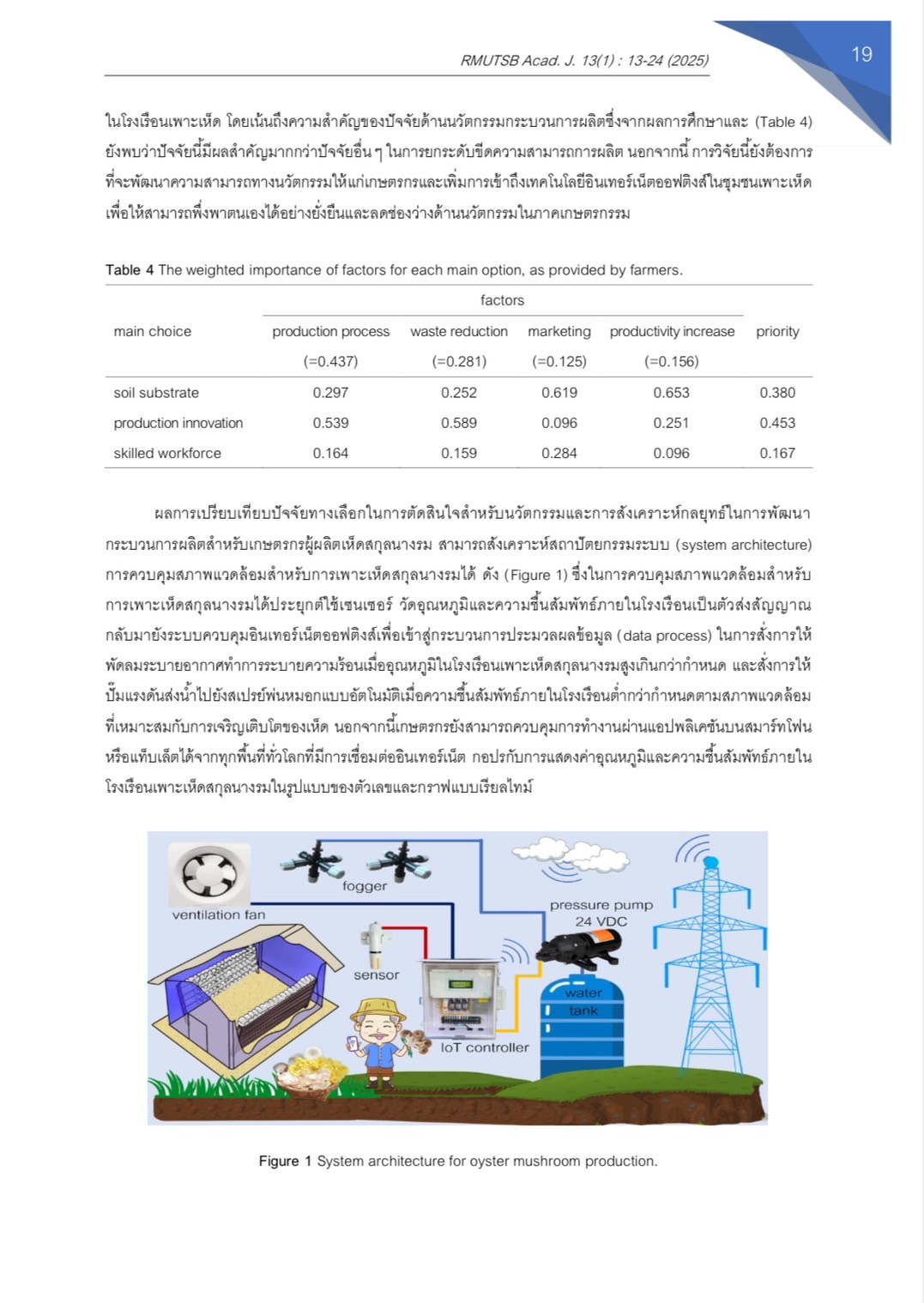
การวิจัยนี้มีวัตถุประสงค์เพื่อศึกษาและวิเคราะห์ปัจจัยด้านนวัตกรรมกระบวนการผลิตและการใช้นวัตกรรมอินเทอร์เน็ตออฟติงส์ในการจัดการสภาพแวดล้อมสำหรับการเพาะเห็ดสกุลนางรมและประเมินสมรรถนะของนวัตกรรมอินเทอร์เน็ตออฟติงส์ โดยเริ่มจากการวิเคราะห์ข้อมูลตามระดับความต้องการในการใช้นวัตกรรมของกลุ่มตัวอย่าง จากผู้เชี่ยวชาญการผลิตเห็ดสกุลนางรมผ่านเครื่องมือกระบวนการลำดับชั้นเชิงวิเคราะห์ ซึ่งเป็นวิธีการทางการจัดการวิศวกรรมที่สามารถเลือกนวัตกรรมที่เหมาะสมกับบริบทชุมชนใน 3 เป้าหมาย ได้แก่ นวัตกรรมการผลิต แรงงานฝีมือ และวัสดุเพาะปลูกพืชคุณภาพสูง ซึ่งเก็บข้อมูลกลุ่มตัวอย่างเกษตรกรที่มีความเชี่ยวชาญในการผลิตเห็ดสกุลนางรมในพื้นที่จังหวัดปทุมธานีและสระแก้ว จำนวน 300 คน ผลการวิจัยพบว่าการเปรียบเทียบปัจจัยในแต่ละทางเลือกสำหรับการตัดสินใจเลือกแนวทางยกระดับขีดความสามารถทางการแข่งขันของกระบวนการผลิตและสร้างมูลค่าจากวัสดุเหลือทิ้งทางการเกษตรสำหรับเกษตรกรผู้ผลิตเห็ดสกุลนางรมที่เหมาะกับบริบทชุมชน และค่าน้ำหนักความสำคัญของทั้ง 4 ปัจจัย ได้แก่ นวัตกรรมด้านกระบวนการผลิต นวัตกรรมด้านการลดของเสีย นวัตกรรมด้านการบริการจัดการการตลาด และนวัตกรรมด้านการเพิ่มผลผลิต ผลการวิจัยพบว่าทางเลือกที่จะต้องทำการตัดสินใจเลือกใช้เทคโนโลยีที่เหมาะที่สุด คือ นวัตกรรมการผลิตโดยใช้อินเทอร์เน็ตออฟติงส์ ซึ่งมีน้ำหนักความสำคัญมากถึง 0.453 หรือคิดเป็นร้อยละ 45.30 รองลงมา คือ วัสดุเพาะปลูกพืชคุณภาพสูง มีน้ำหนักความสำคัญ 0.380 หรือคิดเป็นร้อยละ 38 ยิ่งไปกว่านั้นผลผลิตของเดือนมิถุนายน-สิงหาคม พ.ศ. 2566 ซึ่งเป็นช่วงที่ก้อนเห็ดสกุลนางรมได้ผลผลิตดีที่สุด พบว่านวัตกรรมทางด้านกระบวนการผลิตในด้านของการใช้อินเทอร์เน็ตออฟติงส์สามารถควบคุมสภาพแวดล้อมในการเจริญเติบโตของเห็ดสกุลนางรม และสามารถเพิ่มปริมาณการผลิตเห็ดสกุลนางรมได้ดีกว่าวิธีการผลิตแบบดั้งเดิม ซึ่งเฉลี่ยแล้วการใช้อินเทอร์เน็ตออฟติงส์ในกระบวนการผลิตเห็ดสกุลนางรมได้ผลผลิตมากถึง 712.72 กิโลกรัม เมื่อเทียบกับการผลิตแบบดั้งเดิมเฉลี่ยแล้วได้ 523.46 กิโลกรัม โดยมีปริมาณการผลิตที่เพิ่มขึ้นโดยเฉลี่ยมากถึง 189.26 กิโลกรัม
Article Details

อนุญาตภายใต้เงื่อนไข Creative Commons Attribution-NonCommercial-NoDerivatives 4.0 International License.
ต้นฉบับที่ได้รับการตีพิมพ์ถือเป็นสิทธิของเจ้าของต้นฉบับและของวารสารวิชาการ มทร.สุวรรณภูมิ เนื้อหาบทความในวารสารเป็นแนวคิดของผู้แต่ง มิใช่เป็นความคิดเห็นของคณะกรรมการการจัดทำวารสาร และมิใช่ความรับผิดชอบของมหาวิทยาลัยเทคโนโลยีราชมงคลสุวรรณภูมิ
เอกสารอ้างอิง
Aguaron, J., Escobar, M. T., & Moreno-Jimenez, J. M. (2003). Consistency stability intervals for a judgement in AHP decision support systems. European Journal of Operational Research, 145(2), 382-393. https://doi.org/10.1016/S0377-2217(02)00544-1
Branco, F., Moreira, F., Martins, J., Au-Yong-Oliveira, M., & Goncalves, R. (2019). Conceptual approach for an extension to a mushroom farm distributed process control system: IoT and blockchain. The 2019 World Conference on Information Systems and Technologies (pp. 738-747). Spain. https://link.springer.com/chapter/10.1007/978-3-030-16181-1_69
Darko, A., Chan, A. P. C., Ameyaw, E. E., Owusu, E. K., Parn, E., & Edwards, D. J. (2019). Review of application of analytic hierarchy process (AHP) in construction. International Journal of Construction Management, 19(5), 436-452. https://www.tandfonline.com/doi/full/10.1080/15623599.2018.1452098
Fauzi, R. M., Waranti, F. S., Rais, I. K., & Somantri, Y. (2020). Oyster mushroom cultivation solution based IoT for nova farmers. IOP Conference Series: Materials Science and Engineering, 850, 012044. https://iopscience.iop.org/article/10.1088/1757-899X/850/1/012044
Kazakis, N., Kougias, I., & Patsialis, T. (2015). Assessment of flood hazard areas at a regional scale using an index-based approach and analytical hierarchy process: application in Rhodope–Evros region, Greece. Science of the Total Environment, 538, 555-563. https://doi.org/10.1016/j.scitotenv.2015.08.055
Laowatthanarassamee, N., Heepkaew, P., Jainam, W., Chulee, N., & Chompuchan, Ch. (2023). Laboratory performance evaluation of a low-cost capacitive soil moisture sensor for fine-and medium-textured soils. RMUTSB Academic Journal, 11(2), 254-264. https://li01.tci-thaijo.org/index.php/rmutsb-sci/article/view/258687/177326 (in Thai)
Mastuwach, T., Dumrongwattana, J., Khaenamkaew, D., & Dechochai, U. (2021). Guidelines for promoting mushroom farming in communities. A case study of mushroom farm, police sergeant major Wichian Kongjui, village No. 9, Rommueang subdistrict, Mueang district, Phatthalung, Thailand. Journal of MCU Phetchaburi Review, 4(2), 1-16. https://so03.tci-thaijo.org/index.php/JPR/article/view/256180/171405 (in Thai)
National accounts division state–owned enterprises investment division logistics development strategy division. (September 2022). Thailand’s logistics report 2021 (research report). Office of the national economic and social development council. from https://www.nesdc.go.th/nesdb_en/ewt_dl_link.php?nid=4485.%20https://www.nesdc.go.th/nesdb_en/ewt_dl_link.php?nid=4485
Pankratova, N., & Nedashkovskaya, N., (2015). Methods of evaluation and improvement of consistency of expert pairwise comparison judgements. International Journal of Information Theories and Applications, 22(3), 203-223. http://www.foibg.com/ijita/vol22/ijita22-03-p01.pdf
Pennate, T., Yowaphui, K., Charangab, C., Boonrom, B., Tarahom, U., & Voraboot, P. (2023). Develop an environment control system for the Bhutan oyster mushroom cultivation house by using the IoT embedded system. Agriculture and Technology Journal, 4(1), 43-56. https://li01.tci-thaijo.org/index.php/atj/article/view/257095/177913 (in Thai)
Poolwan, J., Sripan, B., & Kingthong, S. (2021). Development of automatic temperature and humidity control systems for eggs incubators with internet of thing technology. RMUTSB Academic Journal, 9(2), 225-236. https://li01.tci-thaijo.org/index.php/rmutsb-sci/article/view/249695 (in Thai)
Riskiono, S. D., Prasetyawan, P., Mulyanto, A., Iqbal, M., & Prabowo, R. (2020). Control and real-time monitoring system for mushroom cultivation fields based on WSN and IoT. Journal of Physics: Conference Series, 1655, 012003. https://iopscience.iop.org/article/10.1088/1742-6596/1655/1/012003/pdf
Saaty, T. L. (2008). Decision making with the analytic hierarchy process. International Journal of Services Sciences, 1(1), 83-98. https://doi.org/10.1504/IJSSCI.2008.017590
Srilert, N. (2022, November 13). Thailand's path to survival post-COVID crisis: developing a grassroots and rural economy. https://www.bangkokbiznews.com/business/economic/1037004 (in Thai)
Srilert, N. (2023, October 29). Viewing the economy through the perspective of the 'TDRI chairman': how to help Thailand escape the middle-income trap. https://www.bangkokbiznews.com/business/economic/1095405 (in Thai)
Suksai, L., Phanak, R., & Lamaisri, S. (2022). Product development of medicinal mushroom processing according to local wisdom based on sufficiency economy and creative economy in Lahan subdistrict, Square district, Chaiyaphum province. Journal of MCU Ubon Review, 7(2), 103-114. https://so06.tci-thaijo.org/index.php/mcjou/article/view/255668/172230 (in Thai)
Tepping, B. J., (2014). Elementary Sampling Theory, Taro Yamane. Englewood Cliffs, New Jersey: Prentice-Hall, Inc., 1967. Pp. x–405. Journal of the American Statistical Association, 63(322), 728-730. https://doi.org/10.1080/01621459.1968.11009297
