
Effect of N2 flow rates on the structure and hardness of nanocrystalline CrZrN thin films prepared by reactive DC magnetron co-sputtering
Article Sidebar
Main Article Content
บทคัดย่อ
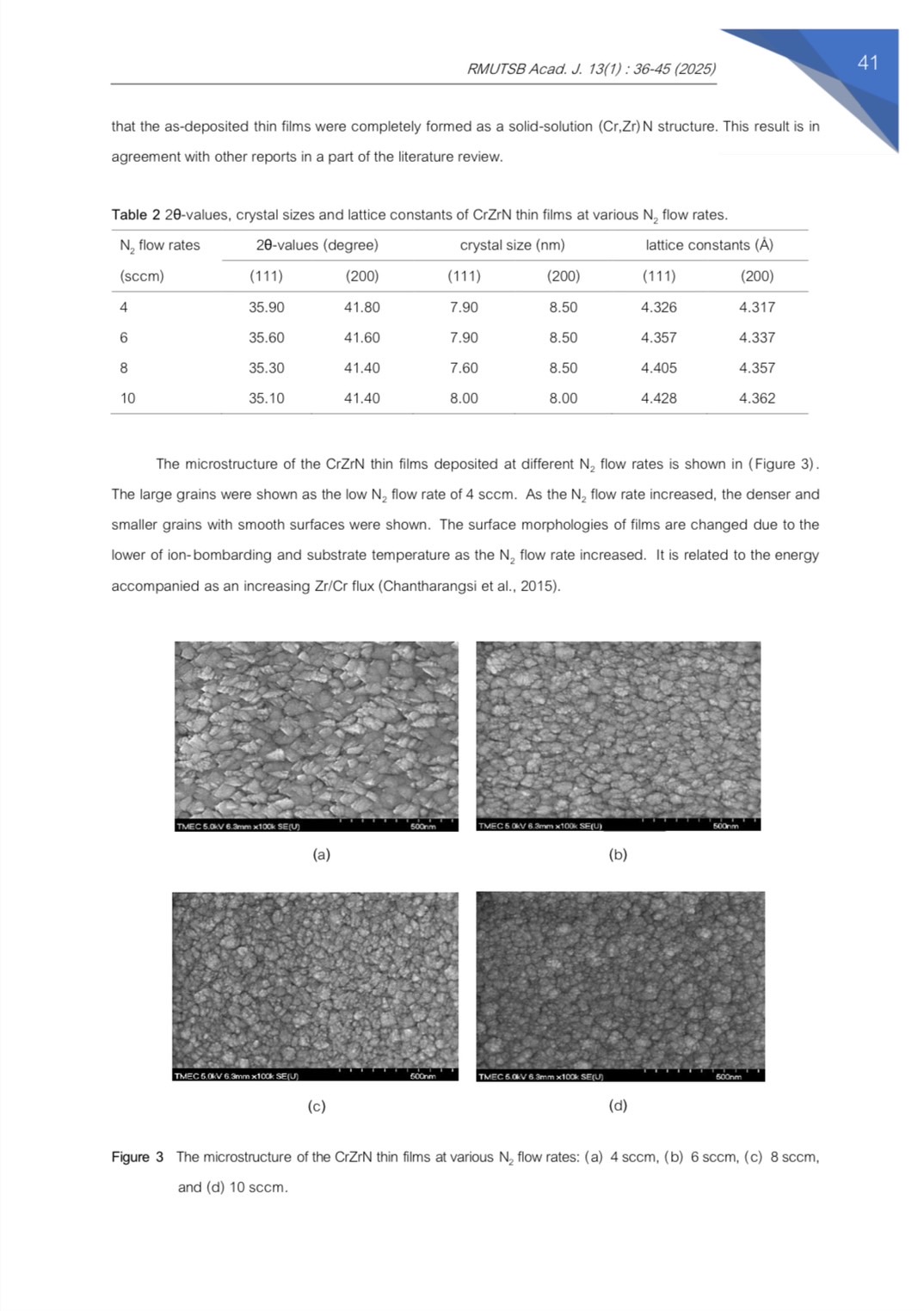
This work successfully investigated the effect of N2 gas flow rates on the structure and hardness of chromium zirconium nitride (CrZrN) thin films. The CrZrN films were deposited on silicon wafers using a reactive DC unbalance-magnetron co-sputtering process with N2 flow rates ranging from 4 to 10 sccm. The crystal structure was investigated using grazing-incidence X-ray diffraction (GI-XRD). Field-emission scanning electron microscopy (FE-SEM) was used to examine the included material's microstructure, surface morphology, and thickness. The elemental composition was determined using energy dispersive spectroscopy (EDS). The hardness was measured using the nanoindentation method in depth-controlled mode. The results reveal that the as-deposited films were formed as a nanocrystalline (Cr,Zr)N solid solution with small crystal sizes less than 10 nm. Increasing the N2 flow rate altered the preferred orientation growth behavior by decreasing the 2θ-values and increasing the lattice constants. The thickness decreased from 569 nm to 410 nm as the N2 flow rate increased, due to target poisoning. The elemental composition of the as-deposited films was affected by changes in the N2 flow rates. The N content increased with higher N2 flow rates, while the Cr and Zr contents decreased. The surface morphology of the films changed as the N2 flow rate increased, due to the reduction in ion-bombardment energy, leading to a decrease in substrate temperature. The as-deposited films consisted of tiny grains, which grew larger with increasing N2 flow rates. Cross-sectional analysis showed that the films exhibited a compact columnar structure. The hardness of CrZrN films in this study ranged from 13.1 to 13.8 GPa at various N2 flow rates.
Article Details

อนุญาตภายใต้เงื่อนไข Creative Commons Attribution-NonCommercial-NoDerivatives 4.0 International License.
ต้นฉบับที่ได้รับการตีพิมพ์ถือเป็นสิทธิของเจ้าของต้นฉบับและของวารสารวิชาการ มทร.สุวรรณภูมิ เนื้อหาบทความในวารสารเป็นแนวคิดของผู้แต่ง มิใช่เป็นความคิดเห็นของคณะกรรมการการจัดทำวารสาร และมิใช่ความรับผิดชอบของมหาวิทยาลัยเทคโนโลยีราชมงคลสุวรรณภูมิ
เอกสารอ้างอิง
Bobzin, K., Brogelmann, T., Maier, H. J., Heidenblut, T., Kahra, C., & Carlet, M. (2021). Influence of residual stresses in hard tool coatings on the cutting performance. Journal of Manufacturing Processes, 69, 340-350. https://doi.org/10.1016/j.jmapro.2021.08.011
Chantharangsi, C., Denchitcharoen, S., Chaiyakun, S., & Limsuwan, P. (2012). Structure and surface morphology of Cr-Zr-N thin films deposited by reactive DC magnetron sputtering. Procedia Engineering, 32, 868-874. https://doi.org/10.1016/j.proeng.2012.02.025
Chantharangsi, C., Denchitcharoen, S., Chaiyakun, S., & Limsuwan, P. (2015). Structures, morphologies, and chemical states of sputter-deposited CrZrN thin films with various Zr contents. Thin Solid Films, 589, 613-619. https://doi.org/10.1016/j.tsf.2015.06.045
Feng, X. G., Zhang, K. F., Zheng, Y. G., Zhou, H., & Wan, Z. H. (2018). Structure, morphologies and mechanical properties study of Cr-Zr-N films. Nuclear Instruments and Methods in Physics Research Section B: Beam Interactions with Materials and Atoms, 436, 112-118. https://doi.org/10.1016/j.nimb.2018.09.009
Khamseh, S., & Araghi, A. (2016). A study of the oxidation behavior of CrN and CrZrN ceramic thin films prepared in a magnetron sputtering system. Ceramics International, 42, 9988-9994. https://doi.org/10.1016/j.ceramint.2016.03.101
Kim, G. S., Kim, B. S., Lee, S. Y., & Hahn, J. H. (2005). Structure and mechanical properties of Cr-Zr-N films synthesized by closed field unbalanced magnetron sputtering with vertical magnetron sources. Surface and Coating Technology, 200, 1669-1675. https://doi.org/10.1016/j.surfcoat.2005.08.101
Kim, D. J., Kim, S. M., La, J. H., Lee, S. Y., Hong, Y. S., & Lee, M. H. (2013). Synthesis and characterization of CrZrAlN films using unbalanced magnetron sputtering with segment targets. Metal and Material International, 19(6), 1295-1299. https://link.springer.com/article/10.1007/s12540-013-6023-x
Krelling, A. P., da Costa, C. E., Milan, J. C. G., & Almeida, E. A. S. (2017). Micro-abrasive wear mechanisms of borided AISI 1020 steel. Tribology International, 111, 234-242. https://doi.org/10.1016/j.triboint.2017.03.017
Luo, Q., Lu, C. C., Liu, L. R., & Zhu, M. Y. (2023). A review on the synthesis of transition metal nitride nanostructures and their energy related applications. Green Energy & Environment, 8, 406-437. https://doi.org/10.1016/j.gee.2022.07.002
Qi, Z. B., Liu, B., Wu, Z. T. Zhu, F. P., Wang, Z. C., & Wu, C. H. (2013). A comparative study of the oxidation behavior of Cr2N and CrN coatings. Thin Solid Films, 544, 515-520. https://doi.org/10.1016/j.tsf.2013.01.031
Subramanian, B., Prabakaran, K., Thampi, V. V. A., & Jayachandran, M. (2013). Electrochemical noise analysis on sputtered chromium nitride coated D9 steels. International Journal of Electrochemical Science, 8, 12015-12027. https://doi.org/10.1016/S1452-3981(23)13239-1
Tsai, D. C., Huang, Y. L., Lin, S. R., Jung, D. R., Chang, S. Y., & Shieu, F. S. (2011). Structure and mechanical properties of (TiVCr)N coatings prepared by energetic bombardment sputtering with different nitrogen flow ratios. Journal of Alloys and Compounds, 509, 3141-3147. https://doi.org/10.1016/j.jallcom.2010.12.026
Witit-anun, N., & Buranawong, A. (2023). Effect of Zr content on the structure and hardness of CrZrN thin films prepared by reactive DC magnetron co-sputtering method. RMUTSB Academic Journal, 11(2), 172-185. https://li01.tci-thaijo.org/index.php/rmutsb-sci/article/view/258773/177320 (in Thai)
Wu, Z. T., Qi, Z. B., Zhang, D. F., Wei, B. B., & Wang, Z. C. (2016). Evaluating the influence of adding Nb on microstructure, hardness and oxidation resistance of CrN coating. Surface and Coatings Technology, 289, 45-51. https://doi.org/10.1016/j.surfcoat.2016.01.047
Zhang, D. H., Yang, T. L., Ma, J., Wang, Q. P., Gao, R. W., & Ma, H. L. (2000). Preparation of transparent conducting ZnO:Al films on polymer substrates by r. f. magnetron sputtering. Applied Surface Science, 158, 43-48. https://doi.org/10.1016/S0169-4332(99)00591-7
