การทดสอบความต้านทานต่อสารเคมีป้องกันกำจัดเชื้อราของเชื้อรา Colletotrichum spp. สาเหตุโรคแอนแทรคโนสของมะม่วงบนอาหารเลี้ยงเชื้อ
Article Sidebar
Main Article Content
บทคัดย่อ
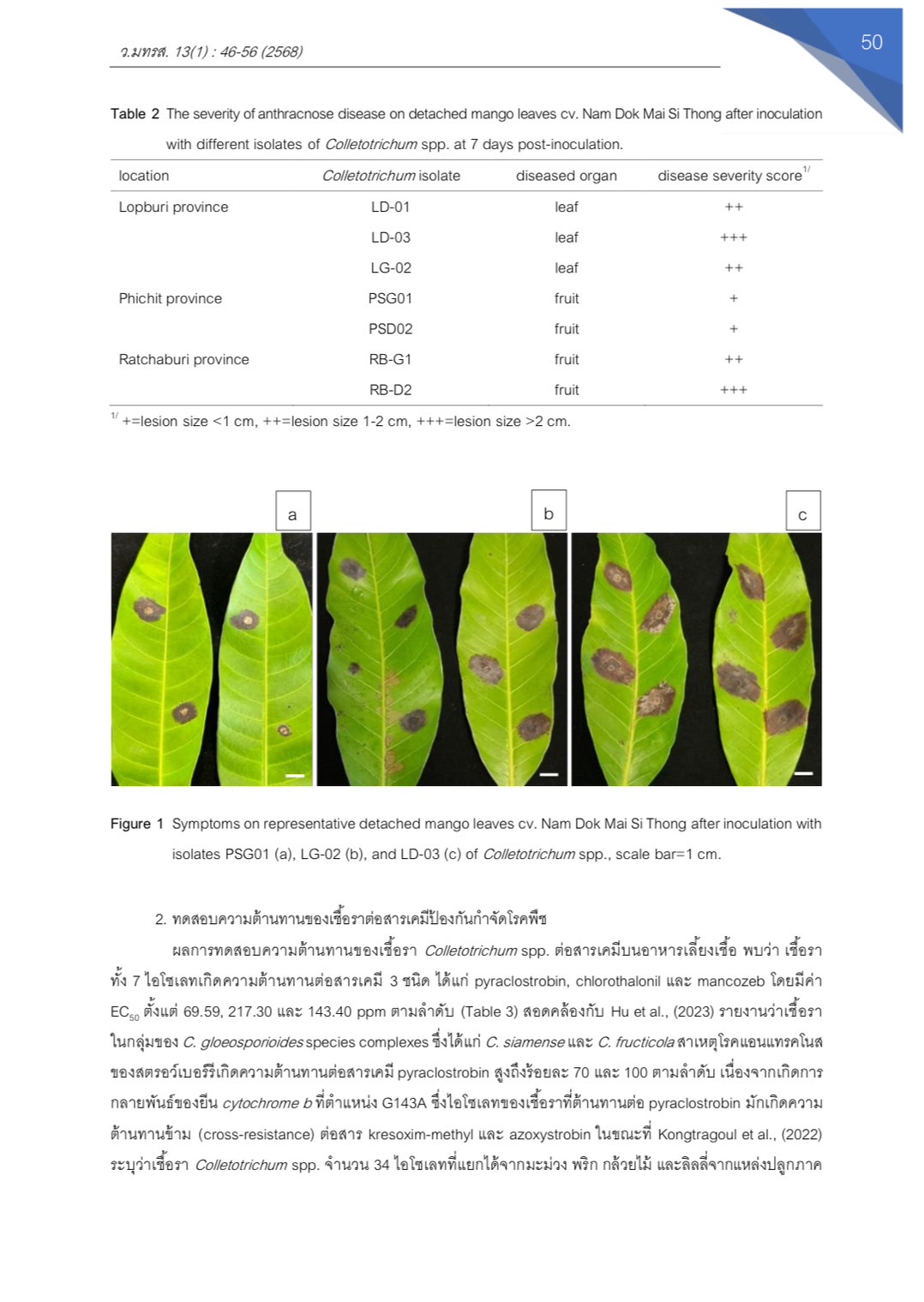
มะม่วงเป็นผลไม้ที่มีความสำคัญทางเศรษฐกิจชนิดหนึ่งต่อการส่งออกของประเทศไทย อย่างไรก็ตามการผลิตมะม่วงมักประสบปัญหาจากโรคแอนแทรคโนสที่มีสาเหตุจากเชื้อรา Colletotrichum spp. ทำให้เกิดการสูญเสียของผลผลิตทั้งปริมาณและคุณภาพ การควบคุมโรคมักนิยมใช้สารเคมีเป็นหลัก แต่บ่อยครั้งไม่สามารถควบคุมโรคได้ เนื่องจากเชื้อราเกิดการพัฒนาความต้านทานต่อสารเคมีขึ้น งานวิจัยนี้ จึงมีวัตถุประสงค์เพื่อทดสอบการก่อโรคของเชื้อราที่แยกได้และประเมินความต้านทานต่อสารเคมีป้องกันกําจัดเชื้อราของเชื้อราก่อโรคในสภาพห้องปฏิบัติการ โดยใช้เชื้อราจำนวน 7 ไอโซเลทจากแหล่งปลูกมะม่วงพันธุ์น้ำดอกไม้สีทอง 3 แหล่ง คือ จังหวัดลพบุรี พิจิตรและราชบุรี จากผลการทดลองพบว่าเชื้อราทุกไอโซเลทสามารถก่อให้เกิดโรคบนใบมะม่วงพันธุ์น้ำดอกไม้สีทอง โดย 2 ไอโซเลท คือ LD-03 (ลพบุรี) และ RB-D2 (ราชบุรี) ก่อให้เกิดโรครุนแรงที่สุด โดยมีขนาดแผลมากกว่า 2 เซนติเมตร เมื่อประเมินความต้านทานต่อสารเคมีของเชื้อราทั้ง 7 ไอโซเลท พบว่าทุกไอโซเลทเกิดความต้านทาน (R) ต่อสารเคมี 3 ชนิด ได้แก่ pyraclostrobin, chlorothalonil และ mancozeb โดยมีค่า EC50 ตั้งแต่ 69.59, 217.30 และ 143.40 ไมโครกรัมต่อมิลลิลิตร ตามลำดับ ในขณะที่ 3 ไอโซเลท ได้แก่ LD-03 (ลพบุรี), PSG01 (พิจิตร) และ RB-G1 (ราชบุรี) เกิดความต้านทานปานกลาง (MR) ต่อสารเคมี difenoconazole โดยมีค่า EC50 ตั้งแต่ 16.72-34.14 ไมโครกรัมต่อมิลลิลิตร และมี 1 ไอโซเลท คือ PSD02 (พิจิตร) เกิดความต้านทาน (R) ต่อสารเคมี 2 ชนิด ได้แก่ difenoconazole และ prochloraz โดยมีค่า EC50 มากกว่า 1000 และ 155.20 ไมโครกรัมต่อมิลลิลิตร ตามลำดับ สำหรับสารเคมีที่เชื้อราก่อโรคส่วนใหญ่ยังแสดงความอ่อนแอ (S) อยู่ คือ prochloraz โดยมีค่า EC50 ตั้งแต่ 0.28-5.37 ไมโครกรัมต่อมิลลิลิตร ซึ่งข้อมูลที่ได้จากการทดลองในครั้งนี้ควรจะนำไปทดสอบบนต้นมะม่วงในสภาพโรงเรือนหรือแปลงทดลองเพื่อยืนยันความมีประสิทธิภาพของสารเคมี prochloraz ก่อนที่จะแนะนำให้มีการใช้ในแหล่งปลูกของ 3 จังหวัดต่อไป
Article Details

อนุญาตภายใต้เงื่อนไข Creative Commons Attribution-NonCommercial-NoDerivatives 4.0 International License.
ต้นฉบับที่ได้รับการตีพิมพ์ถือเป็นสิทธิของเจ้าของต้นฉบับและของวารสารวิชาการ มทร.สุวรรณภูมิ เนื้อหาบทความในวารสารเป็นแนวคิดของผู้แต่ง มิใช่เป็นความคิดเห็นของคณะกรรมการการจัดทำวารสาร และมิใช่ความรับผิดชอบของมหาวิทยาลัยเทคโนโลยีราชมงคลสุวรรณภูมิ
เอกสารอ้างอิง
Batista, D. D. C., Alves-Júnior, M., Barbosa, M. A. G., Peruch, L. A. M., & Barbosa, M. A. G. (2023). Effects of agricultural practices and fungicides on the management postharvest anthracnose and stem-end rot of mango. Australian Journal of Crop Science, 17(9), 677-683. https://doi.org/10.21475/ajcs.23.17.09.p3910
Cao, X., Xu, X., Che, H., West, J. S., & Luo, D. (2017). Distribution and fungicide sensitivity of Colletotrichum species complexes from rubber tree in Hainan, China. Plant Disease, 101(10), 1774-1780. https://doi.org/10.1016/j.cropro.2024.107034
Chen, S. N., Luo, C. X., Hu, M. J., & Schnabel, G. (2016). Sensitivity of Colletotrichum species, including C. fioriniae and C. nymphaeae, from peach to demethylation inhibitor fungicides. Plant Disease, 100(12), 2435-2441. https://doi.org/10.1016/j.pestbp.2022.105049
Department of Agricultural Extension. (2022). Guideline document No. 3/2022: Quality mango production for export. https://mediatank.doae.go.th/medias/file_upload/12-2022/3-1751705114510091.pdf (in Thai)
Dethoup, T., Kaewkrajay, C., & Nujthet, Y. (2024). Field efficacy in controlling mango diseases of antagonist Talaromyces tratensis KUFA 0091 in fresh and dry formulations. European Journal of Plant Pathology, https://doi.org/10.1007/s10658-024-02853-w
Dofuor, A. K., Quartey, N. K. A., Osabutey, A. F., Antwi-Agyakwa, A. K., Asante, K., Boateng, B. O., Ablormeti, F. K., Lutuf, H., Osei-Owusu, J., Osei, J. H. N., Ekloh, W., Loh, S. K., Honger, J. O., Aidoo, O. F., & Ninsin, K. D. (2023). Mango anthracnose disease: the current situation and direction for future research. Frontiers in Microbiology, 14, 1168203. https://doi.org/10.3389/fmicb.2023.1168203
FRAC. (2024, May 23). Fungicide Resistance Action Committee Code List©. https://www.frac.info/docs/default-source/publications/frac-code-list/frac-code-list-2024.pdf
Gama, A. B., Baggio, J. S., Rebello, C. S., Lourenço, S. D. A., Gasparoto, M. C. D. G., Junior, G. J. D. S., Peres, N. A., & Amorim, L. (2020). Sensitivity of Colletotrichum acutatum isolates from citrus to carbendazim, difenoconazole, tebuconazole, and trifloxystrobin. Plant Disease, 104, 1621-1628. https://doi.org/10.1094/PDIS-10-19-2195-RE
Grice, K. R. E., Bally, I. S. E., Wright, C. L., Maddox, C., Ali, A., & Dillon, N. L. (2023). Mango germplasm screening for the identification of sources of tolerance to anthracnose. Australasian Plant Pathology, 52, 27-41. https://doi.org/10.1007/s13313-022-00899-0
Hu, S., Zhang, S., Xiao, W., Liu, Y., Yu, H., & Zhang, C. (2023). Diversity and characterization of resistance to pyraclostrobin in Colletotrichum spp. from strawberry. Agronomy, 13, 2824. https://doi.org/10.3390/agronomy
Ishi, H., Bryson, P. K., Kayamori, M., Miyamoto, T., Yamaoka, Y., & Schnabel, G. (2021). Cross-resistance to the new fungicide mefentrifluconazole in DMI-resistant fungal pathogens. Pesticide Biochemistry and Physiology, 171, 104737. https://doi.org/10.1016/j.pestbp.2020.104737
Jenny, F., Sultana, N., Islam, M. M., Khandaker, M. M., & Bhuiyan, M. A. B. (2019). A review on anthracnose of mango caused by Colletotrichum gloeosporioides. Bangladesh Phytopathological Society, 35(1&2), 65-74. https://bps.net.bd/wp-content/uploads/2020/12/10.-A-REVIEW-ON-ANTHRACNOSE-OF-MANGO-CAUSED-BY-COLLETOTRICHUM-GLOEOSPORIOIDES.pdf
Jones, J. G., Korir, R. C., Walter, T. L., & Everts, K. L. (2020). Reducing chlorothalonil use in fungicide spray programs for powdery mildew, anthracnose, and gummy stem blight in melons. Plant Disease, 104, 3213-3220. https://doi.org/10.1094/PDIS-04-20-0712-RE
Kannan, R., & Dhivya, V. (2023). In-vitro effect of different abiotic stresses on the growth and sporulation of Colletotrichum gloeosporioides causing anthracnose of mango. Indian Journal of Agricultural Research, 57(2), 261-265. https://doi.org/10.18805/IJARe.A-5916
Keeratirawee, K., & Kongtragoul, P. (2023). Synergistic effect of salicylhydroxamic acid in quinone outside inhibitor fungicides and its sensitivity on fruit rot pathogens. Acta Horticulturae, 1396. https://doi.org/10.17660/ActaHortic.2024.1396.17
Kongtragoul, P., Imamoto, K., & Ishii, H. (2020). Resistance to quinone-outside inhibitor (QoI) fungicides in Colletotrichum species isolated from anthracnose disease occurring in Thailand. Current Applied Science and Technology, 20(1), 79-89. https://doi.org/10.14456/cast.1477.8
Kongtragoul, P., Somnuek, S., Udompongsuk, M., Prasom, P., & Jaenaksorn, T. (2022). Cross-resistance to benzimidazole group and mancozeb fungicides in Colletotrichum spp. causing anthracnose disease. Science and Technology Asia, 27(4), 400-408. https://doi.org/10.14456/scitechasia.2022.95
Miguez, M., Reeve, C., Wood, P. M., & Hollomon, D. W. (2004). Alternative oxidase reduces the sensitivity of Mycosphaerella graminicola to QOI fungicides. Pest Management Science, 60(1), 3-7. https://doi.org/10.1002/ps.837
Moral, J., Agustí-Brisach, C., Agalliu, G., de Oliveira, R., Pérez-Rodríguez, M., Roca, L. F., Romero, J., & Trapero, A. (2018). Preliminary selection and evaluation of fungicides and natural compounds to control olive anthracnose caused by Colletotrichum species. Crop Protection, 114, 167-176. https://doi.org/10.1016/j.cropro.2018.08.033
Nelson, S. C. (2008). Mango anthracnose (Colletotrichum gloeosporioides). Cooperative Extension Service, Plant Disease, PD-48. https://scholarspace.manoa.hawaii.edu/server/api/core/bitstreams/10b3cac5-3241-44e8-b562-d1d2df17f6a9/content
Nuchnuanrat, P., & Jitsatta, N. (2021). Evaluation of fungicide carbendazim resistance in Colletotrichum gloeosporioides causing anthracnose disease of mango cv. Aokrong in Chanthaburi province. RMUTSB Academic Journal, 9(2), 164-173. https://li01.tci-thaijo.org/index.php/rmutsb-sci/article/view/250724/173070 (in Thai)
Pate, E. (2024). Suggestions for anthracnose management in strawberries. https://onfruit.ca/wp-content/uploads/2024/05/2024-Anthracnose-Management-Suggestions.pdf
Ross, L. N., & Woodward, J. F. (2016). Koch’s postulates: An interventionist perspective. Studies in History and Philosophy of Biological and Biomedical Sciences, 59, 35-46. https://doi.org/10.1016/j.shpsc.2016.06.001
Tongsri, V., Nianwichai, P., Sichai, K., Songkumarn, P., Suttiviriya, P., & Kongtragoul, P. (2023). Sensitivity tests of dimethomorph, ethaboxam and etridiazole on Phytophthora palmivora causing stem rot and leaf blight of durian in eastern Thailand. Agriculture and Natural Resources, 57(4), 559-568. https://doi.org/10.34044/j.anres.2023.57.4.01
Usman, H. M., Tan, Q., Karim, M. M., Adnan, M., Yin, W. X., Zhu, F. X., & Luo, C. X. (2021). Sensitivity of Colletotrichum fructicola and Colletotrichum siamense of peach in China to multiple classes of fungicides and characterization of pyraclostrobin-resistant isolates. Plant Disease, 105, 3459-3465. https://doi.org/10.1094/PDIS-04-21-0693-RE
Wang, S., Wang, X., He, Q., Lin, H., Chang, H., Liu, Y., Suna, H., & Song, X. (2022). Analysis of the fungicidal efficacy, environmental fate, and safety of the application of a mefentrifluconazole and pyraclostrobin mixture to control mango anthracnose. Journal of the Science of Food and Agriculture, 103, 400-410. https://doi.org/10.1002/jsfa.12154
