
อิทธิพลของแอนไอโซทรอปิกที่มีผลต่อความสามารถในการขึ้นรูปของโลหะแผ่นด้วยการทดสอบการขยายรู
Article Sidebar
Main Article Content
บทคัดย่อ
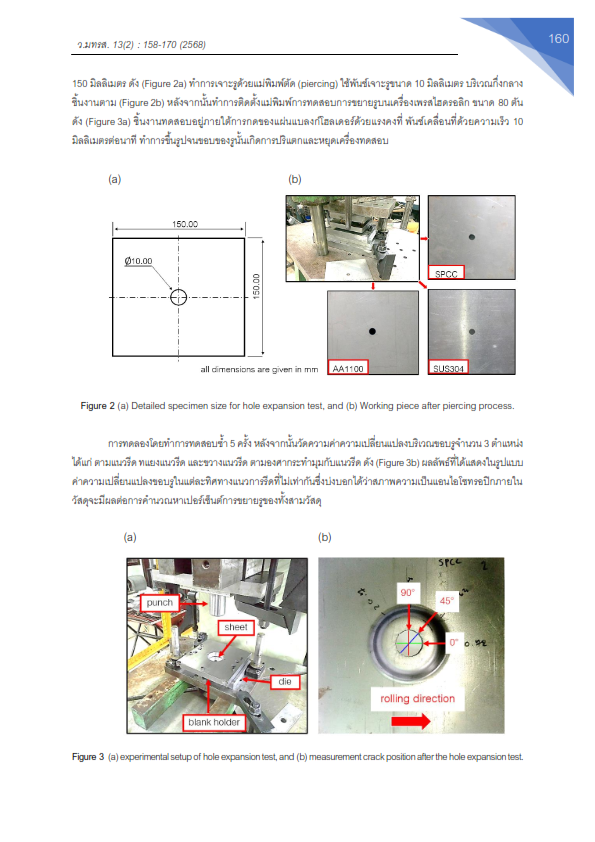
งานวิจัยนี้มีวัตถุประสงค์เพื่อศึกษาผลกระทบของพฤติกรรมแอนไอโซโทรปิกของวัสดุที่มีผลต่อค่าอัตราส่วนการขยายรู (hole expansion ratio: HER) ของโลหะแผ่นเหล็กกล้าคาร์บอนรีดเย็น เกรด SPCC เหล็กกล้าไร้สนิม เกรด SUS304 และอะลูมิเนียม เกรด AA1100 ความหนา 1.20 มิลลิเมตร โดยการทดสอบการขยายรู (hole expansion test) ตามมาตรฐาน ISO-16630 มีพันช์ทรงกระบอกขนาดเส้นผ่านศูนย์กลาง 50 มิลลิเมตร แบบปลายตัดและแบบกรวย 60 องศา ใช้ร่วมกับดายขนาดเส้นผ่านศูนย์กลาง 52.70 มิลลิเมตร และมีแผ่นชิ้นงานทดสอบขนาด 150×150 มิลลิเมตร เจาะรูตรงกลางขนาด 10 มิลลิเมตร หลังจากการทดสอบขึ้นรูปชิ้นงานจนปริแตกวัดขนาดรูเจาะของชิ้นงานทดสอบที่เปลี่ยนแปลงไปเป็นค่าอัตราส่วนการขยายรูที่ได้จากการทดลองเปรียบเทียบกับค่าอัตราส่วนการขยายรูบนพื้นฐานเกณฑ์การครากแอนไอโซทรอปิกของ Hill’48 และวัดค่าความเครียดหลักและรอง (major and minor strains) ในทิศทางของชิ้นทดสอบตามแนวการรีด ทแยงแนวรีดและขวางแนวรีดตามลำดับ (rolling, diagonal and transverse rolling) เพื่อหาค่าอัตราส่วนการขยายรูแบบแอนไอโซทรอปิกและพฤติกรรมความเป็นแอนไอโซโทรปิกของวัสดุบนแผ่นภาพขีดจำกัดการขึ้นรูป ผลการวิจัยพบว่า การทดสอบการขยายรูด้วยพันช์แบบปลายตัดและแบบกรวย 60 องศา ที่ 0, 45 และ 90 องศา กับทิศทางแนวรีด วัสดุ SPCC มีค่าอัตราส่วนการขยายรู เท่ากับ 112.72, 100.56, 115.96, 150.24, 141.16 และ 152.92 เปอร์เซ็นต์ ตามลำดับ วัสดุ SUS304 มีค่าอัตราส่วนการขยายรู เท่ากับ 30.04, 44.48, 32.36, 38.76, 51.48 และ 39.12 เปอร์เซ็นต์ ตามลำดับ และวัสดุ AA1100 มีค่าอัตราส่วนการขยายรูเท่ากับ 15.68, 20.78, 20.22, 20.65, 22.48 และ 23.65 เปอร์เซ็นต์ ตามลำดับ
Article Details

อนุญาตภายใต้เงื่อนไข Creative Commons Attribution-NonCommercial-NoDerivatives 4.0 International License.
ต้นฉบับที่ได้รับการตีพิมพ์ถือเป็นสิทธิของเจ้าของต้นฉบับและของวารสารวิชาการ มทร.สุวรรณภูมิ เนื้อหาบทความในวารสารเป็นแนวคิดของผู้แต่ง มิใช่เป็นความคิดเห็นของคณะกรรมการการจัดทำวารสาร และมิใช่ความรับผิดชอบของมหาวิทยาลัยเทคโนโลยีราชมงคลสุวรรณภูมิ
เอกสารอ้างอิง
Abedini, A., Narayanan, A., & Butcher, C. (2024). On the flat punch hole expansion test of sheet metals: Mechanics of deformation and evaluation of anisotropic plasticity models. Mechanics of Materials, 191, 104931. https://doi.org/10.1016/j.mechmat.2024.104931
Barlat, F., Brem, J. C., Yoon, J. W., Chung, K., Dick, R. E., Lege, D. J., Pourboghrat, F., Choi, S. H., & Chu, E. (2003). Plane stress yield function for aluminum alloy sheets—part 1: Theory. International Journal of Plasticity, 19(9), 1297-1319. https://doi.org/10.1016/S0749-6419(02)00019-0
Belytschko, T., & Tsay, C. S. (1983). A stabilization procedure for the quadrilateral plate element with one‐point quadrature. International Journal for Numerical Methods in Engineering, 19(3), 405-419. https://doi.org/10.1002/nme.1620190308
Chaimongkon, T., Panich, S., & Uthaisangsuk, V. (2021). Anisotropic fracture forming limit curve and its applications for sheet metal forming with complex strain paths of aluminum sheet. The International Journal of Advanced Manufacturing Technology, 115(11), 3553-3577. https://doi.org/10.1007/s00170-021-07357-z
Chinara, M., Paul, S. K., Chatterjee, S., & Mukherjee, S. (2021). Effect of planar anisotropy on the hole expansion ratio of cold-rolled DP 590 steel. Transactions of the Indian Institute of Metals, 75, 535-543. https://doi.org/10.1007/s12666-021-02444-x
Hill, R. (1948). A theory of the yielding and plastic flow of anisotropic metals. Proceedings of the Royal Society A: Mathematical and Physical Sciences, 193(1033), 281-297. https://doi.org/10.1098/rspa.1948.0045
Kacem, A., Krichen, A., & Manach, P. Y. (2015). Finite element analysis of hole-flanging process with various anisotropy assumptions. The International Journal of Advanced Manufacturing Technology, 80, 11-19. https://doi.org/10.1007/s00170-015-6980-y
Korkolis, Y. P., Brownell, B., Coppieters, S., & Tian, H. (2016). Modeling of hole-expansion of AA6022-T4 aluminum sheets with anisotropic non-quadratic yield functions. Journal of Physics: Conference Series, 734, 032083. https://doi.10.1088/1742-6596/734/3/032083
Kuwabara, T., Hashimoto, K., Iizuka, E., & Yoon, J. W. (2011). Effect of anisotropic yield functions on the accuracy of hole expansion simulations. Journal of Materials Processing Technology, 211(3), 475-481. https://doi.org/10.1016/j.proeng.2014.10.346
Kuwabara, T., Mori, T., Asano, M., Hakoyama, T., & Barlat, F. (2017). Material modeling of 6016-O and 6016-T4 aluminum alloy sheets and application to hole expansion forming simulation. International Journal of Plasticity, 93, 164-186. https://doi.org/10.1016/j.ijplas.2016.10.002
Iizuka, E., Hashimoto, K., & Kuwabara, T. (2014). Effects of anisotropic yield functions on the accuracy of forming simulations of hole expansion. Procedia Engineering, 81, 2433-2438. https://doi.org/10.1016/j.proeng.2014.10.346
Park, H. S., Barlat, F., & Lee, S. Y. (2023). Comparison of anisotropic yield functions and calibrations for accurate thickness prediction in hole expansion test. Journal of Materials Processing Technology, 319, 118070. https://doi.org/10.1016/j.jmatprotec.2023.118070
Park, S., Jung, J., Cho, W., Jeong, B. S., Na, H., Kim, S. I., Lee, M. G., & Han, H. N. (2021). Predictive dual-scale finite element simulation for hole expansion failure of ferrite-bainite steel. International Journal of Plasticity, 136, 102900. https://doi.org/10.1016/j.ijplas.2020.102900
Pathak, N., Butcher, C., & Worswick, M. (2016). Assessment of the critical parameters influencing the edge stretchability of advanced high-strength steel sheet. Journal of Materials Engineering and Performance, 25(11), 4919-4932. https://doi.org/10.1007/s11665-016-2316-9
Paul, S. K. (2020a). A critical review on hole expansion ratio. Materialia, 9, 100566. https://doi.org/10.1016/j.mtla.2019.100566
Paul, S. K. (2020b). Effect of punch geometry on hole expansion ratio. Proceedings of the Institution of Mechanical Engineers, Part B: Journal of Engineering Manufacture, 234(3), 671-676. https://doi.org/10.1177/0954405419863222
Soussi, H., & Krichen, A. (2019). Plastic anisotropy effect on forming kinematics of the hole-flanging process. The International Journal of Advanced Manufacturing Technology, 101, 733-746. https://doi.org/10.1007/s00170-018-2974-x
Yoshida, F., Hamasaki, H., & Uemori, T. (2013). A user-friendly 3D yield function to describe anisotropy of steel sheets. International Journal of Plasticity, 45, 119-139. https://doi.org/10.1016/j.ijplas.2013.01.010
Yu, X., Chen, J., & Chen, J. (2016). Interaction effect of cracks and anisotropic influence on degradation of edge stretchability in hole-expansion of advanced high strength steel. International Journal of Mechanical Sciences, 105, 348-359. https://doi.org/10.1016/j.ijmecsci.2015.11.026
