
ผลกระทบของระยะเวลาการบ่มคอนกรีตที่อุณหภูมิสูงต่อกำลังอัดของคอนกรีต
Article Sidebar
Main Article Content
บทคัดย่อ
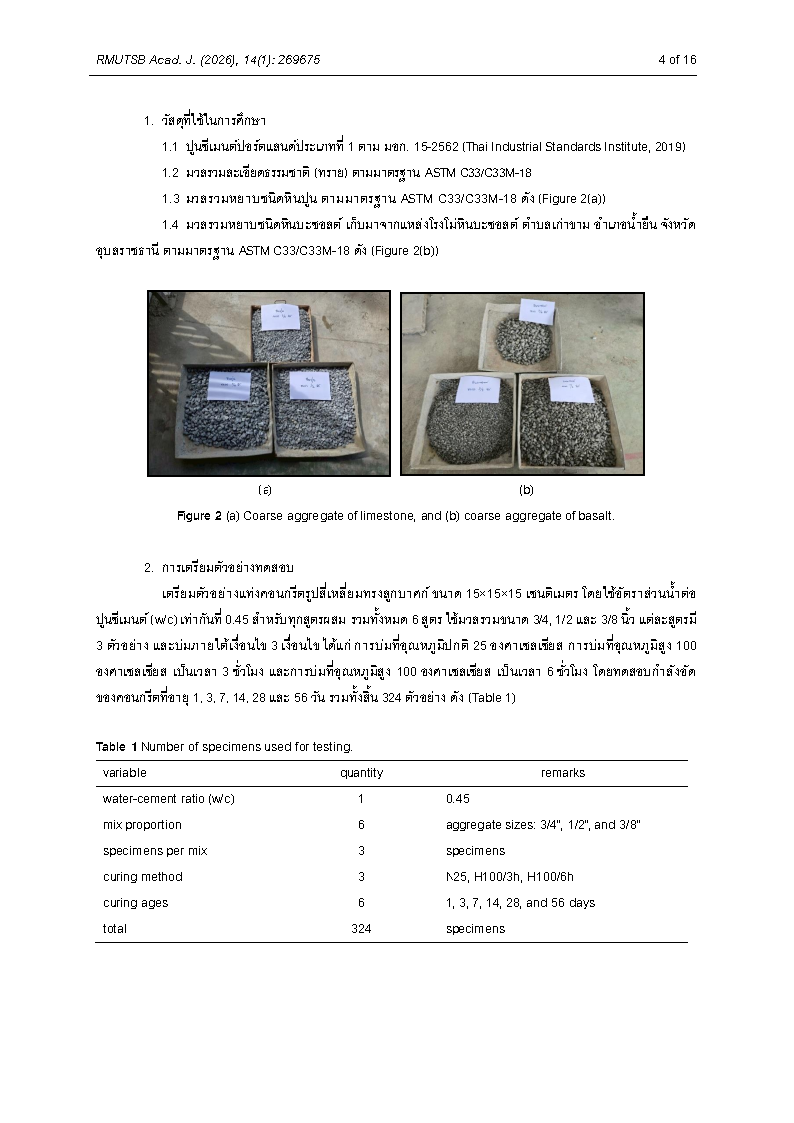
คอนกรีตเป็นวัสดุก่อสร้างสำคัญในงานวิศวกรรมโยธาเนื่องจากมีความแข็งแรงและทนทาน อย่างไรก็ตาม สมบัติทางกลของคอนกรีตอาจเปลี่ยนแปลงเมื่ออยู่ภายใต้อุณหภูมิสูง โดยเฉพาะในส่วนของมวลรวมหยาบ ซึ่งการใช้หินปูนอาจส่งผลให้กำลังอัดลดลงและเกิดรอยแตกร้าว ขณะที่หินบะซอลต์มีความหนาแน่นสูงและทนต่อความร้อน จึงมีศักยภาพในการเพิ่มกำลังอัดของคอนกรีต งานวิจัยนี้มีวัตถุประสงค์เพื่อศึกษาผลของระยะเวลาการบ่มที่อุณหภูมิสูงต่อกำลังอัดของคอนกรีตที่ใช้หินบะซอลต์เป็นมวลรวมหยาบตัวอย่างคอนกรีตทรงลูกบาศก์ขนาด 15×15×15 เซนติเมตร ถูกทดสอบกำลังอัด ที่อายุ 1‚ 3‚ 7‚ 14‚ 28 และ 56 วัน ภายใต้การบ่ม 3 เงื่อนไข ได้แก่ การบ่มที่อุณหภูมิปกติ 25 องศาเซลเซียส การบ่มที่อุณหภูมิสูง 100 องศาเซลเซียส เป็นเวลา 3 และ 6 ชั่วโมง โดยควบคุมอัตราส่วนน้ำต่อซีเมนต์ (w/c) เท่ากับ 0.45 และใช้มวลรวมหยาบขนาด 3/4, 1/2 และ 3/8 นิ้ว จากผลการศึกษาพบว่าคอนกรีตที่ใช้หินบะซอลต์ให้ค่ากำลังอัดสูงกว่าคอนกรีตที่ใช้หินปูนอย่างต่อเนื่องในทุกช่วงอายุและทุกเงื่อนไขการบ่ม โดยเฉพาะที่อายุ 7 และ 28 วัน ซึ่งมีกำลังอัดสูงกว่าประมาณร้อยละ 10-22 ทั้งนี้ที่อายุ 7 วัน สูงกว่าประมาณร้อยละ 10-18 และเพิ่มขึ้นเป็นร้อยละ 15-22 ที่อายุ 28 วัน เนื่องจากอุณหภูมิสูงช่วยเร่งปฏิกิริยาการไฮเดรชันของซีเมนต์ และหินบะซอลต์มีความแข็งแรงและทนต่อความร้อน ส่งผลให้คอนกรีตสามารถรับแรงอัดได้สูงขึ้น งานวิจัยนี้สามารถนำไปใช้เป็นแนวทางในการออกแบบคอนกรีตกำลังสูงระยะต้นภายใต้สภาพแวดล้อมอุณหภูมิสูงได้อย่างเหมาะสม
Article Details

อนุญาตภายใต้เงื่อนไข Creative Commons Attribution-NonCommercial-NoDerivatives 4.0 International License.
ต้นฉบับที่ได้รับการตีพิมพ์ถือเป็นสิทธิของเจ้าของต้นฉบับและของวารสารวิชาการ มทร.สุวรรณภูมิ เนื้อหาบทความในวารสารเป็นแนวคิดของผู้แต่ง มิใช่เป็นความคิดเห็นของคณะกรรมการการจัดทำวารสาร และมิใช่ความรับผิดชอบของมหาวิทยาลัยเทคโนโลยีราชมงคลสุวรรณภูมิ
เอกสารอ้างอิง
Al-Baijat, H. M. (2008). The use of basalt aggregates in concrete mixes in Jordan. Jordan Journal of Civil Engineering, 2(1), 63-70. https://files01.core.ac.uk/download/pdf/234698246.pdf
ASTM International. (2014a). ASTM C131/C131M-14: Standard test method for resistance to degradation of small-size coarse aggregate by abrasion and impact in the Los Angeles Machine. ASTM International. https://www.astm.org/c0131_C0131M-14.html
ASTM International. (2014b). ASTM C136/C136M-14: Standard test method for sieve analysis of fine and coarse aggregates. ASTM International. https://www.astm.org/c0136_C0136M-14.html
ASTM International. (2015a). ASTM C127/C127M-15: Standard test method for relative density (specific gravity) and absorption of coarse aggregate. West Conshohocken, PA: ASTM International. https://www.astm.org/c0127-15.html
ASTM International. (2015b). ASTM C128/C128M-15: Standard test method for relative density (specific gravity) and absorption of fine aggregate. ASTM International. https://www.astm.org/c0128-15.html
ASTM International. (2017). ASTM C29/C29M-17: Standard test method for bulk density (“unit weight”) and voids in aggregate. ASTM International. https://www.astm.org/c0029_C0029M-17.html
ASTM International. (2018). ASTM C33/C33M-18: Standard specification for concrete aggregates. ASTM International. https://store.astm.org/c0033_c0033m-18.html
ASTM International. (2020a). ASTM C39/C39M-20: Standard test method for compressive strength of cylindrical concrete specimens. ASTM International. https://www.astm.org/c0039_c0039m-20.html
ASTM International. (2020b). ASTM C143/C143M-20: Standard test method for slump of hydraulic-cement concrete. ASTM International. https://www.astm.org/c0143_C0143M-20.html
ASTM International. (2020c). ASTM C171/C171M 20: Standard specification for sheet materials for curing concrete. ASTM International. https://www.astm.org/c0171-20.html
Google Earth. (2026). Satellite image of basalt quarry area in Kao Kham Subdistrict, Nam Yuen District, Ubon Ratchathani Province. from https://earth.google.com/
Jha, S., Duggal, P., & Agarwal, C. (2016). To study the durability aspects of concrete using basalt aggregate. Indian Journal of Science and Technology, 9(30), 23-37. https://doi.org/10.17485/ijst/2016/v9i30/99203
Kishore, I. S., Mounika, L., Prasad, C. M., & Krishna, B. H. (2015). Experimental study on the use of basalt aggregate in concrete mixes. International Journal of Civil Engineering, 2(4), 37-40. https://doi.org/10.14445/23488352/IJCE-V2I4P107
Masood, A., Shariq, M., Alam, M. M., Ahmad, T., & Beg, A. (2018). Effect of elevated temperature on the residual properties of quartzite, granite and basalt aggregate concrete. Journal of the Institution of Engineers (India): Series A, 99(3), 485-494. https://doi.org/10.1007/s40030-018-0307-6
Rahmouni, Z. E. A., & Tebbal, N. (2020). Mechanical behavior of high-performance concrete under thermal effect. In Compressive Strength of Concrete. IntechOpen. https://doi.org/10.5772/intechopen.89916
Sethabut, C. (2003). Concrete technology (12th eds.). Product and Construction Materials. (in Thai)
Tang, Y., Su, H., Huang, S., Qu, C., & Yang, J. (2017). Effect of curing temperature on the durability of concrete under highly geothermal environment. Advances in Materials Science and Engineering, 2017(1), 7587853. https://doi.org/10.1155/2017/7587853
Thai Industrial Standards Institute. (2019). Thai Industrial Standard TIS 15: Portland cement industrial product. Thai Industrial Standards Institute, Ministry of Industry. (in Thai)
Tufail, M., Shahzada, K., Gencturk, B., & Wei, J. (2017). Effect of elevated temperature on mechanical properties of limestone, quartzite and granite concrete. International Journal of Concrete Structures and Materials, 11(1), 17-28. https://doi.org/10.1007/s40069-016-0175-2
Ubi, S. E., Nkra, P. O., Agbor, R. B., Ewa, D. E., & Nuchal, M. (2020). Efficacy of basalt and granite as coarse aggregate in concrete mixture. International Journal of Engineering Technologies and Management Research, 7(9), 1-9. https://doi.org/10.29121/ijetmr.v7.i9.2020.769
Yazıcıoglu, S., Tugla, R., Ay, S., & Demirel, B. (2018). Effect of high temperature on compressive strength of concrete prepared using different types of aggregates. In International Sustainable Buildings Symposium (pp. 425-434). Cham: Springer International Publishing. https://doi.org/10.1007/978-3-319-63709-9_34
Yenprasert, N., & Duangchan, A. (2021). The study of properties of lightweight concrete containing aluminum powder. RMUTSB Academic Journal, 9(1), 83-91. https://li01.tci-thaijo.org/index.php/rmutsb-sci/article/view/248711 (in Thai)
Zeyad, A. M., Tayeh, B. A., Adesina, A., de Azevedo, A. R., Amin, M., Hadzima-Nyarko, M., & Agwa, I. S. (2022). Review on effect of steam curing on behavior of concrete. Cleaner Materials, 3, 100042. https://doi.org/10.1016/j.clema.2022.100042
