
ผลของวัสดุปลูกผสมใบทุเรียนร่วมกับมูลไก่และมูลไส้เดือนต่อการเจริญเติบโตและผลผลิตของผักกาดหอมพันธุ์เรดโอ๊ค
Article Sidebar
Main Article Content
บทคัดย่อ
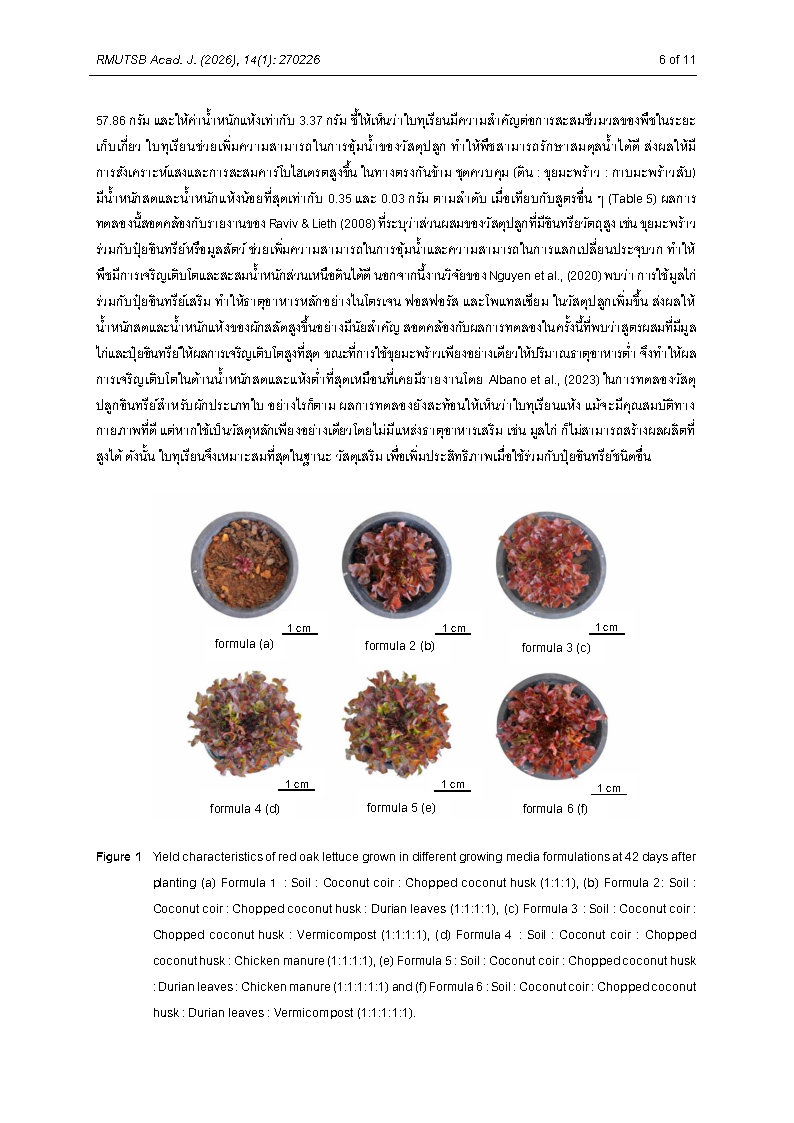
งานวิจัยนี้มีวัตถุประสงค์เพื่อศึกษาศักยภาพของวัสดุเหลือใช้ทางการเกษตรในท้องถิ่นได้แก่ ขุยมะพร้าว กาบมะพร้าวสับ ใบทุเรียน ปุ๋ยมูลไส้เดือน และปุ๋ยมูลไก่ ในการพัฒนาสูตรวัสดุปลูกที่เหมาะสมต่อการเจริญเติบโตและผลผลิตของผักสลัดเรดโอ๊ค โดยวางแผนการทดลองแบบสุ่มสมบูรณ์ (CRD) จำนวน 6 สูตร 5 ซ้ำ ใช้ส่วนผสมพื้นฐาน ชุดควบคุม (สูตรที่ 1) คือ ดิน:ขุยมะพร้าว:กาบมะพร้าวสับ และเสริมวัสดุอื่นเพิ่มเติม ได้แก่ ใบทุเรียน (สูตรที่ 2), ปุ๋ยมูลไส้เดือน (สูตรที่ 3), ปุ๋ยมูลไก่ (สูตรที่ 4), ปุ๋ยมูลไก่ร่วมกับใบทุเรียน (สูตรที่ 5) และปุ๋ยมูลไส้เดือนร่วมกับใบทุเรียน (สูตรที่ 6) วัสดุปลูกทุกสูตรผ่านการหมัก 60 วัน และเก็บข้อมูลการเจริญเติบโตที่ 42 วันหลังย้ายปลูก ผลการวิเคราะห์สมบัติทางเคมีหลังการหมักพบว่าวัสดุปลูกที่มีส่วนผสมของปุ๋ยมูลไก่มีค่าการนำไฟฟ้า และปริมาณธาตุอาหารหลัก สูงกว่ากรรมวิธีอื่นอย่างมีนัยสำคัญทางสถิติ ซึ่งส่งผลต่อการเจริญเติบโตของผักสลัดเรดโอ๊คภายใต้ระบบการผลิตแบบไม่ใช้ปุ๋ยเคมี โดยสูตรที่ 5 ให้ค่า ความสูงต้น จำนวนใบ เส้นผ่านศูนย์กลางลำต้น ความเขียวใบ น้ำหนักสดและน้ำหนักแห้งสูงที่สุด รองลงมา คือ สูตรที่ 4 ซึ่งไม่มีความแตกต่างกันทางสถิติ ในขณะที่ชุดควบคุมให้ค่าผลผลิตต่ำที่สุด สรุปได้ว่าสูตรวัสดุปลูกที่พัฒนาจากวัสดุเหลือใช้ โดยเฉพาะการใช้ปุ๋ยมูลไก่ร่วมกับใบทุเรียน มีศักยภาพเป็นวัสดุปลูกทางเลือกที่มีประสิทธิภาพ สามารถลดการพึ่งพาปุ๋ยเคมี และส่งเสริมการใช้ทรัพยากรอย่างคุ้มค่าและยั่งยืน
Article Details

อนุญาตภายใต้เงื่อนไข Creative Commons Attribution-NonCommercial-NoDerivatives 4.0 International License.
ต้นฉบับที่ได้รับการตีพิมพ์ถือเป็นสิทธิของเจ้าของต้นฉบับและของวารสารวิชาการ มทร.สุวรรณภูมิ เนื้อหาบทความในวารสารเป็นแนวคิดของผู้แต่ง มิใช่เป็นความคิดเห็นของคณะกรรมการการจัดทำวารสาร และมิใช่ความรับผิดชอบของมหาวิทยาลัยเทคโนโลยีราชมงคลสุวรรณภูมิ
เอกสารอ้างอิง
Albano, X., Whitmore, A. P., Sakrabani, R., Thomas, C. L., Sizmur, T., Ritz, K., Harris, J., Pawlett, M., Watts, C., & Haefele, S. M. (2023). Effect of different organic amendments on actual and achievable yields in a cereal-based cropping system. Journal of Soil Science and Plant Nutrition, 23(1), 45-62. https://doi.org/10.1007/s42729-023-01167-w
Altuntasş, Ö., Küçük, R., & Ersoy, L. (2019). The effect of chicken manure on plant growth, nutrient content and yield of lettuce. Biological and Chemical Research, 9, 9-18. https://www.ss-pub.org/wp-content/uploads/2022/04/BCR2022013101.pdf
Bahrun, A., Nur, R. Y., Santoso, E., Afa, L. O., Safuan, L. O., & Muhidin. (2020). Effect of durian shell (DS) biochar on growth and yield of field grown chilli (Capsicum annuum L.). Asian Journal of Crop Science, 12(1), 43-50. https://doi.org/10.3923/ajcs.2020.43.50
Bernal, M. P., Alburquerque, J. A., & Moral, R. (2009). Composting animal manures and chemical criteria for compost maturity assessment: A review. Bioresource Technology, 100, 5444-5453. https://doi.org/10.1016/j.biortech.2008.11.027
Department of Soil Science. (2022). Organic matter test kit for soil quality assessment. Kasetsart University, Thailand. https://www.soilscience.ku.ac.th
Edwards, C. A., Arancon, N. Q., & Sherman, R. (2011). Vermiculture technology: Earthworms, organic wastes, and environmental management. CRC Press. https://doi.org/10.1201/b10453
Edwards, C. A., & Bohlen, P. J. (1996). Biology and ecology of earthworms (3rd eds.). Chapman & Hall.
Havlin, J. L., Tisdale, S. L., Nelson, W. L., & Beaton, J. D. (2014). Soil fertility and fertilizers: An introduction to nutrient management (8th eds.). Pearson Education.
Kim, M. J., Moon, Y., Tou, J. C., Mou, B., & Waterland, N. L. (2016). Nutritional value, bioactive compounds and health benefits of lettuce (Lactuca sativa L.). Journal of Food Composition and Analysis, 49, 19-34. https://doi.org/10.1016/j.jfca.2016.03.004
Li, X., Zhang, Q., Li, L., & Chen, X. (2013). Interactions between compost, vermicompost and earthworms influence plant growth and yield: A one-year greenhouse experiment. Scientia Horticulturae, 160, 148-154. https://doi.org/10.1016/j.scienta.2013.05.042
Li, Q., Fu, C., Liang, C., Ni, X., Zhao, X., Chen, M., & Ou, L. (2022). Crop lodging and the roles of lignin, cellulose, and hemicellulose in lodging resistance. Agronomy, 12(8), 1795. https://doi.org/10.3390/agronomy12081795
Mahathaninwong, N., Wandee, S., Totwaree, N., & Romyen, P. (2022). Aerobic composting and vermicomposting of durian shell and citrus peel wastes. BioResources, 17(1), 1144-1160. https://doi.org/10.15376/biores.17.2.2345-2358
Marschner, P. (2012). Marschner's mineral nutrition of higher plants (3rd eds.). Academic Press.
Nguyen, T. T., Ngo, H. H., Guo, W., Chang, S. W., Nguyen, D. D., & Zhang, X. (2020). Effects of chicken manure and organic amendments on nutrient availability and growth performance of lettuce (Lactuca sativa L.). Journal of Cleaner Production, 256, 120406. https://doi.org/10.1016/j.jclepro.2020.120406
Priyadarshini, D., Priya, G., Kannan, A., Rani, B., Nair, R. V. R., Soumya, V. I., & Raj, A. (2025). Management of lignin-rich crop residue for soil health and sustainability. Journal of Advances in Biology & Biotechnology, 28(10), 1059-1077. https://doi.org/10.9734/jabb/2025/v28i103126
Raviv, M., & Lieth, J. H. (2008). Soilless culture: Theory and practice. Elsevier. https://doi.org/10.1016/B978-0-444-52975-6.X0001-5
Shah, S. H., Houborg, R., & McCabe, M. F. (2017). Response of chlorophyll, carotenoid and SPAD-502 measurement to salinity and nutrient stress in wheat (Triticum aestivum L.). Agronomy, 7, 1-21. https://doi.org/10.3390/agronomy7030061
Suriya-Arunroj, D., Chaiyawat, P., Fukai, S., & Blamey, P. (2000). Identification of nutrients limiting rice seedling growth in soils of northeast Thailand under water-limiting and non-limiting conditions. Kasetsart Journal: Natural Science (Thailand), 34(3), 323-331. https://doi.org/10.1626/pps.3.417
