
การประยุกต์ใช้ความเป็นจริงเสริมร่วมกับแบบจำลองสารสนเทศอาคารเพื่อการตรวจสอบงานก่อสร้างจริง: ข้อเสนอกระบวนการส่งมอบโครงการแบบใหม่
Article Sidebar
Main Article Content
บทคัดย่อ
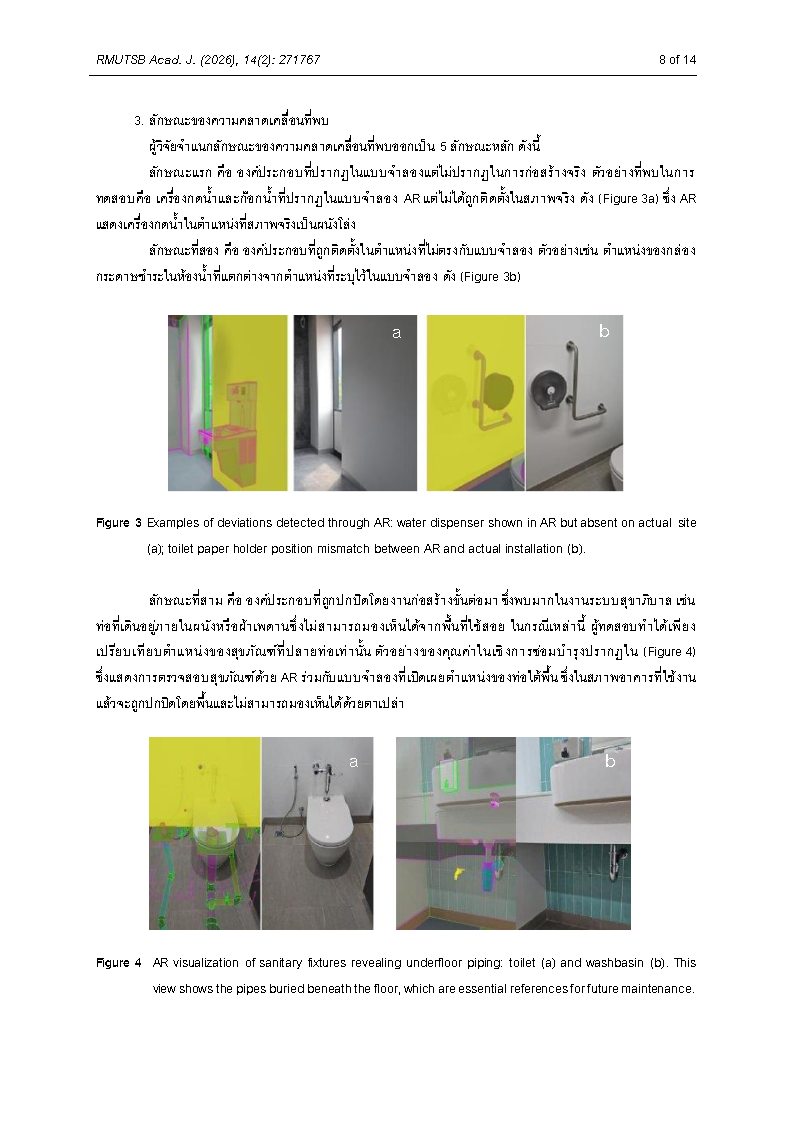
ขั้นตอนการส่งมอบโครงการก่อสร้างเป็นกิจกรรมสำคัญที่ต้องการการตรวจสอบความสอดคล้องระหว่างแบบจำลองดิจิทัลกับสภาพการก่อสร้างจริง แม้ว่าอุตสาหกรรมก่อสร้างไทยจะนำแบบจำลองสารสนเทศอาคาร (BIM) มาใช้อย่างแพร่หลาย แต่การตรวจสอบในขั้นการส่งมอบยังคงพึ่งพาการเปรียบเทียบบนหน้าจอคอมพิวเตอร์และความเชี่ยวชาญของผู้ปฏิบัติงานเป็นหลัก โดยยังขาดกระบวนการที่บูรณาการการตรวจสอบในอัตราส่วน 1:1 กับสภาพหน้างานเข้ากับกระบวนการส่งมอบอย่างเป็นระบบ งานวิจัยนี้มีวัตถุประสงค์เพื่อนำเสนอกระบวนการส่งมอบโครงการก่อสร้างรูปแบบใหม่ โดยบูรณาการเทคโนโลยีความเป็นจริงเสริม (AR) เข้ากับ BIM เพื่อสนับสนุนการตรวจสอบแบบจำลอง BIM ให้สอดคล้องกับสภาพการก่อสร้างจริง สำหรับการเตรียมความพร้อมในการส่งมอบโครงการในระดับ LOD 500 วิเคราะห์นัยยะเชิงปฏิบัติต่อเจ้าของอาคาร และเสนอเงื่อนไขการนำไปใช้ในบริบทอุตสาหกรรมก่อสร้างไทย การศึกษามีลักษณะเป็นการพิสูจน์แนวคิด (proof-of-concept) ร่วมกับการนำเสนอกระบวนการ (process proposal) โดยใช้อาคารกรณีศึกษาที่อยู่ระหว่างการก่อสร้าง พัฒนาแบบจำลอง BIM ในซอฟต์แวร์ Autodesk Revit ในระดับ LOD 400 ขึ้นไป แปลงเป็นไฟล์ IFC และแสดงผลผ่านแอปพลิเคชัน Gamma AR บนอุปกรณ์เคลื่อนที่ ทดสอบในจุดตรวจสอบ 48 จุด ครอบคลุมงานสถาปัตยกรรมและงานระบบสุขาภิบาล ผลการศึกษาเป็นการจำแนกเชิงคุณภาพ พบความคลาดเคลื่อนระหว่างแบบจำลองและสภาพจริง 5 ลักษณะหลัก ได้แก่ องค์ประกอบที่ปรากฏในแบบจำลองแต่ไม่มีในสภาพจริง ตำแหน่งติดตั้งไม่ตรง องค์ประกอบที่ถูกปกปิด ความคลาดเคลื่อนเชิงแนวของระบบท่อ และขนาดรูปร่างที่ต่างจากผลิตภัณฑ์จริง จากจุดตรวจสอบ 48 จุด พบความสอดคล้อง 32 จุด คิดเป็นร้อยละ 66.70 และพบความคลาดเคลื่อน 16 จุด คิดเป็นร้อยละ 33.30 โดยประเภทที่พบบ่อยที่สุดคือ องค์ประกอบที่ปรากฏในแบบจำลองแต่ไม่มีในสภาพจริง (5 จุด ร้อยละ 31.25) บนพื้นฐานของข้อค้นพบ งานวิจัยเสนอ 4 บทบาทของ AR ได้แก่ เครื่องมือตรวจสอบระหว่างก่อสร้าง กลไกยืนยันความพร้อมในการส่งมอบ LOD 500 เครื่องมือสนับสนุนการบริหารจัดการอาคาร และกลไกย้อนปรับแบบจำลองตามสภาพจริง (model reconciliation) การนำกระบวนการนี้ไปใช้อย่างยั่งยืนต้องอาศัยเงื่อนไข 3 ประการ คือ เงื่อนไขเชิงสัญญา เงื่อนไขเชิงการบังคับใช้ และเงื่อนไขเชิงงบประมาณ ผลการศึกษาชี้ให้เห็นว่า AR ไม่ใช่เครื่องมือที่ทดแทนความเชี่ยวชาญของมนุษย์ แต่มีศักยภาพในการสนับสนุนให้การตรวจสอบในขั้นการส่งมอบมีประสิทธิภาพและความน่าเชื่อถือมากขึ้น และส่งเสริมการใช้ BIM เป็นระบบเอกสารแบบมีชีวิต (living documentation)
Article Details

อนุญาตภายใต้เงื่อนไข Creative Commons Attribution-NonCommercial-NoDerivatives 4.0 International License.
ต้นฉบับที่ได้รับการตีพิมพ์ถือเป็นสิทธิของเจ้าของต้นฉบับและของวารสารวิชาการ มทร.สุวรรณภูมิ เนื้อหาบทความในวารสารเป็นแนวคิดของผู้แต่ง มิใช่เป็นความคิดเห็นของคณะกรรมการการจัดทำวารสาร และมิใช่ความรับผิดชอบของมหาวิทยาลัยเทคโนโลยีราชมงคลสุวรรณภูมิ
เอกสารอ้างอิง
Azuma, R. T. (1997). A survey of augmented reality. Presence: Teleoperators and Virtual Environments, 6(4), 355-385. https://doi.org/10.1162/pres.1997.6.4.355
BIMForum. (2019). Level of development (LOD) specification part I & commentary: For building information models and data. BIMForum. https://bimforum.org/lod
Carozza, L., Tingdahl, D., Bosché, F., & van Gool, L. (2014). Markerless vision-based augmented reality for urban planning. Computer-Aided Civil and Infrastructure Engineering, 29(1), 2-17. https://doi.org/10.1111/mice.12029
Chalhoub, J., Ayer, S. K., & McCord, K. H. (2021). Augmented reality to enable users to identify deviations for model reconciliation. Buildings, 11(2), 77. https://doi.org/10.3390/buildings11020077
Chung, S. W., Kwon, S. W., Moon, D. Y., & Ko, T. K. (2018). Smart facility management systems utilizing open BIM and augmented/virtual reality (pp. 1252-1257). Proceedings of the 35th International Symposium on Automation and Robotics in Construction. https://doi.org/10.22260/ISARC2018/0181
Eastman, C. M., Teicholz, P. M., Sacks, R., & Lee, G. (2018). BIM handbook: A guide to building information modeling for owners, designers, engineers, contractors, and facility managers (3rd ed.). John Wiley & Sons.
El Jazzar, M., Piskernik, M., & Nassereddine, H. (2021). A framework for construction 4.0 based on reflections from US construction organizations. Sustainability, 13(24), 13774. https://doi.org/10.3390/su132413774
Fan, S. L., Lee, C. Y., Chong, H. Y., & Skibniewski, M. J. (2023). A critical review of augmented reality applications for building life-cycle management. Automation in Construction, 145, 104644. https://doi.org/10.1016/j.autcon.2022.104644
Gallaher, M. P., O'Connor, A. C., Dettbarn, J. L., & Gilday, L. T. (2004). Cost analysis of inadequate interoperability in the U.S. capital facilities industry (NIST GCR 04-867). National Institute of Standards and Technology. https://doi.org/10.6028/NIST.GCR.04-867
Kwon, O. S., Park, C. S., & Lim, C. R. (2014). A defect management system for reinforced concrete work utilizing BIM, image-matching and augmented reality. Automation in Construction, 46, 74-81. https://doi.org/10.1016/j.autcon.2014.05.015
Lin, Y. C., Chen, Y. P., Yien, H. W., Huang, C. Y., & Su, Y. C. (2018). Integrated BIM, game engine and VR technologies for healthcare design: A case study in cancer hospital. Advanced Engineering Informatics, 36, 130-145. https://doi.org/10.1016/j.aei.2018.03.005
McGraw-Hill Construction. (2014). The business value of BIM for construction in major global markets: How contractors around the world are driving innovation with building information modeling (SmartMarket Report). McGraw-Hill Construction.
Messi, L., Spegni, F., Vaccarini, M., Corneli, A., & Binni, L. (2024). Seamless augmented reality registration supporting facility management operations in unprepared environments. Journal of Information Technology in Construction, 29, 1156-1180. https://doi.org/10.36680/j.itcon.2024.051
Ngowtanasawan, G. (2017). A causal model of BIM adoption in the Thai architectural and engineering design industry. Procedia Engineering, 180, 793-803. https://doi.org/10.1016/j.proeng.2017.04.240
Ngowtanasuwan, G., & Hadikusumo, B. H. W. (2017). System dynamics modelling for BIM adoption in Thai architectural and engineering design industry. Construction Innovation, 17(3), 301-322. https://doi.org/10.1108/CI-03-2016-0018
Pan, N. H., & Isnaeni, N. N. (2024). Integration of augmented reality and building information modeling for enhanced construction inspection: A case study. Buildings, 14(3), 612. https://doi.org/10.3390/buildings14030612
Rawdin, A., Khudhair, A., & Li, H. (2026). BIM and ISO 19650 implementation in the Welsh construction industry: A case study of bottom-up governance in a non-mandated region. Journal of Information Technology in Construction, 31, 461-476. https://doi.org/10.36680/j.itcon.2026.021
Schranz, C., Urban, H., & Gerger, A. (2021). Potentials of augmented reality in a BIM based building submission process. Journal of Information Technology in Construction, 26, 441-457. https://doi.org/10.36680/j.itcon.2021.024
Sidani, A., Dinis, F. M., Duarte, J., Sanhudo, L., Calvetti, D., Baptista, J. S., Poças Martins, J., & Soeiro, A. (2021). Recent tools and techniques of BIM-based augmented reality: A systematic review. Journal of Building Engineering, 42, 102500. https://doi.org/10.1016/j.jobe.2021.102500
Song, J., Park, S., Lee, K., Bae, J., Kwon, S., Cho, C.-S., & Chung, S. (2023). Augmented reality-based BIM data compatibility verification method for FAB digital twin implementation. Buildings, 13(11), 2683. https://doi.org/10.3390/buildings13112683
Zollmann, S., Hoppe, C., Kluckner, S., Poglitsch, C., Bischof, H., & Reitmayr, G. (2014). Augmented reality for construction site monitoring and documentation. Proceedings of the IEEE, 102(2), 137-154. https://doi.org/10.1109/JPROC.2013.2294314
