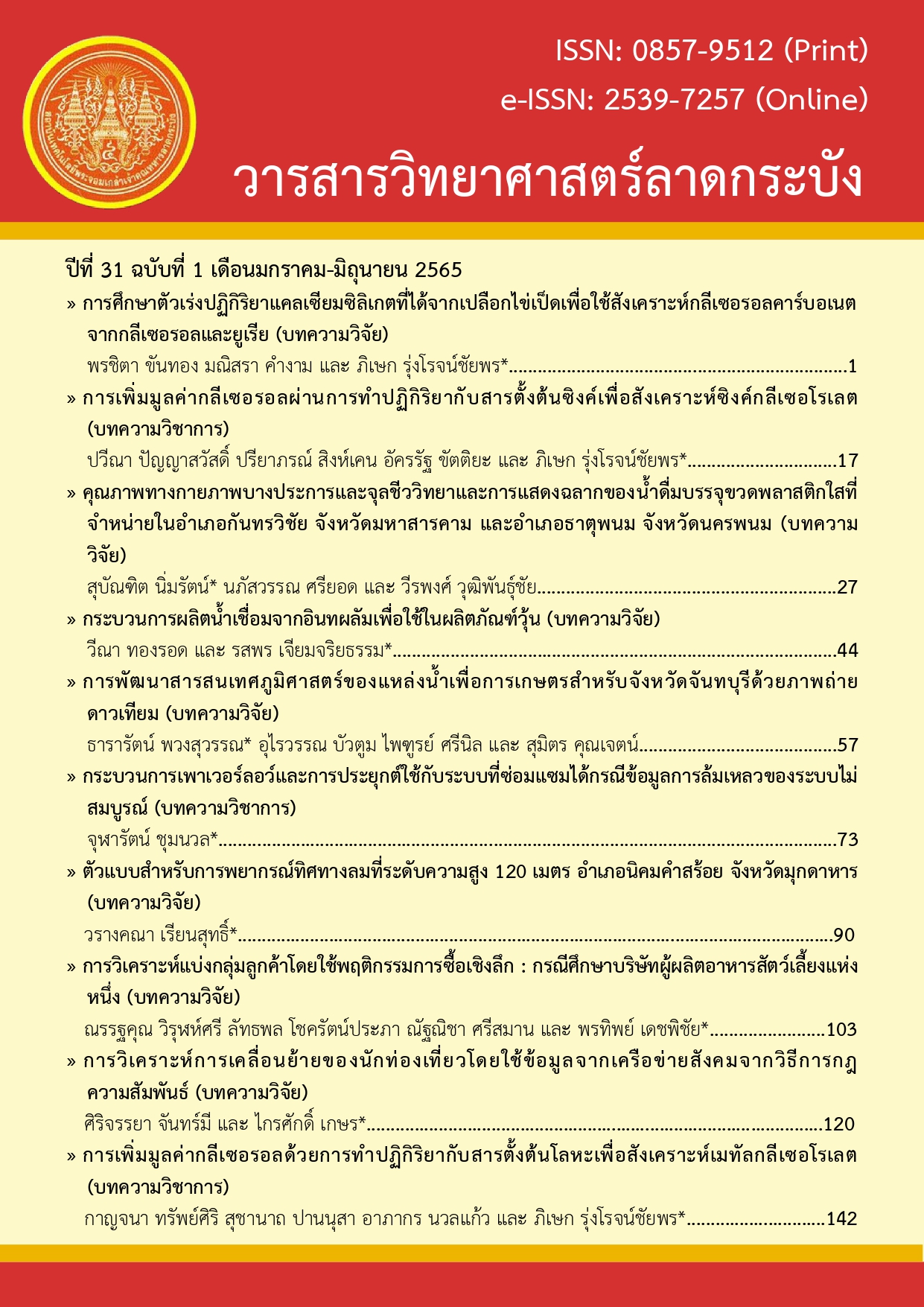
กระบวนการเพาเวอร์ลอว์และการประยุกต์ใช้กับระบบที่ซ่อมแซมได้ กรณีข้อมูลการล้มเหลวของระบบไม่สมบูรณ์
Article Sidebar
Main Article Content
บทคัดย่อ
กระบวนการเพาเวอร์ลอว์หรือตัวแบบเพาเวอร์ลอว์ เป็นตัวแบบที่ใช้กันอย่างแพร่หลายในการตรวจสอบและประเมินความเชื่อถือได้ของระบบที่ซ่อมแซมได้ก่อนที่จะถูกนำไปใช้งานหรือนำไปจำหน่ายให้กับลูกค้า ในบทความนี้จะนำเสนอการอนุมานเชิงสถิติเบื้องต้นสำหรับพารามิเตอร์ของตัวแบบดังกล่าว โดยจะพิจารณากรณีที่เวลาที่ระบบเกิดการล้มเหลวในช่วงแรกของการทดสอบระบบไม่สามารถบันทึกได้ ซึ่งข้อมูลลักษณะเช่นนี้สามารถเกิดขึ้นได้บ่อยครั้งในขั้นตอนของการพัฒนาระบบ และข้อมูลดังกล่าวมีความสำคัญต่อการกำหนดนโยบายในการรับประกันสินค้า นอกจากนี้ ในตอนท้ายของบทความจะนำเสนอตัวอย่างการนำกระบวนการเพาเวอร์ลอว์ไปประยุกต์ใช้กับเวลาการล้มเหลวของเครื่องยนต์โดยที่มีข้อมูลบางส่วนไม่สามารถบันทึกได้
Article Details

อนุญาตภายใต้เงื่อนไข Creative Commons Attribution-NonCommercial-NoDerivatives 4.0 International License.
เอกสารอ้างอิง
จุฬารัตน์ ชุมนวล. 2563. กระบวนการเพาเวอร์ลอว์และการประยุกต์ใช้กับระบบที่ซ่อมแซมได้. วารสารวิทยาศาสตร์ประยุกต์, 19(2), 175-187. [Chumnaul, J. 2020. Power-law process and its applications on repairable systems. The Journal of Applied Science, 19(2), 175-187. (in Thai)]
Chumnaul, J. 2019. Inferences on the power-law process with applications to repairable systems. Ph.D. thesis, Mississippi State University.
Chumnaul, J. and Sepehrifar, M. 2018. Generalized confidence interval for the scale parameter of the power-law process with incomplete failure data. Computational Statistics and Data Analysis, 128, 17-33.
Finkelstein, J.M. 1976. Confidence bounds on the parameters of Weibull process. Technometrics, 18(1), 115-117.
Crow, L.H. 1982. Confidence Interval Procedures for the Weibull Process with Application to Reliability Growth. Technometrics, 24(1), 67–72.
Lee, L. and Lee, S.K. 1978. Some Results on Inference for the Weibull Process. Technometrics, 20(1), 41-45.
Kyparisis, J. and Singpurwalla, N.D. 1985. Bayesian Inference for the Weibull Process with Applications to Assessing Software Reliability Growth and Predicting Software Failures. Computer Science and Statistics: Proceedings of the Sixteenth Symposium on the Interface (ed. L. Billard), Amsterdam, 57-64.
Shaul, K.B., Idit, L. and Benjamin, R. 1992. Bayesian Inference for the Power Law Process. Annals of the Institute of Statistical Mathematics, 44, 623-639.
Gaudoin, O., Yang, B. and Xie, M. 2003. A Simple Goodness-of-Fit Test for the Power- Law Process, Based on the Duane Plot. IEEE Transactions on Reliability, 52(1), 69-74.
Gaudoin, O., Yang, B. and Xie, M. 2006. Confidence intervals for the scale parameter of the power-law process. Communications in Statistics - Theory and Methods, 35(8), 1525–1538.
Cocozza-Thivent, C. 1997. Processus Stochastiques Et Fiabilite Des Systemes. Springer Verlag: Berlin.
Wang, B., Xie, M. and Zhou, J. 2013. Generalized confidence interval for the scale parameter of the power-law process. Communications in Statistics - Theory and Methods, 42, 898-906.
Yu, J.W., Tian, G.L. and Tang, M.L. 2008. Statistical inference and prediction for the Weibull process with incomplete observations. Computational Statistics and Data Analysis, 52(3), 1587-1603.
Tian, G.L., Tang, M.L. and Yu, J.W. 2011. Bayesian Estimation and Prediction for the Power Law Process with Left-Truncated Data. Journal of Data Science, 9(3), 445–470.
Dempster, A.P., Laird, N.M. and Rubin, D.B. 1977. Maximum likelihood from incomplete data via the EM algorithm (with discussion). Journal of the Royal Statistical Society. Series B., 39(1), 1–38.
Zhou, Y.Q. and Weng, Z.X. 1992. Reliability growth. Science Press: Beijing.
Engelhardt, M., Bain, L.J. and Blumenthal, B. 1992. Statistical Analysis of a Weibull Process with Left-Censored Data. Survival Analysis: State of the Art, NSSE 211, 173–195.
