ความสัมพันธ์ของลักษณะโครงสร้างสังคมพืชกับปัจจัยดินบางประการและการเก็บกักคาร์บอน บริเวณป่านันทนาการน้ำตกหินตั้ง จังหวัดอุดรธานี
Article Sidebar
Main Article Content
บทคัดย่อ
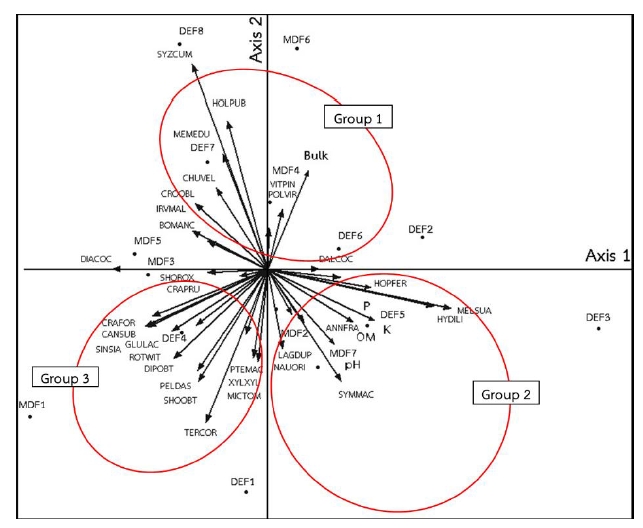
ฐานข้อมูลด้านลักษณะสังคมพืชที่สัมพันธ์กับปัจจัยแวดล้อมและการกักเก็บคาร์บอน สามารถยกระดับการจัดการพื้นที่ป่าคุ้มครอง การศึกษาครั้งนี้มีวัตถุประสงค์เพื่อศึกษาการปรากฎสังคมพืชตามปัจจัยดิน และการกักเก็บคาร์บอน ในพื้นที่ป่านันทนาการน้ำตกหินตั้ง อำเภอหนองวัวซอ จังหวัดอุดรธานี ทำการวางแปลงตัวอย่างแบบสุ่มเจาะจง (purposive sampling) ขนาด 20 เมตร x 20 เมตร จำนวน 15 แปลง พร้อมเก็บข้อมูลองค์ประกอบชนิดของพรรณไม้ต้นและปัจจัยดิน เพื่อใช้วิเคราะห์ลักษณะสังคมพืชตามการแปรผันของปัจจัยดิน พร้อมกับประเมินการกักเก็บคาร์บอนในแต่ละหมู่ไม้ ผลการศึกษาพบไม้ต้น 51 ชนิด 51 สกุล 26 วงศ์ จากต้นไม้ทั้งหมด 636 ต้น สามารถจำแนกสังคมพืชย่อยได้ 2 สังคมได้แก่ 1) สังคมพืชป่าเบญจพรรณ พบชนิดไม้ทั้งหมด 39 ชนิด 34 สกุล 21 วงศ์ มีค่าดัชนีความหลากชนิด เท่ากับ 3.03 มีความหนาแน่นของไม้ต้นและขนาดพื้นที่หน้าตัด เท่ากับ 1,164.29 ต้นต่อเฮกตาร์ และ 18.50 ตารางเมตรต่อเฮกตาร์ ตามลำดับ โดยชนิดไม้เด่นถูกกำหนดด้วยความหนาแน่นรวมของดิน 2) สังคมพืชป่าดิบแล้ง พบชนิดไม้ทั้งหมด 32 ชนิด 29 สกุล 22 วงศ์ มีค่าดัชนีความหลากชนิด เท่ากับ 2.60 มีความหนาแน่นของไม้ต้นและขนาดพื้นที่หน้าตัด เท่ากับ 968.75 ต้นต่อเฮกตาร์ และ 30.05 ตารางเมตรต่อเฮกตาร์ ตามลำดับ โดยชนิดไม้เด่นถูกกำหนดด้วยปริมาณอินทรียวัตถุ ฟอสฟอรัส โพแทสเซียม และค่าความเป็นกรด–ด่าง นอกจากนั้นพบว่าสังคมพืชป่าดิบแล้งมีปริมาณมวลชีวภาพและปริมาณการกักเก็บคาร์บอนสูงกว่าสังคมป่าเบญจพรรณ มีค่าเท่ากับ 57.78±29.37 ตันต่อเฮกตาร์ และ 99.58±50.62 ตันคาร์บอนต่อเฮกตาร์ ผลการศึกษาบ่งชี้ว่าความสัมพันระหว่างสังคมพืชกับปัจจัยดินมีความสำคัญต่อการจัดการพื้นที่ป่า ดังนั้นข้อมูลดังกล่าวสามารถนำไปใช้เป็นแนวทางในการจัดการด้านการปลูกป่าทดแทน และเพิ่มบทบาทสำคัญของพื้นที่คุ้มครองในการดูดซับคาร์บอนได้อย่างมีประสิทธิภาพมากยิ่งขึ้น
Downloads
Article Details

อนุญาตภายใต้เงื่อนไข Creative Commons Attribution-NonCommercial-NoDerivatives 4.0 International License.
ข้าพเจ้าและผู้เขียนร่วม (ถ้ามี) ขอรับรองว่า ต้นฉบับที่เสนอมานี้ยังไม่เคยได้รับการตีพิมพ์และไม่ได้อยู่ในระหว่างกระบวนการพิจารณาตีพิมพ์ลงในวารสารหรือสิ่งตีพิมพ์อื่นใด ข้าพเจ้าและผู้เขียนร่วม (ถ้ามี) ยอมรับหลักเกณฑ์และเงื่อนไขการพิจารณาต้นฉบับ ทั้งยินยอมให้กองบรรณาธิการมีสิทธิ์พิจารณาและตรวจแก้ต้นฉบับได้ตามที่เห็นสมควร พร้อมนี้ขอมอบลิขสิทธิ์ผลงานที่ได้รับการตีพิมพ์ให้แก่วารสารวนศาสตร์ คณะวนศาสตร์ มหาวิทยาลัยเกษตรศาสตร์ กรณีมีการฟ้องร้องเรื่องการละเมิดลิขสิทธิ์เกี่ยวกับภาพ กราฟ ข้อความส่วนใดส่วนหนึ่ง หรือ ข้อคิดเห็นที่ปรากฏในผลงาน ให้เป็นความรับผิดชอบของข้าพเจ้าและผู้เขียนร่วม (ถ้ามี) แต่เพียงฝ่ายเดียว และหากข้าพเจ้าและผู้เขียนร่วม (ถ้ามี) ประสงค์ถอนบทความในระหว่างกระบวนการพิจารณาของทางวารสาร ข้าพเจ้าและผู้เขียนร่วม (ถ้ามี) ยินดีรับผิดชอบค่าใช้จ่ายทั้งหมดที่เกิดขึ้นในกระบวนการพิจารณาบทความนั้น”
เอกสารอ้างอิง
Asanok, L., Kotkangphon, J., Rodkongrai, S., Chanduang, D., Ketdee, P., Khasuk, M. 2017. The influencing of canopy gap and conspecific adult tree determined the characteristic of dominant species in Ban Se Pa La freshwater swamp forest, Umphang district, Tak province. Thai Forest Ecological Research Journal. 1(1): 19–26. (in Thai)
Asanok, L., Taweesuk, R., Papakjan, N. 2020. Woody species colonization along edge-interior gradients of deciduous forest remnants in the Mae Khum Mee Watershed, Northern Thailand. International Journal of Forestry Research, 2020(1): 5867376. https://doi.org/10.1155/2020/5867376
Blake, G.R., Hartge, K.H. 1986. Bulk Density. In A. Klute (ed.) Methods of Soil Analysis. Part 1–Physical and Mineralogical Methods Second Edition. American Society of Agronomy, Madison WI, USA.
Climate Center. 2020. Climate of Udon Thani Province. Development–tmd: Climate Center of Thailand. Bangkok. (in Thai)
Craine, J.M., Ocheltree, T.W., Nippert, J.B., Towne, E. G., Skibbe, A.M., Kembel, S.W., Fargione, J.E. 2012. Global diversity of drought tolerance and grassland climate–change resilience. Nature Climate Change. 3(1): 63–67. doi:10.1038nclimate1634
Dhamanitayakul, P. 1979. The Phenology of Trees in Dry Evergreen Forest and its Application to Timing for Logging Operation: Forest Research Bulletin Number 64. Faculty of Forestry, Kasetsart University, Bangkok (in Thai).
Hammitt, W.E. 2004. Recreation: user needs and preferences. Encyclopedia of Forest Sciences. 949–958. doi.org10.1016B0–12–145160–700164–2
IPCC. 2006. Guidelines for National Greenhouse Gas Inventories: Chapter 4 Forest Land. https: www.ipcc–nggip.iges.or.jppublic2006glpdf4_Volume4V4_04_Ch4_Forest_Land.pdf, 28 May 2022.
Kent, M., Coker, P. 1994. Vegetation description and analysis: A practical approach. The Geographical Journal, 159(2), 237. doi.org10.2307/3451427
Kongdam, P., Pimprasit, S., Vacharinrat, C., Marod, D. 2016. Forest structure and species composition in restoration by Teak plantation at Jedkhod–Pongkhonsao Natural Study and Ecotourism Center, Kheang Khoi district, Saraburi province. Thai Journal of Forestry, 35(1): 11–23.
Krishna, M.P., Mohan, M. 2017. Litter decomposition in forest ecosystems: a review. Energy, Ecology and Environment, 236–249. doi.org10.1007s40974–017–0064–9
Laing, R.S., Ong, K.H., Kueh, R.J.H., Mang, N.G., King, P.J.H., Sait, M. 2019. Stand structure, floristic composition and species diversity along altitudinal gradients of a Bornean Mountain range 30 years after selective logging. Journal of Mountain Science, 16(6): 1419–1434.
Magurran, A.E. 1988. Ecological Diversity and its Measurement. Princeton University Press, Princeton, New Jersey. USA.
Marod, D. 2012. Integrated Forest Restoration for Soil and Water Conservation. Department of Biology, Faculty of Forestry, Kasetsart University, Bangkok, Thailand. (in Thai)
Marod, D, Kutintara, U. 2009. Forest Ecology. Faculty of Forestry, Kasetsart University, Bangkok, Thailand (in Thai)
Marod, D., Kutintara, U., Tanaka, H., Nakashizuka, T. 1999. Structural dynamics in a mixed deciduous forest western Thailand. Journal of Vegetation Science, 10: 777-786.
Marod, D., Thinkamphaeng, S., Thongsawi, J., Phumphuang, W., Kokoet, T., Hermhuk, S., Nakthanom, A. 2018. Forest structure and species composition in the dry evergreen forest at Wang Nam Khiao Forestry Student Training and Research Station, Nakhon Ratchasima province. Thai Forest Ecological Research Journal, 2(1): 45–54. (in Thai)
McCune, B., Mefford, M.J. 2011. PC–ORD. Multivariate Analysis of Ecological Data. Version 6.0 for Windows. MjM Software, Gleneden Beach, Oregon, U.S.A.
Nuanurai, N. 2005. Comparison of Leaf Area Index, Above–ground Biomass and Carbon Sequestration of Forest Ecosystem by Forest Inventory and Remote Sensing at Kaeng Krachan National Park, Thailand. M.Sc. thesis, Faculty of Science, Chulalongkorn University, Bangkok, Thailand. (in Thai)
Ogawa, H., Yoda, K., Kira, T. 1965. A preliminary survey on the vegetation of Thailand. Nature and Life in SE Asia, 1: 21–157.
Phetchaburi National Park Research and Development Center. 2019.The Study of Carbon Accumulation in the ASEAN Heritage Area, Kaeng Krachan National Park. Research of National Park. Department of National parks Wildlife and Plant Conservation, Bangkok, Thailand. (in Thai).
Phuma, P., Suddee, S. 2014. Plant Name of Thailand Tem Smitinan, Edition 2014. Forest Herbarium BKF. Department of National Park, Bangkok, Thailand (in Thai)
Planning and Information Office. 2017. 5–year Action Plan of Royal Forest Department (2017–2022). Royal Forest Department, Bangkok, Thailand. (in Thai)
Planning and Information Office. 2020. National Forest Policy Drafting and National Forest Development Master Plan Subcommittee. Royal Forest Department, Bangkok, Thailand. (in Thai)
Planning and Information Office. 2022. Annual Report 2022. Royal Forest Department. Bangkok, Thailand. (in Thai)
Planning and Information Office. 2023. Annual Report 2023. Royal Forest Department. Bangkok, Thailand. (in Thai)
Plant Protection Promotion and Soil–Fertilizer Management Division. 2015. Soil and Fertilizer. Department of Agricultural Extension: Ministry of Agriculture and Cooperatives. Bangkok, Thailand. (in Thai)
Ruangpanit, N. 2005. Forests and Forestry in Thailand. Faculty of Forestry, Kasetsart University, Bangkok, Thailand. (in Thai)
Santisuk, T. 2005. Forest of Thailand. Thai Forest Bulletin, Department of National parks Wildlife and Plant Conservation, Bangkok, Thailand. (in Thai)
Sonkanha, W., Anusontpornperm, S., Thanachit, S., Kheoruenromne, I., Artchawakom, T. 2012. Soil Characteristics under Various Types of Forest in Sakaerat Environmental Research Station. Khon Kaen Agriculture Journal, 40: 7–18. (in Thai)
Sorensen, T. 1948. A method of establishing groups of equal amplitude in plant sociology based on similarity of species content. Biologiske Skrifter, 5(4): 1–34.
Srithawat na Ayudhya, S., Nilphan, S., Pittanon, J. 1995. Comparative Study of Bulk Density of Different Soil Series According to Soil Series Groups. Land Development Department, Ministry of Agriculture and Cooperatives, Bangkok, Thailand. (in Thai)
Thipayasak, T. 1984. Classification of Soil Use. and Assessing Suitability by Physical Methods for the Benefit of Planning the Management of Khao Yai National Park and Nearby Areas. Kasetsart University, Bangkok, Thailand. (in Thai)
Tsutsumi, T., Yoda. K., Sahunalu. P., Dhan–manonda. P., Prachaiyo, B. 1983. Forest: Felling, Burning and Regeneration. In Shifting Cultivation, and Experiment at Nam Phrom, Nortreast Thailand and it’s Implication for Upland Farming in the Monsoon Tropics (K. Kyuma and C. Pairintra Eds.). Tokyo University, Japan. pp. 13–62.
Wiriyakitjanateekul, W., Kerdchana, C. 2016. Methods of Soil Analysis and Interpretation for Soil Survey and Classification: Physical Properties. Land development department: Ministry of Agriculture and Cooperatives. Bangkok, Thailand. (in Thai)
