Vegetation Structure Characteristics Related to Edaphic Factors and Carbon Stock in Hin Tang Waterfall Recreational Forest, Udon Thani Province, Thailand
Article Sidebar
Main Article Content
Abstract
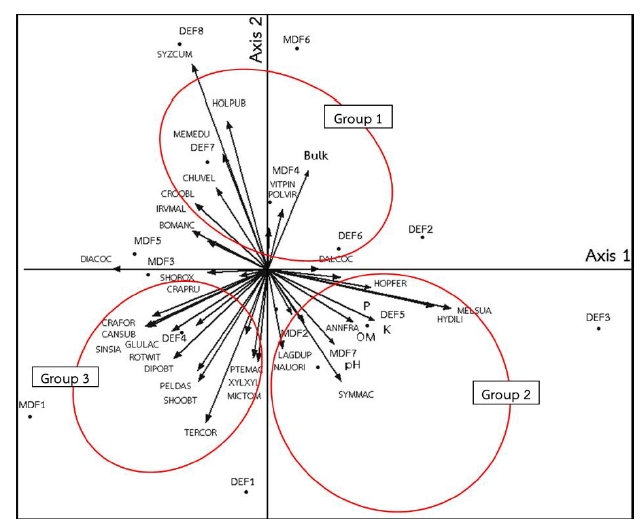
Databases of vegetation structure characteristics related to edaphic factors and carbon stock can support management for forest protection. This study characterized the plant community structure, soil factor gradient, and carbon storage in the Hin Tang Waterfall Recreational Forest area, Nong Wua So district, Udon Thani province, Thailand. Fifteen purposive sampling plots of 20 m x 20 m were established in the study area. Data on species composition and soil factors were collected for use in determining vegetation characteristics related to soil properties, as well as for evaluating carbon storage in each plant community. Based on the results, there were 636 trees, consisting of 51 tree species, 51 genera, and 26 families. The study sites could be divided into two sub–communities. The first consisted of mixed deciduous forest (MDF) containing 39 species, 34 genera, and 21 families, having a Shannon index (H') of 3.03. The stem density and basal area were 1,164.29 trees ha–1 and 18.50 m3 ha–1, respectively, with the dominant species in this forest type determined based on bulk density. The second sub–community was dry evergreen forest (DEF), with 32 species, 29 genera, and 22 families, having an H' value of 2.60. The stem density and basal area were 968.75 trees ha–1 and 30.05 m3 ha–1, respectively, with the dominant species determined by the amounts of organic matter, phosphorus, and potassium, and the pH. The biomass and carbon storage in DDF (57.78 ± 29.37 t ha–1 and 99.58 ± 50.62 t C ha–1, respectively) were higher than in MDF. Based on the results, plant community and soil factor relationships could provide important information for forest area management. Therefore, the data could be applied in guidelines for managing reforested areas, as well as playing an important role in protected areas to achieve more efficient carbon sequestration.
Downloads
Article Details

This work is licensed under a Creative Commons Attribution-NonCommercial-NoDerivatives 4.0 International License.
ข้าพเจ้าและผู้เขียนร่วม (ถ้ามี) ขอรับรองว่า ต้นฉบับที่เสนอมานี้ยังไม่เคยได้รับการตีพิมพ์และไม่ได้อยู่ในระหว่างกระบวนการพิจารณาตีพิมพ์ลงในวารสารหรือสิ่งตีพิมพ์อื่นใด ข้าพเจ้าและผู้เขียนร่วม (ถ้ามี) ยอมรับหลักเกณฑ์และเงื่อนไขการพิจารณาต้นฉบับ ทั้งยินยอมให้กองบรรณาธิการมีสิทธิ์พิจารณาและตรวจแก้ต้นฉบับได้ตามที่เห็นสมควร พร้อมนี้ขอมอบลิขสิทธิ์ผลงานที่ได้รับการตีพิมพ์ให้แก่วารสารวนศาสตร์ คณะวนศาสตร์ มหาวิทยาลัยเกษตรศาสตร์ กรณีมีการฟ้องร้องเรื่องการละเมิดลิขสิทธิ์เกี่ยวกับภาพ กราฟ ข้อความส่วนใดส่วนหนึ่ง หรือ ข้อคิดเห็นที่ปรากฏในผลงาน ให้เป็นความรับผิดชอบของข้าพเจ้าและผู้เขียนร่วม (ถ้ามี) แต่เพียงฝ่ายเดียว และหากข้าพเจ้าและผู้เขียนร่วม (ถ้ามี) ประสงค์ถอนบทความในระหว่างกระบวนการพิจารณาของทางวารสาร ข้าพเจ้าและผู้เขียนร่วม (ถ้ามี) ยินดีรับผิดชอบค่าใช้จ่ายทั้งหมดที่เกิดขึ้นในกระบวนการพิจารณาบทความนั้น”
References
Asanok, L., Kotkangphon, J., Rodkongrai, S., Chanduang, D., Ketdee, P., Khasuk, M. 2017. The influencing of canopy gap and conspecific adult tree determined the characteristic of dominant species in Ban Se Pa La freshwater swamp forest, Umphang district, Tak province. Thai Forest Ecological Research Journal. 1(1): 19–26. (in Thai)
Asanok, L., Taweesuk, R., Papakjan, N. 2020. Woody species colonization along edge-interior gradients of deciduous forest remnants in the Mae Khum Mee Watershed, Northern Thailand. International Journal of Forestry Research, 2020(1): 5867376. https://doi.org/10.1155/2020/5867376
Blake, G.R., Hartge, K.H. 1986. Bulk Density. In A. Klute (ed.) Methods of Soil Analysis. Part 1–Physical and Mineralogical Methods Second Edition. American Society of Agronomy, Madison WI, USA.
Climate Center. 2020. Climate of Udon Thani Province. Development–tmd: Climate Center of Thailand. Bangkok. (in Thai)
Craine, J.M., Ocheltree, T.W., Nippert, J.B., Towne, E. G., Skibbe, A.M., Kembel, S.W., Fargione, J.E. 2012. Global diversity of drought tolerance and grassland climate–change resilience. Nature Climate Change. 3(1): 63–67. doi:10.1038nclimate1634
Dhamanitayakul, P. 1979. The Phenology of Trees in Dry Evergreen Forest and its Application to Timing for Logging Operation: Forest Research Bulletin Number 64. Faculty of Forestry, Kasetsart University, Bangkok (in Thai).
Hammitt, W.E. 2004. Recreation: user needs and preferences. Encyclopedia of Forest Sciences. 949–958. doi.org10.1016B0–12–145160–700164–2
IPCC. 2006. Guidelines for National Greenhouse Gas Inventories: Chapter 4 Forest Land. https: www.ipcc–nggip.iges.or.jppublic2006glpdf4_Volume4V4_04_Ch4_Forest_Land.pdf, 28 May 2022.
Kent, M., Coker, P. 1994. Vegetation description and analysis: A practical approach. The Geographical Journal, 159(2), 237. doi.org10.2307/3451427
Kongdam, P., Pimprasit, S., Vacharinrat, C., Marod, D. 2016. Forest structure and species composition in restoration by Teak plantation at Jedkhod–Pongkhonsao Natural Study and Ecotourism Center, Kheang Khoi district, Saraburi province. Thai Journal of Forestry, 35(1): 11–23.
Krishna, M.P., Mohan, M. 2017. Litter decomposition in forest ecosystems: a review. Energy, Ecology and Environment, 236–249. doi.org10.1007s40974–017–0064–9
Laing, R.S., Ong, K.H., Kueh, R.J.H., Mang, N.G., King, P.J.H., Sait, M. 2019. Stand structure, floristic composition and species diversity along altitudinal gradients of a Bornean Mountain range 30 years after selective logging. Journal of Mountain Science, 16(6): 1419–1434.
Magurran, A.E. 1988. Ecological Diversity and its Measurement. Princeton University Press, Princeton, New Jersey. USA.
Marod, D. 2012. Integrated Forest Restoration for Soil and Water Conservation. Department of Biology, Faculty of Forestry, Kasetsart University, Bangkok, Thailand. (in Thai)
Marod, D, Kutintara, U. 2009. Forest Ecology. Faculty of Forestry, Kasetsart University, Bangkok, Thailand (in Thai)
Marod, D., Kutintara, U., Tanaka, H., Nakashizuka, T. 1999. Structural dynamics in a mixed deciduous forest western Thailand. Journal of Vegetation Science, 10: 777-786.
Marod, D., Thinkamphaeng, S., Thongsawi, J., Phumphuang, W., Kokoet, T., Hermhuk, S., Nakthanom, A. 2018. Forest structure and species composition in the dry evergreen forest at Wang Nam Khiao Forestry Student Training and Research Station, Nakhon Ratchasima province. Thai Forest Ecological Research Journal, 2(1): 45–54. (in Thai)
McCune, B., Mefford, M.J. 2011. PC–ORD. Multivariate Analysis of Ecological Data. Version 6.0 for Windows. MjM Software, Gleneden Beach, Oregon, U.S.A.
Nuanurai, N. 2005. Comparison of Leaf Area Index, Above–ground Biomass and Carbon Sequestration of Forest Ecosystem by Forest Inventory and Remote Sensing at Kaeng Krachan National Park, Thailand. M.Sc. thesis, Faculty of Science, Chulalongkorn University, Bangkok, Thailand. (in Thai)
Ogawa, H., Yoda, K., Kira, T. 1965. A preliminary survey on the vegetation of Thailand. Nature and Life in SE Asia, 1: 21–157.
Phetchaburi National Park Research and Development Center. 2019.The Study of Carbon Accumulation in the ASEAN Heritage Area, Kaeng Krachan National Park. Research of National Park. Department of National parks Wildlife and Plant Conservation, Bangkok, Thailand. (in Thai).
Phuma, P., Suddee, S. 2014. Plant Name of Thailand Tem Smitinan, Edition 2014. Forest Herbarium BKF. Department of National Park, Bangkok, Thailand (in Thai)
Planning and Information Office. 2017. 5–year Action Plan of Royal Forest Department (2017–2022). Royal Forest Department, Bangkok, Thailand. (in Thai)
Planning and Information Office. 2020. National Forest Policy Drafting and National Forest Development Master Plan Subcommittee. Royal Forest Department, Bangkok, Thailand. (in Thai)
Planning and Information Office. 2022. Annual Report 2022. Royal Forest Department. Bangkok, Thailand. (in Thai)
Planning and Information Office. 2023. Annual Report 2023. Royal Forest Department. Bangkok, Thailand. (in Thai)
Plant Protection Promotion and Soil–Fertilizer Management Division. 2015. Soil and Fertilizer. Department of Agricultural Extension: Ministry of Agriculture and Cooperatives. Bangkok, Thailand. (in Thai)
Ruangpanit, N. 2005. Forests and Forestry in Thailand. Faculty of Forestry, Kasetsart University, Bangkok, Thailand. (in Thai)
Santisuk, T. 2005. Forest of Thailand. Thai Forest Bulletin, Department of National parks Wildlife and Plant Conservation, Bangkok, Thailand. (in Thai)
Sonkanha, W., Anusontpornperm, S., Thanachit, S., Kheoruenromne, I., Artchawakom, T. 2012. Soil Characteristics under Various Types of Forest in Sakaerat Environmental Research Station. Khon Kaen Agriculture Journal, 40: 7–18. (in Thai)
Sorensen, T. 1948. A method of establishing groups of equal amplitude in plant sociology based on similarity of species content. Biologiske Skrifter, 5(4): 1–34.
Srithawat na Ayudhya, S., Nilphan, S., Pittanon, J. 1995. Comparative Study of Bulk Density of Different Soil Series According to Soil Series Groups. Land Development Department, Ministry of Agriculture and Cooperatives, Bangkok, Thailand. (in Thai)
Thipayasak, T. 1984. Classification of Soil Use. and Assessing Suitability by Physical Methods for the Benefit of Planning the Management of Khao Yai National Park and Nearby Areas. Kasetsart University, Bangkok, Thailand. (in Thai)
Tsutsumi, T., Yoda. K., Sahunalu. P., Dhan–manonda. P., Prachaiyo, B. 1983. Forest: Felling, Burning and Regeneration. In Shifting Cultivation, and Experiment at Nam Phrom, Nortreast Thailand and it’s Implication for Upland Farming in the Monsoon Tropics (K. Kyuma and C. Pairintra Eds.). Tokyo University, Japan. pp. 13–62.
Wiriyakitjanateekul, W., Kerdchana, C. 2016. Methods of Soil Analysis and Interpretation for Soil Survey and Classification: Physical Properties. Land development department: Ministry of Agriculture and Cooperatives. Bangkok, Thailand. (in Thai)
