Classification of Recreation Opportunity Spectrum of National Parks in Tak Province
Article Sidebar
Main Article Content
Abstract
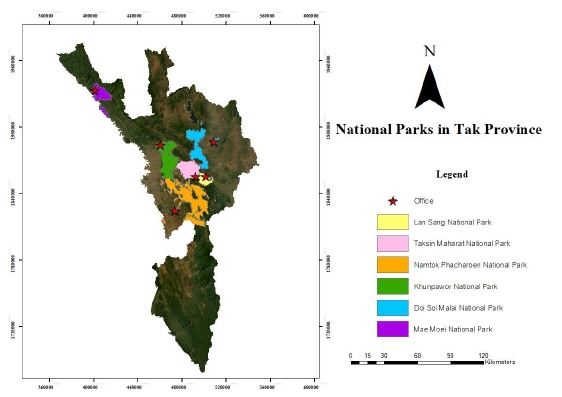
Classification of recreational opportunities involves defining recreation based on differences in recreational environmental elements to provide visitors with a meaningful recreational experience that satisfies as many of their needs as possible. The objectives of this study were to study the recreational settings and to classify the recreation opportunity spectrum (ROS) of the recreation areas in 6 national parks at 24 sites in Tak province, Thailand. The indicators used to classify the ROS classes were composed of 7 groups: access, remoteness, naturalness, social encounter, visitor management, facilities and site management and visitor impacts. The indicators were collected during November 2022–April 2023. A logistic regression equation was used in the analysis. Based on the results, most the studied areas in the national parks in Tak Province were categorized as modified natural area (MN; 41.67%), followed by values that were similar for the primitive area (P; 25.00%) and semi-primitive motorized area (SPM; 20.83%). Considering the national parks according to the ROS: 1) most recreation areas in Lan Sang National Park were classified as semi-primitive motorized (SPM);. 2) the areas in Taksin Maharat National Park were in the SPM and primitive (P) classes; 3) the areas in Khun Phra Wo National Park were in the modified natural area (MN) and P classes; 4) most areas in Mae Moei National Park were in the MN and semi-primitive non-motorized (SPNM) classes; 5) most areas in Namtok Pha Charoen National Park were in the MN class; and 6) most areas in Doi Soi Malai National Park for Petrified Wood were in the SPNM class.
Downloads
Article Details

This work is licensed under a Creative Commons Attribution-NonCommercial-NoDerivatives 4.0 International License.
ข้าพเจ้าและผู้เขียนร่วม (ถ้ามี) ขอรับรองว่า ต้นฉบับที่เสนอมานี้ยังไม่เคยได้รับการตีพิมพ์และไม่ได้อยู่ในระหว่างกระบวนการพิจารณาตีพิมพ์ลงในวารสารหรือสิ่งตีพิมพ์อื่นใด ข้าพเจ้าและผู้เขียนร่วม (ถ้ามี) ยอมรับหลักเกณฑ์และเงื่อนไขการพิจารณาต้นฉบับ ทั้งยินยอมให้กองบรรณาธิการมีสิทธิ์พิจารณาและตรวจแก้ต้นฉบับได้ตามที่เห็นสมควร พร้อมนี้ขอมอบลิขสิทธิ์ผลงานที่ได้รับการตีพิมพ์ให้แก่วารสารวนศาสตร์ คณะวนศาสตร์ มหาวิทยาลัยเกษตรศาสตร์ กรณีมีการฟ้องร้องเรื่องการละเมิดลิขสิทธิ์เกี่ยวกับภาพ กราฟ ข้อความส่วนใดส่วนหนึ่ง หรือ ข้อคิดเห็นที่ปรากฏในผลงาน ให้เป็นความรับผิดชอบของข้าพเจ้าและผู้เขียนร่วม (ถ้ามี) แต่เพียงฝ่ายเดียว และหากข้าพเจ้าและผู้เขียนร่วม (ถ้ามี) ประสงค์ถอนบทความในระหว่างกระบวนการพิจารณาของทางวารสาร ข้าพเจ้าและผู้เขียนร่วม (ถ้ามี) ยินดีรับผิดชอบค่าใช้จ่ายทั้งหมดที่เกิดขึ้นในกระบวนการพิจารณาบทความนั้น”
References
Department of National Parks, Wildlife and Plant Conservation. 2015. National Parks in Thailand. https://portal.dnp.go.th/p/nationalpark, 25 February 2021. (in Thai)
Department of National Parks, Wildlife and Plant Conservation. 2019. National Park Revenue and Number of Tourists and Vehicles. http://portal.dnp.go.th/Content/national park?contentId=11191, 27 February 2021. (in Thai)
Department of National Parks, Wildlife and Plant Conservation. 2020. National Park Management Policy. Department of National Parks, Wildlife and Plant Conservation. Bangkok, Thailand. (in Thai)
Department of National Parks, Wildlife and Plant Conservation. 2023. National Park Revenue and Number of Tourists and Vehicles. https://catalog.dnp.go.th/dataset/stat-tourism, 24 June 2024. (in Thai)
Gomes, C.R., Figueiredo, M.d.A., Salvio, G.M.M. 2021. Recreational opportunities offered in protected natural areas: analysis of the most visited national parks in Brazil and the United States of America in 2017. Sociedade & Natureza, 33: 1–13. doi: 10.14393/SN-v33-2021-58518
Ministry of Tourism and Sports. 2020. Tourism Statistics. https://mots.go.th/more_news_new.phpcid=411, 31 March 2021. (in Thai)
Oishi, Y. 2013. Toward the improvement of trail classification in national parks using the recreation opportunity spectrum approach. Environmental Management, 51: 1126-1136. doi: 10.1007/s00267-013-0040-x
Phongkhieo, N. T. 2012. Parks Recreation and Nature Tourism. Department of Conservation Science, Faculty of Forestry, Kasetsart University, Bangkok, Thailand. (in Thai)
Phongkhieo, N. T. 2018. Parks Recreation and Nature Tourism, 2nd ed. Department of Conservation Science, Faculty Forestry, Kasetsart University, Bangkok, Thailand. (in Thai)
Suksmawati, H., Rahmatin, L. S., Firdaus, P. 2021. Recreation opportunity spectrum analysis of strategic area tourism destination Pelang region. E-Journal of Tourism, 8(2): 172-183.
Tanakanjana, N. 2007. Recreation opportunity classification and challenges in maintaining recreation diversity in Thailand’s national parks. In: Rethinking Protected Areas in a Changing World: Proceeding of the 2007 George Wright Society Biennial Conference on Parks, Protected Areas, and Cultural Sites. The George Wright Society, Hancock, MI, USA.
Tanakanjana, N., Arunpraparat, W., Nuampakdee, R., Phongpattananurak, N., Chumsaengsri, T. 2006. Decision Support System for Sustainable Management Planning of Nature-based Recreation Areas, Phase I. Faculty of Forestry, Kasetsart University, Bangkok, Thailand. (in Thai)
Tanakanjana, N., Chettamart, S., Emphandhu, D., Pitchakum, N., Singhavorawut, S., Termtrakul, L., Rachkiri, S. 1998. Manual for Ecotourism Facility Design and Development. Tourism Authority of Thailand and Faculty of Forestry, Kasetsart University, Bangkok, Thailand. (in Thai)
USDA Forest Service. 2017. National Recreation Opportunity Spectrum (ROS) Inventory Mapping Protocol. USDA Forest Service, Washington, USA.
Warzecha, C., Manning, R., Lime, D., Freimund, W. 2001. Diversity in outdoor recreation planning and managing a spectrum of visitor opportunities in and among parks. The George Wright Forum, 18(3): 99-111.
Xiao, X., Manning, R., Lawson, S., Valliere, W., Krymkowski, D. 2018. Indicators for a transportation recreation opportunity spectrum in national parks. Journal of Park and Recreation Administration, 36: 90-112.
