Clonal Variations of Acacia auriculiformis A. Cunn. ex Benth. Hybrid at Silvicultural Research Center 6 (Nakhon Ratchasima)
Article Sidebar
Main Article Content
Abstract
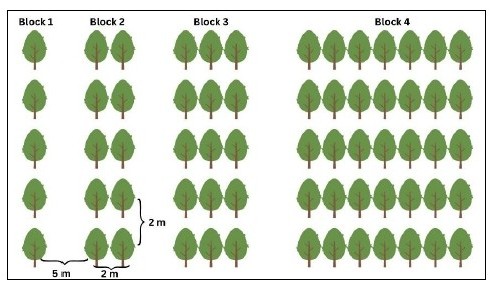
Genetic improvement of Acacia auriculiformis A. Cunn. ex Benth. hybrids have enhanced their growth potential and adaptability to planting sites. However, differences in stem characteristics, yield and growth are evident. Consequently, this study examined the variation in 23 clones of a 5-year-old A. auriculiformis hybrid that had been planted at Silvicultural Research Center 6 (Nakhon Ratchasima) in terms of their growth, biomass and fresh weight, stem volume and carbon storage. The clonal test involved plots in a randomized complete block design with four replications. The diameter at breast height and total height of all trees were measured; subsequently, allometric equations were developed to estimate the biomass, carbon storage and stem fresh weight and volume of the trees.
Based on the results, there were highly significant differences (p<0.01) for all variables examined among the 23 clones. The RFD 3-2 clone, which was registered as a new plant variety, produced the highest total biomass and carbon stored in biomass, with mean values of 99.03 and 47.20 t/ha, respectively. Furthermore, the stem fresh weight and volume of this clone were the highest, with mean values of 102.12 t/ha and 130.02 m3/ha, respectively, due to its straight stem and lack of forking at a low level. In addition, clones No. 12 and 13 were superior in terms of growth, biomass, stem fresh weight and stem volume, with values that were comparable to those of the RFD 3-2 clone. The findings suggested that these A. auriculiformis hybrid clones were suitable for reforestation and commercial plantations in Nakhon Ratchasima province and other regions with similar site conditions.
Downloads
Article Details

This work is licensed under a Creative Commons Attribution-NonCommercial-NoDerivatives 4.0 International License.
ข้าพเจ้าและผู้เขียนร่วม (ถ้ามี) ขอรับรองว่า ต้นฉบับที่เสนอมานี้ยังไม่เคยได้รับการตีพิมพ์และไม่ได้อยู่ในระหว่างกระบวนการพิจารณาตีพิมพ์ลงในวารสารหรือสิ่งตีพิมพ์อื่นใด ข้าพเจ้าและผู้เขียนร่วม (ถ้ามี) ยอมรับหลักเกณฑ์และเงื่อนไขการพิจารณาต้นฉบับ ทั้งยินยอมให้กองบรรณาธิการมีสิทธิ์พิจารณาและตรวจแก้ต้นฉบับได้ตามที่เห็นสมควร พร้อมนี้ขอมอบลิขสิทธิ์ผลงานที่ได้รับการตีพิมพ์ให้แก่วารสารวนศาสตร์ คณะวนศาสตร์ มหาวิทยาลัยเกษตรศาสตร์ กรณีมีการฟ้องร้องเรื่องการละเมิดลิขสิทธิ์เกี่ยวกับภาพ กราฟ ข้อความส่วนใดส่วนหนึ่ง หรือ ข้อคิดเห็นที่ปรากฏในผลงาน ให้เป็นความรับผิดชอบของข้าพเจ้าและผู้เขียนร่วม (ถ้ามี) แต่เพียงฝ่ายเดียว และหากข้าพเจ้าและผู้เขียนร่วม (ถ้ามี) ประสงค์ถอนบทความในระหว่างกระบวนการพิจารณาของทางวารสาร ข้าพเจ้าและผู้เขียนร่วม (ถ้ามี) ยินดีรับผิดชอบค่าใช้จ่ายทั้งหมดที่เกิดขึ้นในกระบวนการพิจารณาบทความนั้น”
References
Avery, T. E. 1967. Forest Measurements. McGraw - Hill Inc. New York, USA.
Choengsaad, J., Poolsiri, R., Diloksumpun, S. 2016. Growth, biomass and nutrient content of Acacia hybrid clones in Sa Kaeo province. Journal of Forestry, 35(2): 54-65. (in Thai)
Diloksumpun, S. 2007. Carbon storage in forests and global warming. Journal of Soil and Water Conservation, 22(3): 40-49. (in Thai)
Diloksumpun, S., Wongprom, J. 2016. Clonal Test of Acacia auriculiformis Hybrids on Mining Rehabilitation Area at Phang-Nga Forestry Research Station, Phang-Nga Province. Final Report, Kasetsart University Research and Development Institute, Bangkok, Thailand. (in Thai)
Diloksumpun, S., Wongprom, J., A-kakhun, S. 2016. Growth and phyllode functional traits of Acacia hybrid clones planted on a post mining rehabilitation site in southern Thailand. In: Proceedings of SEAMEO BIOTROP 2nd International Conference on Tropical Biology "Ecological Restoration in Southeast Asia: Challenges, Gains, and Future Directions", SEAMEO BIOTROP, Bogor-INDONESIA, 12-13 October 2015, pp. 98-112.
Faculty of Forestry. 2011. Handbook on the Potential of Tree Species for Promotion under the A/R Clean Development Mechanism Project. Aksorn Siam, Bangkok, Thailand. (in Thai)
Faculty of Forestry. 2017. Strategy and Action Plan for Extension of Integrated Economic Trees (2018-2036). Royal Forest Department, Bangkok, Thailand. (in Thai)
Kha, L.D., Nguyen N.D., Hai D., Vinh H.Q. 1998. Clonal Tests and Propagation Options for Natural Hybrids between Acacia mangium and A. auriculiformis. In: Turnbull JW (Ed.), Advances in Tropical Acacia Research. Proceedings of an international workshop held in Bangkok, Thailand, 11-15 February 1991. pp. 203-210.
Khotrma, R., Poolsiri, R., Haruthaithanasan, M. 2016. Aboveground biomass and nutrient content of various Acacia hybrid clones planted on degraded soil at Kanchanaburi province. King Mongkut’s Agricultural Journal, 34: 21-30. (in Thai)
Kira, T., Shidei, T. 1967. Primary production and turnover of organic matter in difference forest ecosystems of the Weatern Pacific. Japanese Journal of Ecology, 17(2): 70-87.
Luangviriyasaeng, V. 2002. Breeding Acacia species for commercial plantations. In: The Proceedings of the 7th Silviculture Seminar, “Silviculture for the Development of Economic Forest Plantations” Kasetsart University, Bangkok, Thailand, pp. 1-10. (in Thai)
Luangviriyasaeng, V. 2013. Economic Fast-growing Tree Improvement for Farmers and Community. Forest Research and Development Bureau, Royal Forest Department, Bangkok, Thailand. (in Thai)
Luangviriyasaeng, V., Pinyopusarerk, K., Pitpreecha, K., Simsiri, A., Kiatvuttinand, B. 1995. Early growth of acacia auriculiformis progeny trials. Journal of Forestry, 14: 81-93. (in Thai)
R Core Team. 2022. R: A Language and Environment for Statistical Computing. https://www.R-project.org/, 17 November 2023.
Royal Forest Department. 2023. Forest Area Statistics. https://data.forest.go.th/dataset/https-www-forest-go-th-land, 18 August 2024. (in Thai)
Royampaeng, S. 2001. Physiology of Intraspecific and Interspecific Hybrids of Acacia auriculiformis A. Cunn. E Benth. Ph.D. Thesis, Northern Territory University, Australia.
Royampaeng, S. 2002. Growth and physiological performance of Acacia auriculiformis x A. mangium hybrids. In: Proceedings of the 7th Silviculture Seminar. “Silviculture for the Development of Economic Forest Plantations” Kasetsart University, Bangkok, Thailand, pp. 370-382. (in Thai)
Sahunala, P. 2009. Biomass estimation of plants and forests. Forestry Management Journal, 3(5): 63-88. (in Thai)
Sriarkarin, S., Suksard, S., Khunrattanasiri, W., Jundang, W., Junkerd, N., Tuklang, S. 2022. Yield assessment and financial return analysis of 6 years old Acacia mangium Willd. at Wang Nam Khiao Forestry Research and Student Training Station, Nakhon Ratchasima province. Thai Journal of Forestry, 41(2): 63-74. (in Thai)
Staporn, D. 2022: Ecological Application and Silvicultural Practices for Rehabilitation at Sakaerat Silvicultural Research Station Northeastern Thailand. Ph.D. Thesis, Kasetsart University, Bangkok, Thailand. (in Thai)
Thepchatri, T., Diloksumpun, S., Haruthaithanasan, M. 2018. Clonal variations in growth and some leaf functional traits of Acacia hybrids in Fang District, Chiang Mai Province. Thai Journal of Forestry, 37(1): 84-95. (in Thai)
Viriyabuncha, C. 2003. Manual for Estimation of Forest Biomass Production. Department of National Parks, Wildlife and Plant Conservation, Bangkok, Thailand. (in Thai)
