Status of Soil Properties in Various Land Use Types at Mae Kham Mee Watershed
Article Sidebar
Main Article Content
Abstract
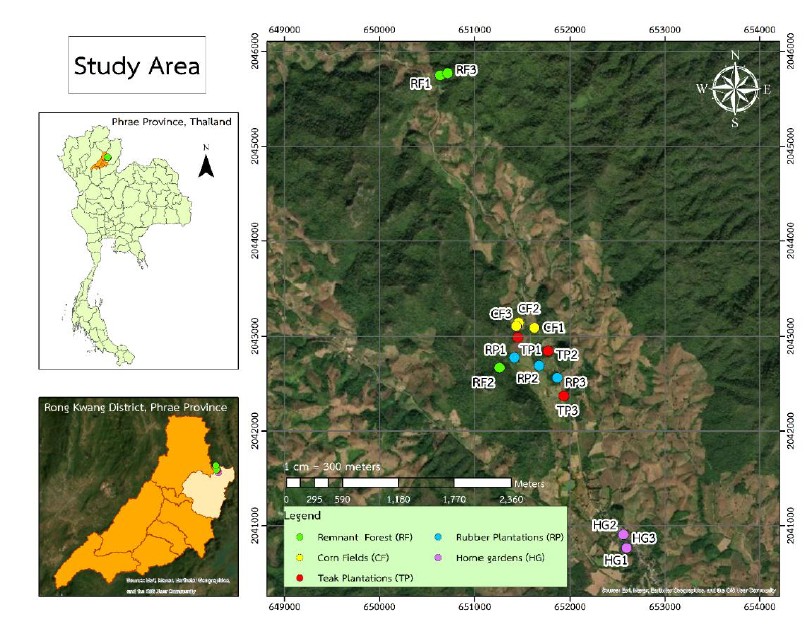
This study investigated the status of soil properties in five different land-use types within the Mae Kham Mee Watershed: teak plantation, home garden, rubber plantation, corn field, and remnant forest. Soil samples were collected from two depths, 0-5 cm (topsoil) and 20-25 cm (subsoil), with 3 samples from each area, for a total of 15 samples. The samples were analyzed for both physical and chemical properties, and the relationships between these properties and land-use types were examined. The results showed that at the 0-5 cm depth, the average soil hardness was 23.02 cm, soil moisture was 13.82% by weight, bulk density was 1.12 g/cm³, and pH was 5.84. At the 20-25 cm depth, the average soil hardness was 23.96 cm, soil moisture was 16.62% by weight, bulk density was 1.15 g/cm³, and pH was 5.86. The subsoil had slightly higher hardness and bulk density but also higher moisture compared to the topsoil, while the pH values for both layers were similarly acidic. The analysis of the relationships between soil properties and land use clearly indicates that land-use type has a significant impact on both the physical and chemical properties of the soil at different depths. The remnant forest areas had the best soil properties, maintaining their natural state. In contrast, the relationships found in the corn field and teak plantation areas showed signs of significant soil degradation, while the home garden area had high soil fertility due to human management.
Downloads
Article Details

This work is licensed under a Creative Commons Attribution-NonCommercial-NoDerivatives 4.0 International License.
ข้าพเจ้าและผู้เขียนร่วม (ถ้ามี) ขอรับรองว่า ต้นฉบับที่เสนอมานี้ยังไม่เคยได้รับการตีพิมพ์และไม่ได้อยู่ในระหว่างกระบวนการพิจารณาตีพิมพ์ลงในวารสารหรือสิ่งตีพิมพ์อื่นใด ข้าพเจ้าและผู้เขียนร่วม (ถ้ามี) ยอมรับหลักเกณฑ์และเงื่อนไขการพิจารณาต้นฉบับ ทั้งยินยอมให้กองบรรณาธิการมีสิทธิ์พิจารณาและตรวจแก้ต้นฉบับได้ตามที่เห็นสมควร พร้อมนี้ขอมอบลิขสิทธิ์ผลงานที่ได้รับการตีพิมพ์ให้แก่วารสารวนศาสตร์ คณะวนศาสตร์ มหาวิทยาลัยเกษตรศาสตร์ กรณีมีการฟ้องร้องเรื่องการละเมิดลิขสิทธิ์เกี่ยวกับภาพ กราฟ ข้อความส่วนใดส่วนหนึ่ง หรือ ข้อคิดเห็นที่ปรากฏในผลงาน ให้เป็นความรับผิดชอบของข้าพเจ้าและผู้เขียนร่วม (ถ้ามี) แต่เพียงฝ่ายเดียว และหากข้าพเจ้าและผู้เขียนร่วม (ถ้ามี) ประสงค์ถอนบทความในระหว่างกระบวนการพิจารณาของทางวารสาร ข้าพเจ้าและผู้เขียนร่วม (ถ้ามี) ยินดีรับผิดชอบค่าใช้จ่ายทั้งหมดที่เกิดขึ้นในกระบวนการพิจารณาบทความนั้น”
References
Asanok, L., Lattirasuvan, T. 2015. Tree species composition of plant communities in the Mae Kham Mee Watershed, Phrae Province. In: Proceedings of the 5th National Forest Ecology Research Network Conference: Natural resource capital: Value, development, and conservation. Department of National Parks, Wildlife and Plant Conservation, National Park Innovation Institute. pp. 195-202. (in Thai) Chankaeo, K. 2008. Principles of Watershed Management. Kasetsart University Press, Bangkok, Thailand. (in Thai) Chen, S., Lin, B., Li, Y., Zhou, S. 2020. Spatial and temporal changes of soil properties and soil fertility evaluation in a large grain-production area of subtropical plain, China. Geoderma, 357(113937). Don, A., Schumacher, J., Freibauer, A. 2011. Impact of Tropical Land-Use Change on Soil Organic Carbon Stocks A Meta-Analysis. Global Change Biology, 17(4): 1658-1670. Ewunetu, T., Yihenew, G. S., Eyayu, M., Habtamu, A., Ashenafei, G. 2025. Soil properties under different land uses and slope gradients: Implications for sustainable land management in the Tach Karnuary watershed, Northwestern Ethiopia. Journal of Environmental Sciences, 13(1518068). Javed, A., Eeman, A., Khansaa, B. A., Asma, O., Samreen, R. 2022. Soil fertility: factors affecting soil fertility, and biodiversity responsible for soil fertility. International Journal of Plant, Animal and Environmental Sciences, 12(1): 21-33. Kassie, A. A., Ahmed, S. A., Abdi A. B. 2025. Variations in Soil Properties Across Land Use Types in the Shemit Watershed, Northern Ethiopian. Wiley Advances in Agriculture, 2025(9313798). Kumar, B. M., Nair P. K. R. 2004. The enigma of tropical home gardens. Agroforestry Systems, 61: 135-152. Land Development Department. 2024. Manual of Soil Physical Analysis. Office of Land Development Science, Department of Land Development, Ministry of Agriculture and Cooperatives, Bangkok, Thailand. (in Thai) Lal, R. 2005. Soil erosion and carbon dynamics. Soil and Tillage Research, 81(2): 137-142. Lattirasuvan, T., Asanok, L., Mangkita, W., Yothaphakdee, T. and Kamtan, R. 2020. Structure and land use change in the Mae Kham Mee Watershed. In: Proceedings of the 9th National Forest Ecology Research Network Conference. Faculty of Forestry, Kasetsart University. (in Thai) Lema, B., Mesfin, S., Kebede, F., Abraha, Z., Fitiwy, I., Haileselassie, H. 2019. Evaluation of soil physical properties of long-used cultivated lands as a deriving indicator of soil degradation, north Ethiopia. Physical Geography, 40(4): 323–338. Nair, P. K. R. 2001. Do tropical home gardens elude science, or is it the other way around?. Agroforestry Systems, 53: 239-245.
Nilawonk, W., Attanandana, T., Phonphoem, A., Yost, R., Shuai, X. 2008. Potassium Release in Representative MaizeProducing Soils of Thailand. Soil Science Society of America Journal, 72(3): 791-797. Office of Soil Survey and Land Use Planning. 2005. The Wonders of Soil. Land Development Department, Ministry of Agriculture and Cooperatives, Bangkok. (in Thai) Pansak, W., Hilger, T. H., Dercon, G., Kongkaew, T., Cadisch, G. 2008. Changes in the relationship between soil erosion and N loss pathways after establishing soil conservation systems in uplands of Northeast Thailand. Agriculture, Ecosystems & Environment, 128(3): 167-176. Phankamolsil, N., Tengprasert, T., Kheoruenromne, I., Phankamolsil, Y., Gilkes, R.J, Sonsri, K. 2024. Interactive influences of salinity and sodicity levels on depth-wise soil organic matter and micronutrient elements in Thailand. Environmental Research Communications, 6(2024): 045008. Pramono, I. B., Roshetko, J. M., Manurung, G. E. S. 2011. Smallholder teak plantations in Gunungkidul, Indonesia: Productivity and profitability. International Journal of Forestry Research, 2010, 1-11. Sakurai, K., Puriyakorn, B., Preechapanya, P., Tanpibal, V., Muangnil, K., Prachaiyo, B. 1995. Improvement of biological productivity in degraded lands in Thailand III. Tropics, 4(2/3): 151-172. Singtana, K., Piankhit, P., Phongkaranyapas, K., Nosaengsri, M., Asanok, L. 2024. Vegetation Structure Characteristics and Edaphic Factors in Tham Sing Recreational Forest, Udon Thani Province. Thai Forest Ecological Research Journal, 8(2): 419-436. Somprakon, S., Yothaphakdee, T., Haopinjai, I., Piankid, P., Yodkaew, S., Khruema, K., Lattirasuvan, T. 2024. Soil fertility and carbon sequestration assessment in an 8-year restoration forest area in Phrae Province. Thai Journal of Forestry, 43(1): 167-179. (in Thai) Tanaka, S., Lattirasuvan, T., Nakamoto, K., Sritulanon, C., Sakura, K. 2010. Soil fertility under various types of upland farming in northern Thailand. I. Case study of a village located in a transitional zone of hill evergreen and mixed deciduous forests. Tropics, 18(4): 185-199. Wannawong, S. 2001. Soil moisture variation from different land use types at Phu Wiang watershed, Khon Kaen province. In: Proceedings of the Forestry Conference 2002. September16-20, 2002. Royal Forest Department, Bangkok, pp. 280-287. (in Thai) Wiriyakitchanathikul, W., Kerdchana, C. 2016. Manual of Soil Physical Analysis and Interpretation for Soil Surveys and Classification. Office of Land Development Science, Department of Land Development, Ministry of Agriculture and Cooperatives, Bangkok, Thailand. (in Thai) Yao, Y., Chen, J., Li, F., Sun, M., Yang, X., Wang, G., Ma, J., Sun, W. 2022. Exchangeable Ca2+ content and soil aggregate stability control the soil organic carbon content in degraded Horqin grassland. Ecological Indicators, 134(2022): 108507.
