Relationship Between Bamboo Clump Characteristics and Egg Spawn of Bamboo Caterpillar (Omphisa fuscidentalis) at Pang Da Royal Agricultural Station, Chiang Mai Province
Article Sidebar
Main Article Content
Abstract
Bamboo caterpillars are edible insects that are highly valued and popular. They can be found in natural bamboo forests as well as in cultivated bamboo gardens where the environment is suitable for their distribution.
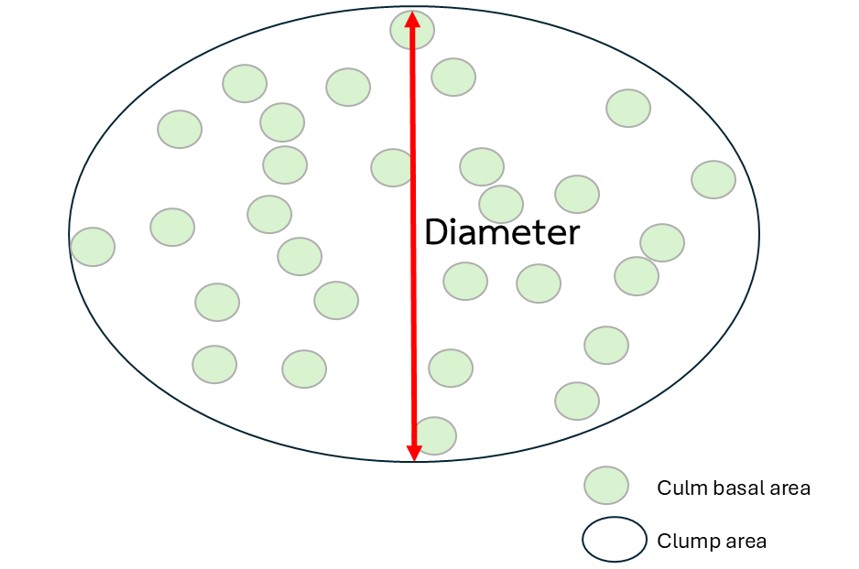
A study on the relationship between the characteristics of bamboo clumps and the egg-laying of bamboo caterpillars was conducted in a bamboo plantation aimed at producing bamboo shoots for sale, specifically at the Pang Da Agricultural Station in Chiang Mai Province. The study examined four characteristics of the bamboo clumps: the number of bamboo shoots, the number of bamboo stalks, the density of the bamboo stalks in each clump, and the distribution of the bamboo stalks in each clump, along with an investigation of the egg-laying of bamboo caterpillar moths in the year 2022.
The results of the surveys were analyzed to find the correlation between the bamboo stalk characteristics and the egg-laying of bamboo caterpillars. It was found that the characteristic of bamboo stalks that most significantly affected the egg-laying of bamboo caterpillars was the distribution of bamboo stalks in each clump, followed by the number of bamboo shoots in each clump, the number of bamboo stalks in each clump, and the density of bamboo stalks in each clump, in that order. The distribution of bamboo stalks had the greatest impact, as it provided a habitat for the bamboo caterpillar moths to hide. The number of bamboo shoots was the next leading factor, as a greater number of shoots means more food and habitat for the bamboo caterpillars. The number of stalks in the area, which was a managed bamboo plantation, did not vary significantly. Lastly, the density of bamboo stalks in each clump had the least impact due to high variability in the data.
Downloads
Article Details

This work is licensed under a Creative Commons Attribution-NonCommercial-NoDerivatives 4.0 International License.
ข้าพเจ้าและผู้เขียนร่วม (ถ้ามี) ขอรับรองว่า ต้นฉบับที่เสนอมานี้ยังไม่เคยได้รับการตีพิมพ์และไม่ได้อยู่ในระหว่างกระบวนการพิจารณาตีพิมพ์ลงในวารสารหรือสิ่งตีพิมพ์อื่นใด ข้าพเจ้าและผู้เขียนร่วม (ถ้ามี) ยอมรับหลักเกณฑ์และเงื่อนไขการพิจารณาต้นฉบับ ทั้งยินยอมให้กองบรรณาธิการมีสิทธิ์พิจารณาและตรวจแก้ต้นฉบับได้ตามที่เห็นสมควร พร้อมนี้ขอมอบลิขสิทธิ์ผลงานที่ได้รับการตีพิมพ์ให้แก่วารสารวนศาสตร์ คณะวนศาสตร์ มหาวิทยาลัยเกษตรศาสตร์ กรณีมีการฟ้องร้องเรื่องการละเมิดลิขสิทธิ์เกี่ยวกับภาพ กราฟ ข้อความส่วนใดส่วนหนึ่ง หรือ ข้อคิดเห็นที่ปรากฏในผลงาน ให้เป็นความรับผิดชอบของข้าพเจ้าและผู้เขียนร่วม (ถ้ามี) แต่เพียงฝ่ายเดียว และหากข้าพเจ้าและผู้เขียนร่วม (ถ้ามี) ประสงค์ถอนบทความในระหว่างกระบวนการพิจารณาของทางวารสาร ข้าพเจ้าและผู้เขียนร่วม (ถ้ามี) ยินดีรับผิดชอบค่าใช้จ่ายทั้งหมดที่เกิดขึ้นในกระบวนการพิจารณาบทความนั้น”
References
Aaron T. Dossey, Juan A. Morales-Ramos, M. Guadalupe Rojas. 2016. Insects as Sustainable Food Ingredients. Elsevier Science., New York.
Biossiere, M., Beyessa, M., Atmadja, S. 2019. Guiding principle for sustainable bamboo forest management planning: Benishangul-Gumuz Regional State (BGRS). Rome, FAO. 32pp.
Dachavisit, S. 2001. Bamboo Farm. Kasatsart LTD., PART. Bangkok, Thailand. (in Thai)
Keawnin, W., Wiwatwitaya, D., Sungkaew, S. 2023. Evaluation of the Damage Caused by the Bamboo Caterpilar (Omphisa Fuscidentalis) in Sweet Giant Bamboo (Dendrocalamus latiflorus) a Royal Agricultural Station Pangda, Chiang Mia Province. Thai Journal of Forestry 42(2): 99-112. (in Thai)
Pattanawiboon, R., Phuriyakorn, P., Sathitwiboon, W. 2001. Bamboo in Thailand. Forest Research and Deverlopment Office, Royal Forest Department. Bangkok
Royal Project Foundation. 2021. The Royal Agricultural Station Pang Da. https://royalproject.org/devstation/pangdah, September 5, 2024.
Samoengtai Subdistrict Municipality. 2024. General condition and basic information. https://www.samoengtai.go.th/content/generalinfo, September 5, 2024.
Singtripop, T. 2012. The Miracle of Bamboo Borer Life. Nopburee PRESS co., LTD. Chiang Mai, Thailand. (in Thai)
Singtripop, T., Wanichacheewa, S., Tsuzuki, S., Sakurai, S. 1999. Larval Growth and Diapause in a Tropical Moth, Omphisa fuscidentalis Hampson. Zoological Science, 16(5): 725-733.
Suksard, S., Wiwatwittaya, D. 1998. Marheting of Bamboo Caterpillar (Omphisa sp.). Thai Journal of Forestry, 17: 36-42. (in Thai)
Sungkaew, S., Teerawattananon, A., Jindawong, K. 2014. Bamboo of Thailand, 2nd ed. Amarin Printing and Publishing Public Co., Ltd. Bangkok, Thailand. (in Thai)
Tasen, W., Kanchanluang, R., Na Lampang, S., Suwan, N. 2007 Controlling Measures of Bamboo Shoot Borer. Thai Journal of Forestry, 26: 51-59. (in Thai)
Thounaojam, S., Tourangbam, S., K Mamocha, S. 2022. Nutritive value of bamboo worm Omphisa fuscidentalis (Lepidoptera: Crambidae): An edible insect as protein rich food. The Pharma Innovation Journal. 11(7): 2229-2233.
Wiwatwitaya, D. 1992. Biology of Bamboo caterpillar. In: Proceeding of the Forestry Conference 1992. RDF, Bangkok, Thailand, pp. 99-110. (in thai)
Wiwatwitaya, D. 1995. Ecology of Bamboo caterpillar (Omphisa sp.). In Proceedings of the 33rd Kasetsart University Annual Conference: Animal Science and Veterinary Science. Kasetsart University, Bangkok, Thailand, pp. 59-65. (in thai)
Wiwatwitaya, D. 2023. Guidelines for raising and increasing the productivity of bamboo borers in Thailand. https://www.arda.or.th, 12 January 2026.
Wisetsfinyakon, R., Sornsathapornkul, P., Ketanond, P., Laosakul, S. 2002. Estabilshment and Management of Bamboo Farm. Aksorn Siam LTD., PART. Bangkok, Thailand. (in Thai)
