
In Vitro Shoot Growth and Acclimatization of Orchid Ginger (Alpinia mutica Roxb.) Thai Medicinal Plant
Article Sidebar
Main Article Content
Abstract
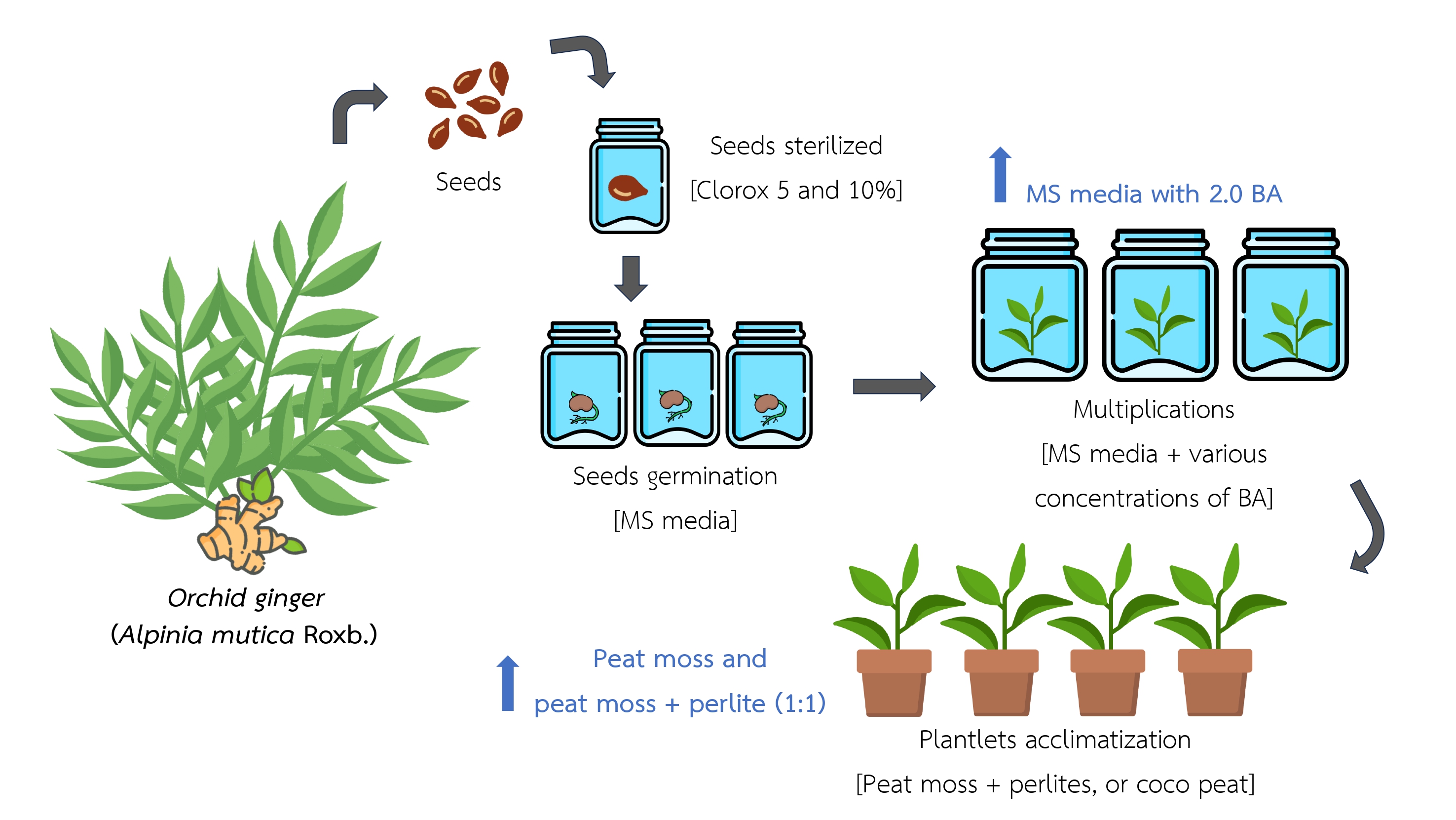
There are more than 200 species in the genus Alpinia. Plants in this genus are important for medicinal, culinary, and ornamental purposes. The most common method of propagating Alpinia species is rhizome division and seed dispersal under natural conditions. Tissue culture is an alternative method that can rapidly increase the number of plant species for commercial use. This experiment aimed to study the in vitro growth and propagation of orchid ginger or Ka Nam (Alpinia mutica Roxb.). Orchid ginger seeds were sterilized using Clorox solution at concentrations of 5% and 10%, then germinated on modified Murashige and Skoog (MS) medium. In the shoot induction study, orchid ginger shoots were cultured on MS medium supplemented with various concentrations of BA (0, 0.5, 1.0, 1.5 and 2.0 mg/ L BA) for 6 weeks. The results revealed that MS medium supplemented with 2.0 mg/L BA induced the highest number of shoots (5.40). The greatest root number and root length were observed on MS medium containing 1.5 mg/L BA. Therefore, the propagation of orchid ginger for conservation and commercial purposes can be effectively achieved on MS medium supplemented with 1.5–2.0 mg/L BA. Additionally, peat moss and a combination of peat moss and perlite were found to be effective nursery substrates for promoting the growth of orchid ginger seedlings derived from tissue culture.
Article Details
References
Zhou,Y.Q.,Liu, H., He, M.X.,Wang,R., Zeng,Q.Q., Wang, Y., Ye W.C. and Zhang, Q.W., 2018,A Review of the Botany,Phytochemical, and Pharmacological Properties of Galangal.Natural and Artificial Flavoring Agents and Food Dyes, Academic Press. pp 351-396.
Leong-Skornickova,J., Dang,T.H.,Bình, N.Q., Hlavata, K., Trưong, L.H., Dat, N.Q., Trung, N.T. and Newman, M., 2019, The identity of Amomum trilobum and Amomum unifolium (Zingiberaceae: Alpinioideae), and descriptionof fournew related species from Vietnam. Phytotaxa 401(3): 149.
Saensouk, S., Chantaranothai, P. and Larsen, K., 2003, Notes on the genus Alpinia (Zingiberaceae) inThailand. Thai For. Bull. (Bot.) 31: 95-104.
Palee, J., Kamtaeja, S. and Lakerd, J., 2020, The utilization of the Family Zingiberaceae based onlocal wisdom in Chiang Saen district, Chiang Rai province and its micropropagation for conservation. Ramkhamhaeng Res. J. Sci. Technol. 23(1): 27-38. (in Thai)
Yusoff, M.M., Ibrahim, H. and Hamid, N.A., 2011, Chemical characterization and antimicrobial activity of rhizome essential oils of very closely allied Zingiberaceae species endemic to Borneo: Alpinia ligulata K. Schum. and Alpinia nieuwenhuizii Val.Chem.Biodivers. 8: 916-923.
Sirat, M.H. and Jani, N.A., 2013, Chemical constituentsof the leaf of Alpinia mutica Roxb. Nat. Prod. Res. 27(16): 1468-1470.
Phang, C.W., Abd Malek, S.N., Ibrahim, H. and Wahab, N.A., 2011, Antioxidant properties of crude and fractionated extracts of Alpinia mutica rhizomes and their total phenolic content. Afr. J.Pharm. Pharmacol. 5(7): 842-852.
Mahae,M.and Chaiseri,S.,2009, Antioxidant activities and antioxidative components in extractsof Alpinia galanga(L.) Sw.Kasetsart J. (Nat. Sci.) 43: 358-369.
Arambewela,L.S.R., Menuka Arawwawala,L.D.A.and Athauda, N.,2010, Antioxidant and antifungal activities of essential oil of Alpinia calcarataRoscoe rhizomes. J. Ayurveda Integr. Med. 1(3): 199-202.
Srividya, A.R., Dhanabal,S.P.,Misra,V.K.and Suja, G.,2010, Antioxidant and antimicrobial activity of Alpinia officinarum. Indian J.Pharm. Sci.: 145-148.
Chan, E.W.C., Pei Ng, V., Tan, V.V. and Low, Y.Y., 2011, Antioxidant and antibacterial properties of Alpinia galanga, Curcuma longa, and Etlingera elatior (Zingiberaceae). Pharmacogn. J. 3(22): 54-61.
Biana, Q.Y., Wang,S.Y., Xu,L.J., Chan, C.O.,Mok,D.K.W. and Chen, S.B., 2013, Two new antioxidant diarylheptanoids from the fruits of Alpinia oxyphylla. J. Asian Nat. Prod. Res. 15(10): 1094-1099.
POWO, 2023, Alpinia Mutica. Available Source: https://powo.science.kew.org/taxon/urn:lsid:ipni.org:names:795340-1,February 18, 2023.
The National Resources and Environment Policy and Planning Office, 2021. Alpinia mutica. Available Source: https://thbif.onep.go.th/taxons/information/11572,February 18, 2023. (in Thai)
Saensouk, S., Saensouk, P. and N.Chanshotikul, 2018, Diversity and traditional uses of Zingiberaceae in Nong Khai province,Thailand. KKU Res. J,45(3): 574-594. (in Thai)
Theanphong, O., Jenjittikul, T. and Mingvanish, W., 2019, Chemical Constituents and In Vitro antioxidant Activities from Alpinia mutica Roxb.Fruit.The 35th International Annual Meeting in Pharmaceutical Sciences and CU-MPU International Collaborative Research Conference: 235-238.
Ibrahim, H., Sivasothy, Y., Syamsir, D.R.,Nagoor, N.H., Jamil, N. and Awang, K.,2014, Essential oil composition and antimicrobial activities of two closely related species, Alpinia mutica Roxb.and Alpinia latilabris Ridl., from Peninsular Malaysia. Sci. World J. 430831: 1-6.
Saensouk, S., 2011, Endemic and rare plants of ginger family in Thailand. KKU Res. J, 16(3): 306-330. (in Thai)
Kankamol, C., 2010, Factors Affecting In Vitro Microrhizome Induction of Alpinia Galanga Swartz and Alpinia Nigra Burrt, Research Report,Suansunandha Rajabhat University, Bangkok, 80 p. (in Thai)
Kamol, P., Boonpramook, U. and Kongbangkerd, A., 2012, Effect of cytokinins and auxins on development of Curcuma manga valeton and zijp. Cultured in vitro. Thai. J. Bot. 87-92. (in Thai)
Mueangsaen, N., Maensiri, D., Grote, P.J., Machikowa, T. and Saensouk, P., 2018, Conservation and Propagation of Rare and Economic Plants (Zingiberaceae),Plant Genetic Conservation Project under The Royal Initiative of Her Royal Highness, Princess Maha Chakri Sirindhorn (RSPG), Research Report,Suranaree Universityof Technology, Nakhon Ratchasima, 102 p. (in Thai)
Prachai, R., Jirakiattikul, Y. and Rithichai, P.,2019, Effect of BA and NAA oninvitro shoot multiplication of Boesenbergia rotunda L. Agricultural Sci. J. 13-16. (in Thai)
Murashige, T. and Skoog, F., 1962, A revised medium for rapid growth and bioassays with tobacco tissue cultures. Physiol. Plant. 15(3): 473-497.
Selvakkumar, C., Balakrishnan, A. and Lakshmi, B.S., 2007, Rapid in vitro micropropagation of Alpinia officinarum hance, An important medicinal plant, through rhizome bud explants. Asian J.Plant Sci. 6(8): 1251-1255.
Singh, M.N., Chanu, A.L., Devi,Y.P., Singh,W.R.C. and Singh, H.B., 2014, Micropropagation-an in vitro technique for the conservation of Alpinia galanga. Adv. Appl. Sci. Res. 5(3): 259-263.
Sahoo,S.,Singh,S.,Sahoo, A.,Sahoo,B.C.,Jena, S., Kar, B. and Nayak, S., 2020, Molecular and phytochemical stability of long term micropropagated greater galanga (Alpinia galanga) revealed suitable for industrial applications. Ind. Crops Prod. 148: 274-284
Illg, R.D. and Faria, R.T., 1995, Micropropagation of Alpinia purpurata from inflorescence buds. Plant Cell, Tissue Organ Cult. 40: 183-185.
Chirangini,P.,Sinha,S.K.and Sharma, G.J.,2005, In vitro propagation and microrhizome induction in Kaempferia galanga Linn.and K. rotundaLinn. Indian J. Biotechnol. 4: 404-408.
Saensouk,P.,Saensouk,S.and Pimmuen,P., 2017, In vitro propagation of Globba schomburgkii Hook. f.via bulbil explants.Walailak J. Sci. Technol, 15(10): 701-710.
