
Light Curve Analysis of Overcontact Binary System TIC 125754458
Article Sidebar
Main Article Content
Abstract
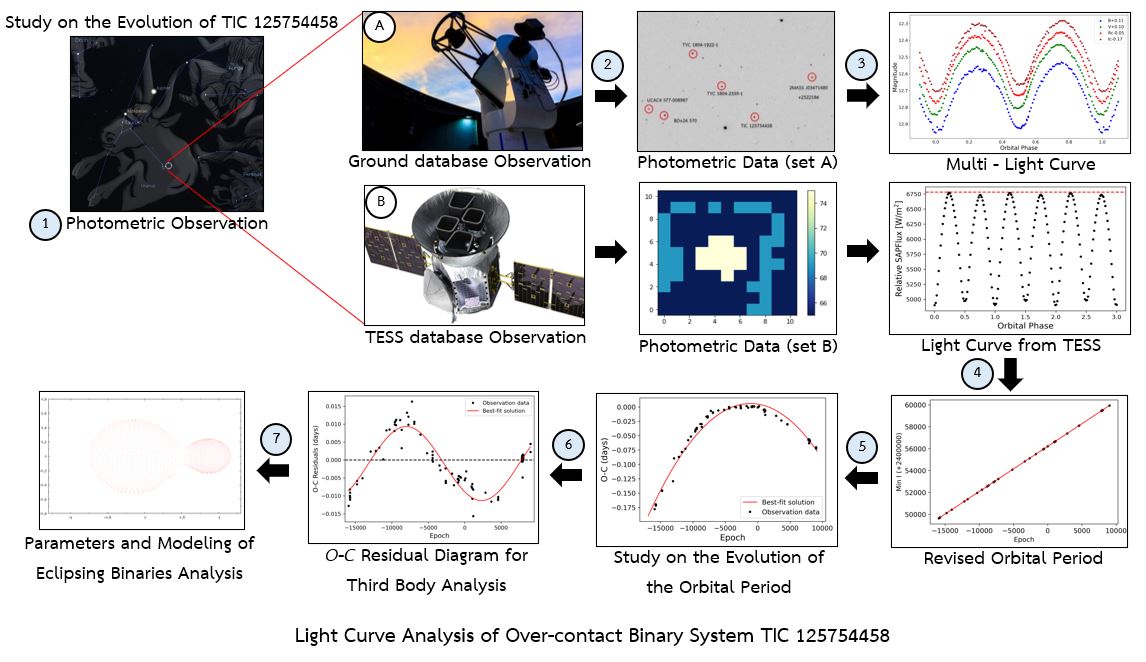
The objectives of this study were to analyze the light curves and investigate the evolutionary stages of overcontact eclipsing binary star systems with low mass ratios (q < 0.25). Observations were conducted using optical data gathered from a reflecting telescope in the visible spectrum, following the Johnson-Cousins UBVRCIC photometric systems, along with data from the TESS telescope. The optical analysis results were applied to determine the physical characteristics and develop a model for studying the evolution of the overcontact binary system. The findings revealed a symmetrical light curve typical of a W UMa Subtype A eclipsing binary system, with a newly determined orbital period of 0.412519±0.000001 days. According to the Angular Momentum Loss (AML) theory, this period is decreasing at a rate of 1.354039±1.382400×10⁻⁷ day per year. Additionally, the third light in the eclipsing binary system (EB) was analyzed, indicating a sinusoidal pattern with an amplitude of approximately 0.007950 days and an orbital period of about 20 years for the third body.
Article Details
References
Binnendijk, L.(1950). Photographic lightcurves of AH Tauri and a new variable He 556. Bull. Astron. Inst. Neth; 11: P.20
Kholopov, P. N., Samus, N. N., Frolov, M. S., Goranskij, V. P., Gorynya, N. A., Kireeva, N. N., Kukarkina, N. P., Kurochkin, N. E., Medvedeva, G. I. and Perova, N. B. (1988). VizieR Online Data Catalog: General Catalog of Variable Stars, 4th Ed. (GCVS4). Available Source: https://ui.adsabs.harvard.edu/abs/1996yCat.2139....0K/abstract ,December 10, 2023 .
Yang, Y. G. and Liu, Q. (2004). CU Tauri: A W UMa-type system with a small mass ratio. Astrophys. Space Sci, 289(1), 137-145.
Wilson, R. E. and Devinney, E. J. (1971). Realization of accurate close-binary light curves: Application to MR Cygni, Astrophys. J, 166, 605-619.
Wilson, R. E. (1990). Accuracy and Efficiency in the Binary star reflection effect. Astrophys. J, 356, 613-622.
Davidge, T. J. and Molone, E. F. (1984). A study of the O'Connell effect in the light curves of eclipsing binaries. Astrophys. J. Suppl. Ser, 55 (1), 571-584.
Qian, S. B., Yang, Y. G., Soonthornthum, B., Zhu, L. Y., He, J. J. and Yuan, J. Z., 2005, Deep, Low mass ratio Overcontact binary system. III. Cu Tauri and TV Muscae. Astrophys. J, 130(1), 224-233.
Nelson, R.H. (2013). Information Bulletin on Variable stars, 6018, 1.
Kallrath, J., Milone, E.F., Terrell, D. and Young, A. T. (1998). Recent improvements to a version of the wilson-devinney program. Astrophys. J, 508(1), 308-313.
Zhang, X. B., Zhang, R.X. and Deng, L.(2005). Photometric study of AH cancri, a wUMa-type system in M67. Astrophys. J, 129(2), 979-984.
He, J., Qian, S. B. and Soonthornthum, B. (2011). New Progress on High Fill-Out, Extreme Mass Ratio Overcontact Binary Systems. Proceedings of the 9 th Pacific Rim Conference on Stellar Astrophysics (PRCSA2011), 14-20 Apr 2011, Lijiang, China.
Zhu, L. Y., Qian, S. B., Soonthonthum, B. and Yang, Y. G. (2006). Deep, low mass ratio overcontact binaries. II. IK persei. Astrophys. J, 129(6), 2806-2814.
Crispim, J.T. M.,Ramos, G.S., Amorim,R. G. S.B. de, Aguiar, J. L. A., and Brito, A. C. de. (2023).Para Proceedings 4. Sociedade Astronômica Brasileira (SAB). Retrieved from Available Source: https://sab-astro.org.br/wp-content/uploads/2023/04/ParaProceedings-4.pdf, December 10, 2023.
Space Telescope Science Institute. (n.d.). Mikulski Archive for Space Telescopes (MAST). (2023). Available Source:https://mast.stsci.edu/portal/Mashup/Clients/Mast/Portal.html, December10, 2023.
Prša, P., Conroy, K. E., Horvat, M., Pablo, H.,Kochoska, A.,Bloemen,S., Giammarco, J., Hambleton, K. M., Degroote, P., and Batalha, D. G. (2012).PHOEBE: A software package for modeling eclipsing binaries. Astrophys. J. Suppl. Ser, 201(2), 1-29.
Nelson, R.H. (2017). Inf. Bull. Var. Stars,6234, 1.
Agerer, F. and Hüebscher, J. (1997). Inf.Bull. Var. Stars, 4472, 1.
Agerer, F. and Hüebscher, J. (1998). Inf.Bull. Var. Stars, 4562, 1.
Agerer, F. Dahm, M. and Hüebscher, J.(1999). Inf. Bull. Var. Stars, 4912, 1.
Agerer, F. and Hüebscher, J. (2000). Inf.Bull. Var. Stars, 4912, 1.
Agerer, F. and Hüebscher, J. (2002). Inf.Bull. Var. Stars, 5296, 1.
Agerer, F. and Hüebscher, J. (2003). Information Bulletin on Variable Stars, 5484, 1.
Nelson, R.H. (2003).Inf. Bull. Var. Stars,5371, 1.
Nelson, R.H. (2004). Inf. Bull. Var. Stars,5493, 1.
Hüebscher, J., Aston P. and Walter, F. (2005). Inf. Bull. Var. Stars, 5657, 1.
Nelson, R.H. (2006). Inf. Bull. Var. Stars,5672, 1.
Brát, L., Šmelcer, L., Kučáková, H., Ehren-berger,R.,Kocián,R.,Lomoz,F., Urbančok, L., Svoboda, P., Trnka, J., Marek, P., Dřevěný,R., Uhlář,R.,Poddaný,S., Zasche, P. and Skarka, M. (2008). B.R.N.O. Time of minimum. Open. Eur. J. Var. stars, 0094.
Nelson, R.H. (2008). Inf. Bull. Var. Stars,5760, 1.
Hüebscher, J., Aston P. and Walter, F. (2009). BAV Mitteilungen, 203, 1.
Hüebscher, J. (2014). Inf. Bull. Var. Stars,6118, 1.
Diethelm, R. (2010). Inf. Bull. Var. Stars,5920, 1.
Diethelm, R. (2011). Inf. Bull. Var. Stars, 6011, 1.
Honkova, K., Jurysek, J., Lehky, M., Smelcer, L., Trnka, J. and Masek, M. (2013).B.R.N.O.Timeof minimum. Open. Eur. J. Var. stars, 0160, 1.
Nelson, R.H. (2013). Inf. Bull. Var. Stars, 6050, 1.
Diethelm, R. (2013). Inf. Bull. Var. Stars, 6063, 1.
Basturk, O., Bahar, E., Senavci, H. V., Kilicoglu, T., Ozavci, I., Burdanov, A.,Yilmaz, M., Caliskan, S., Tezcan, C. T., Yorukoglu, O., Ozkeles, A., Izci, D. D., Gumus, D., Avci, Z., Ozturk, D., Selam, S. O., Ekmekci, F. and Albayrak, B. (2014). Inf. Bull. Var. Stars, 6125. 1.
Honkova, K., Jurysek, J., Lehky, M., Smelcer, L., Trnka, J. and Masek, M. (2014). B.R.N.O. Time of minimum of eclipsing binary. Open. Eur. J. Var. Stars, 0165, 1.
Juryšek, J., Hoňková, K., Šmelcer, L., Mašek, M., Lehký, M., Bílek, F., Mazanec, J., Hanžl, D. and Magris, M. (2017). B.R.N.O. Time of minimum. Open. Eur. J. Var. Stars, 0179, 1.
Erkan, N. and Ulaș, B. (2016). The low mass ratio contact binary system V728 Herculis. New Astron. Rev, 46(1), 73-77.
Eaton, J. A. (2016). AW ursae majoris: a semidetached mass -transferring system indeed?. Mon. Not.R. Astron.Soc,457(1), 836-843.
Wolf, M. (2014). Light-time effect as a valuable tool in stellar astrophysics. Contrib. Astron. Obs. Skaln. Pleso, 43(3), 493-497.
Rangsungnoen,T. (2015).Third bodyand evolution of a binary system FZ orionis. KKU. Sci. J, 43 (2), 333-345. (in Thai)
Honkova, K., Jurysek, J., Lehky, M., Smelcer, L., Masek, M. and Mazanec, J. (2015).B.R.N.O.Timeof minimum. Open. Eur. J. Var. Stars, 0168. 1.
Soonthornthum, B. (2007). Thailand: Astro-physics. National Astronomical Research Instituteof Thailand Ministryof Science and Technology.
University of Strasbourg/CNRS. Simbad Astronomical Database. (2020). Available Source: https://simbad.u-strasbg.fr/simbad/sim-basic?Ident=%09TIC+125754458&submit=SIMBAD+search, December 10, 2023.
Mass Ratio and Spot ParameterEstimation from Eclipsing Binary Star Light Curves Terrell, D. (2022). Galaxie, 10(1), 8.
