
Developing Fermented Bio Extracts from Agricultural Waste to Increase Cassava Production
Article Sidebar
Main Article Content
Abstract
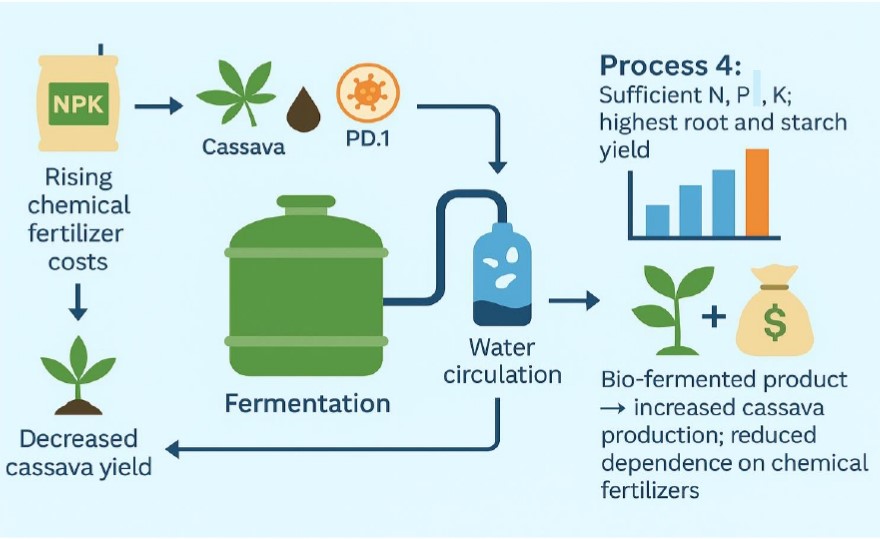
Since the price of chemical fertilizers has increased significantly due to conflicts among major fertilizer producers and exporters (Russia and Ukraine), the cost of crop production in Thailand has risen, resulting in lower yields. Organic fertilizers offer an alternative approach for supplying nutrients to the soil and enhancing crop productivity. Accordingly, this research aims to develop a process for transforming agricultural waste materials into biologically fermented products that meet the fertilizer standards specified by the Department of Agriculture. These fermented products were applied to experimental cassava plants, and crop yields were assessed. Cassava leaves and water from a circulating pump were used as raw materials for fermentation. The experiment was conducted using an A x B factorial design in a completely randomized design (CRD), with two replicates (n = 2). Key parameters (temperature, pH, and dissolved oxygen) were monitored daily during the 30-day fermentation process, and the resulting products were analyzed for nitrogen (N), phosphorus (P), and potassium (K) contents. The results showed that Process 4 produced a fermented product containing all essential macronutrients at levels meeting the required criteria. Furthermore, when bio-fermented products were applied to Cassava plant experimental plots, Process 4 yielded the best results in terms of fresh tuber weight and starch content. In summary, the findings indicate that the process developed in this study for producing bio-fermented products can enhance agricultural productivity and can serve as a guideline for sustainable agricultural practices, offering economic, social,environmental, and ecological benefits.
Article Details
References
OAE 2022, “Agricultural Production Data,” Office of Agricultural Economics 2024, Available Source: https://oae.go.th/home/article/475, September 5, 2022. (in Thai)
Lovely, L., Mirasol, P., Ocampo, A., Valdez, A., Cordora, D. F. and Oberthür, T., 2018, Cassava response to fertilizer application, J. Bett Crops. 102 (2): 11–13.
Tunpaiboon, N., “Business Trend / Industrial for the Chemical Fertilizer Industry in 2023-2025,”Article Krungsri Research, 2023, Available Source: https://www.krungsri.com/th/research/industry/industryoutlook/chemicals/chemical-fertilizers/io/io-chemical-fertilizers-2023-2025, December 12, 2023. (in Thai)
Suhag, M., 2016, Potential of biofertilizers to replace chemical fertilizers, Int. Adv. Res. J Sci. Eng. Techno. 3 (5): 163-167.
Chojnacka, K., Moustakas, K. and Witek-Krowiak, A., 2019, Bio-based fertilizers: A practical approach towards circular economy, J. Bioresour Technol. 295: 1-11.
Glittenberg, D., Matyjaszewski, K. and Moller, M., 2012, 10.07 - Starch-based biopolymers in paper, corrugating, and other industrial applications, Polym. Sci. A Comp. Ref. 10: 165-193.
Dionisi, D., 2022, Theory and Design of Fermentation Processes. 1st Ed., CRC Press is an Imprint of Taylor and Francis Group., Boca Raton, FL, 276 p.
CMU 2022, “Theories and Summaries from Relevant Documents Fertilizer Theory,” Chiang Mai University, Available Source: https://archive.lib.cmu.ac.th/full/T/2558/enenv50558tmk_ch2.pdf, August 20, 2022. (in Thai)
LEC Partners 2024, Aerobic Fermentation Processing, Available Source: https://lee-enterprises.com/aerobic-fermentation-processing/, June 30, 2024.
Soderberg, A. C., 2014, Chapter 6 - Fermentation Design. Fermentation and Biochemical Engineering Handbook. pp. 85-108.
ACC 2022, “Article - the Harnessing Cassava Residues for Sustainability,” Asean Cassava Center, Available Source: https://sustainablecassava.org/information-hub/articles/CassavaWasteHandbook2/, June 12, 2022.
Howeler, R. (2017). Effect of Cassava Production on Soil Fertility and the Long-Term Fertilizer Requirements to Maintain High Yields. In: Centro Internacional de Agricultura Tropical (CIAT), The Cassava Handbook: A Reference Manual Based on the Asian Regional Cassava Training Course. CIAT, Cali, Colombia. pp. 411–428.
Alamu, E.O., Dixon, A., Eyinla, T.E. and Maziya-Dixon, B., 2022, Characterization of macro and micro-minerals in cassava leaves from genotypes planted in three different agroecological locations in Nigeria, J. Heliyon. 8(11): e11618.
Hawlader, N.H., Md. Fakir, S.A., Ahmad, M., Nesa, H., Md. Rahman, M., Hasan, I., Md. Islam, M.,Md. Islam, S. and Md. Majumder, S.I., 2020, Cassava leaf compost influences growth, yield and nutrient uptake of rice, Annu. Res. Rev. Biol. 35(9): 23-33.
Ravindran, V., 1991, Preparation of Cassava Leaf Products and Their Use as Animal Feeds. In FAO Animal Production and Health Paper, No. 95, pp. 111–125, Food and Agriculture Organization, Rome.
Boukhers, I., Boudard. F., Morel, S., Servent, A., Portet, K., Guzman, C., Vitou, M., Kongolo, J., Michel, A. and Poucheret, P., 2022, Nutrition, healthcare benefits and phytochemical properties of cassava (manihot esculenta) leaves sourced from three countries (reunion, guinea, and costa Rica), Food Sci. J. 11(14): 1-15.
Sosnowski, J., Truba, M. and Vasileva, V., 2023, The impact of auxin and cytokinin on the growth and development of selected crops, J. Agric. Rev. 13 (3): 1-15.
Fauzan, N.D., Yusnita, Y., Asmara, S., Karyanto, A. and Widyastuti, R. A. D., 2025, Improving cassava growth and yield through auxin paste treatment on cuttings: A clonal comparison, Indones. J. Agric. 53(1): 122-130.
Kurve, A., Kawale, D., Deshmukh, S., Gedam, M. and Sarve, S., 2024, Cassava leaves as a fertilizer: A sustainable technique, Int. J. Recent Adv. Multidiscip. Top. 5(2): 21-22.
Ryan, P., Aerated Liquid Compost Generator, Available Source:
https://rainsurfer.ie/blogs/aeratedliquid-fertiliser/aerated-liquid-compost-generator, December 24, 2024.
Sarin, P. and Riddech, N., 2018, Effects of agricultural residues as carriers for bio-fertilizer production to promote tomato growth in saline soil, CMU. Sci. J. 45(4): 1699-1712.
A. Allouzi, M.M., A. Allouzi, S.M., Keng, Z.X., Supramaniam, C.V., Singh, A. and Chong. S., 2021, Liquid biofertilizers as a sustainable solution for agriculture, J. Heliyon. 8(12): 1-13.
DOA 2022, “Subject: Organic Fertilizer Criteria” Department of Agriculture 2014, Archives 2014 to Present, Available Source: https://www.doa.go.th/ard/wp-content/uploads/2019/11/FEDOA11.pdf, September 21, 2022. (in Thai)
LDD 2022, “Biotechnology Products,” Land Development Department, Available Source: https://www.ldd.go.th/menu_5wonder/, August 24, 2022. (in Thai)
Bhatti, A.A., Haq, S. and Bhat, R.A., 2017, Actinomycetes benefaction role in soil and plant Health, J. Microb. Pathog. 111: 458-467
DOA 2022, “Organic Fertilizer Analysis Method Guide,” Department of Agriculture (ISBN 978-974-436-679-5) Archives 2008 to Present, Available Source: http://lib.doa.go.th/multim/e-book/EB00061.pdf, September 12, 2022. (in Thai)
LDD 2022, “How to Collect Soil Samples for Analysis,” Land Development Department, Available Source: http://iddindee.ldd.go.th/web/SoilData/3/pdf/, September 15, 2022. (in Thai)
OAE 2022, “How to Plant Cassava,” Office of Agricultural Economic, Available Source: https://www.doa.go.th/fc/ubonratchathani/wp-content/uploads/2022/07/, September 30, 2022. (in Thai)
