
Development of a Silkworm-Rearing House Using the Internet of Things (IoT) System for Temperature and Humidity Control
Article Sidebar
Main Article Content
Abstract
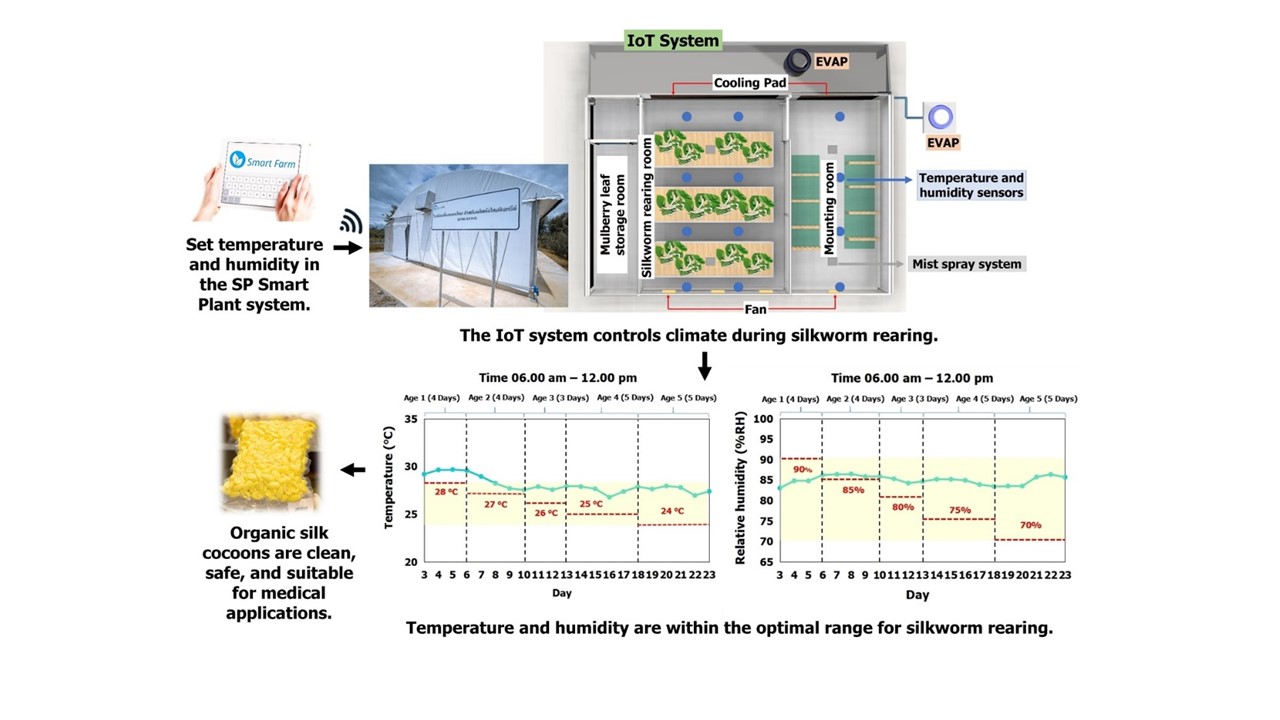
This research involves the development of a silkworm-rearing house equipped with an Internet of Things (IoT) system to regulate temperature and humidity within the facility. It also includes the design of the rearing area and processes in accordance with the standards outlined in TAS 8203 by the National Bureau of Agricultural Commodity and Food Standards (2017). The silkworm-rearing facility is located in Dan Thap Tako Subdistrict, Chom Bueng District, Ratchaburi Province. The Tubtim Siam 06 variety of silkworms was used as the model species. The results indicate that the IoT-equipped silkworm-rearing house, used for rearing silkworms from the 1st instar to the 5th instar, maintained temperature between 25.72°C and 30.25°C, and relative humidity values between 77.66%RH and 89.90%RH during the periods of 6:00 a.m.-12:00 p.m. and 6:00 p.m.-12:00 a.m. The IoT system effectively regulated both temperature and humidity, providing an environment suitable for silkworm development. The cocoon products produced in this facility demonstrated superior quality compared with reference data from the Queen Sirikit Department of Sericulture. Moreover, the silk cocoons obtained were clean, safe, and suitable for medical applications. Therefore, this silkworm-rearing house equipped with the IoT system is considered suitable and convenient for farmers, enabling year-round silkworm production.
Article Details
References
Office of Sericulture Conservation and Standard Conformity Assessment, 2015, Conservation Silk Varieties, The Queen Sirikit Department of Sericulture, Bangkok, 154 p. (in Thai)
Aeknarajindawat, N., 2023, Knowledge management in sericulture cultivation and weaving of natural dyed silk of the community enterprise group in Phon District, Khon Kaen Province, Rajapark J. 17(50): 232-246. (in Thai)
Wechagarn, A., Choenkwan, S. and Kiatsuranont, P., 2020, Needs for extension on mulberry cultivation and silkworm rearing of farmers in Si Sa Ket province, Khon Kaen Agr J. 48(2): 369-380. (in Thai)
Suwannapa, J., Techniques for Rearing Silk during the Summer, Available Source: https://www.rakbankerd.com/agriculture/print.php?id=2018&s=tblanimal, May 6, 2024. (in Thai)
Kittisut, P., 2015, Self-temperature inspection system of closed chicken farm by data transmission through mobile phone, RMUTI J. 8(1): 140-150. (in Thai)
Suriyasomboon, A. and Techakampu, M., 2010, Effect of Temperature and Humidity on Reproductive Performance of Gestating Sows under Different Housing Systems in Thailand, Proceedings of 48th Kasetsart University Annual Conference: Veterinary Medicine, pp. 58-66. (in Thai)
Juechan, J., 2019, Temperature and Humidity Monitoring System in Server Room Using IoT, Research Report, Burapha University, Chonburi, 139 p. (in Thai)
Phumcharoen, J. and Ploywattanawong, L., 2022, The IoT technology for control the earthworm culture environment, KKU Res J (GS). 22(1): 145-155. (in Thai)
Kamonkunanon, S., Songneam, N., Supawantanakul, D. and Siringam, T., 2023, The development of factor control of production process for cool group of mushrooms in smart farm using internet of things technology, Life Sci Environ J. 24(1): 1-13. (in Thai)
Arreerard, T. and Arreerard, W., 2020, IoT system for humidity and temperature monitoring to promote cultivation of mushrooms in greenhouses to have a complete product, J Appl Inf Tech. 6(1): 7-17. (in Thai)
Nopparatmaitree, M. and Kitpipit, W., 2016, Study on rearing area and floor level under evaporative cooling system house on environment, heat stress index, and mortality rate of broilers, Khon Kaen Agr J. 44(1): 442-447. (in Thai)
Panthirat, K., 2018, Mulberry Cultivation, Sericulture and Management by Small scale Sericulturists in Nongbua Lamphu Province, Master Thesis, Sukhothai Thammathirat Open University, Bangkok, 108 p. (in Thai)
National Bureau of Agricultural Commodity and Food Standards, 2016, Good Practices for Silk Cocoon Production. Guidance on the Application of Thai Agricultural Standard. TAS 8201(G)-2016, Bangkok, 41 p. (inThai)
National Bureau of Agricultural Commodity and Food Standards, 2017, Organic Silk Part 1 : Silk Coocoon, Silk Filament Sheet and Silk Yarn. Thai Agricultural Standard. TAS 8203 Part 1-2017, Bangkok, 15 p. (inThai)
National Bureau of Agricultural Commodity and Food Standards, 2021, Organic Agriculture: The Production, Processing, Labelling and Marketing of Organically Produce and Products. Thai Agricultural Standard. TAS 9000-2021, Bangkok, 60 p. (inThai)
The Queen Sirikit Department of Sericulture, 2014, Knowledge on Thai Silk Product Development, Bangkok, 82 p. (inThai)
Yamfang, M., Boonwan, C., Laongwan, C., Assanee, N., Pairintra, R. and Guptasa M., 2021, The application of combined systems including evaporative cooling and vapor compression air conditioning system for a silkworm rearing house, J. Eng. RMUTT. 19(1): 13-23. (in Thai)
Notification of The Ministry of Public Health, 2022, Specification of Qualities or Standards of Food Packaging Made from Plastic, Bangkok, 23 p. (inThai)
