
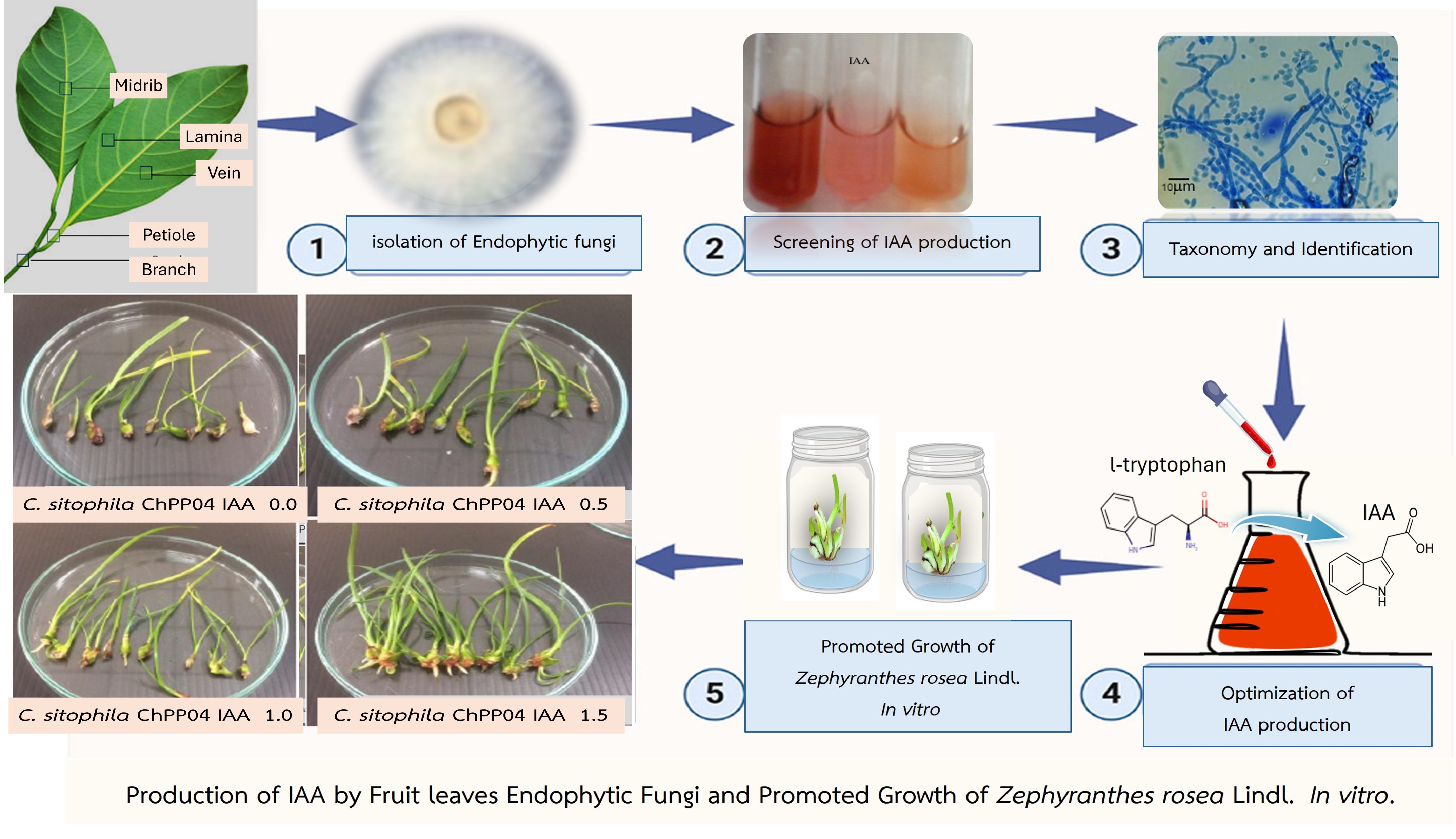
การผลิต IAA โดยเชื้อราเอนโดไฟต์จากใบไม้ผลและส่งเสริมการเจริญเติบโตของ Zephyranthes rosea Lindl. ในการเพาะเลี้ยงเนื้อเยื่อ
Article Sidebar
Main Article Content
บทคัดย่อ
ราเอนโดไฟท์เป็นราที่อาศัยอยู่ในเนื้อเยื่อพืชแบบพึ่งพาอาศัยโดยไม่ก่อให้เกิดอาการโรค สามารถสังเคราะห์กรดอินโดลอะซิติก(IAA)ที่มีผลต่อการเจริญเติบโตและพัฒนาการของพืช การศึกษานี้เพื่อศึกษากิจกรรมส่งเสริมการเจริญเติบโตของบัวดินในสภาพปลอดเชื้อโดยเชื้อราเอนโดไฟต์ที่แยกได้จากส่วนต่าง ๆ ของใบมังคุด เงาะ สาเก จำปาดะ ขนุน ลองกอง และ ลางสาด บนอาหาร PDA ที่เติมยาปฏิชีวนะ tetracycline และ ampicillin เข้มข้น 50 มิลลิลิตร/ลิตร จำนวน 53 ไอโซเลทที่แยกได้ มีเพียง 26 ไอโซเลท ที่ผลิต IAA ได้ โดยรา Chrysonilia sitophila ChPP04 ที่แยกจากก้านใบจำปาดะผลิต IAA ได้สูงสุด 675.97±0.32 ไมโครกรัม/มิลลิลิตรในอาหาร Czapek broth ที่เติม L-tryptophan เข้มข้น 1.50 มิลลิกรัม/ลิตร ประสิทธิภาพ IAA จากรา C. sitophila ChPP04 ต่อการเจริญของบัวดินสีชมพูบนอาหาร MS เติม BA เข้มข้น 2.0 มิลลิกรัม/ลิตรร่วมกับ IAA เข้มข้น 1.5 มิลลิกรัม/ลิตร ชักนำให้เกิดยอดจำนวน 7.11 ± 1.98 ยอด ความยาวยอด 2.90 ± 1.10 เซนติเมตร และชักนำให้เกิดรากโดยใช้ NAA เข้มข้น 1.0 มิลลิกรัม/ลิตร มีจำนวนราก 1.9±3.11 ราก มีความยาวราก 1.4±2.21 เซนติเมตร จากผลการวิจัยแสดงให้เห็นว่า IAA ที่ผลิตจากราเอนโดไฟต์มีศักยภาพในการเป็นสารเร่งการเจริญเติบโตของพืชในวงศ์ Amaryllidaceae ในการเพาะเลี้ยงเนื้อเยื่อได้
Article Details
เอกสารอ้างอิง
Rodriguez, R.J., White, F.J., Arnold, A.E. and Redman, R.S., 2009, Fungal endophytes: diversity and functional roles, New Phytol. 182: 314-330.
Hashem, A.H., Attia, M.S., Kandil, E.K.,Fawzi, M.M., Abdelrahman, A.S. and Khader, M.S.,2023,Bioactive compounds and biomedical applications of endophytic fungi:arecent review, Microb Cell Fact. 22(1): 1-23.
Devi, R., Verma, R., Dhalaria, R., Kumar, A., Kumar, D. and Puri, S., 2023, A systematic review on endophytic fungi and its role in the commercial applications, Planta. 257(4): 70-95.
Dwibedi,V., Rath, S.K., Joshi, M., Kaur, R.,Kaur, G. and Singh, D., 2022, Microbial endophytes: Application towards sustainable agriculture and food security, Appl Microbiol Biot. 106(17): 5359-5384.
Debnath, S.C., Teixeira da Silva, J.A. and Bhowmik, N., 2006, Indole-3-acetic acid (IAA) and its role in plant tissue culture. Plant Growth Regul, 50(1): 1-19.
Behzad Kaviani and Sara Zakizadeh., 2013, Role of photoperiod on some growth characters of Amaryllis (Hippeastrum johnsonii) ,a bulbous plant,Eur. J. Exp. Biol. 3(1): 289-291.
Buddharaksa, P., Kaewdungtip ,C. and U-Kong, W., 2011, In vitro culture of Hippeastrum johnsonnii Bury and Caladium bicolorVent, Naresuan Univ. J. Sci. Technol. 19(1): 18-23. (in Thai)
Khamrit, R. and Ngonphukhiao, S. 2020, In vitro shoot and root induction of Hippeastrum johnsonii,KhonKaen Agric. J., 48 Suppl 1: 1025-1030. (in Thai)
Buddharaksa,P., Chundet,R.and U-Kong, W., 2012, Micropropagation of Caladium bicolor Vent., Kalanchoe blossfeldiana Poellnitz. and Kakanchoe pinnata Pers, J. Sci. Ladkrabang., 21(2): 1-15. (in Thai)
Rattana, K., Sangchanjiradet, S. and Munglue, P., 2017, Effect of BA and NAA on in vitro culture of young leaves of Caladium bicolor Vent,SDU Res J.10(3):34-45. (in Thai)
Chomchuen, E., Hutangkur, P. and Chikhuntod, U., 2012, Factors affecting the propagation of water onion (Crinum thaianum) using in vitro bulb culture,Agricultural Sci J.43(2):589-592. (inThai)
Ulrich, K., Ulrich, A. and Ewald, D., 2008, Diversity of endophytic bacterial communities in Poplar grownunder field conditions,FEMS Microbiol Ecol.63:169-180.
Murali, M., Janardhan, A. and Krishna, N.,2020, Endophytic fungi as potential sources of IAA: Applications in plant tissue culture. Fungal Biol Rev. 34(2): 57-66.
Rodrigues, K.F. and Samuels, G.J., 2008, Preliminary study of endophytic fungi in a tropical palm, Mycol Res. 94: 827-830.
Greenfield, M.,Pareja,R., Ortiz,V., Gómez- Jiménez, M.I., Vega, F.E. and Parsa, S.,2015, A novel method toscaleup fungal endophyte isolations, Biocontrol Sci Techn. 25(10): 1208-1212.
Zhang,F., J.Yuan, X.Yang,Y. Cui,L. Chen,W. Ran, and Shen, Q., 2013, Putative Trichoderma harzianum mutant promotes cucumber growth by enhanced production of indole acetic acid and plant colonization, Plant Soil. 368: 433-444.
Banlangnak, W., Chueakrut, S. and Preechanukul, K., 2007, Isolation and Selection of Actinomycetes Capable of Producing Antibiotic-Resistant Bacteria, Master Thesis, Naresuan University,Phitsanulok, 125 p. (in Thai)
Navi,S.S.,Bandy,R., Hall, A.J.and BramelCox, P., 1999, A Pictorial Guide for the Identification of Mold Fungi on Sorghum Grain, Inf Bul. (59), International Crops Research Institute for Semi Arid Tropics, Patancheru, AndhraPradesh, India, 118 p.
Dugan, F.M., 2008, The Identification of Fungi: An Illustrated Introduction with Keys, Glossary and Guide to Literature. St. Paul, Minnesota, The American Phytopathological Society, 346 p.
Guarro, J., Gene, J. and Stihigel, A.M.,1999, Developments in Fungal Taxonomy,Clin Microbiol Rev. 12(3): 454-500.
Murashige, T. and Skoog, F., 1962, A revised medium for rapid growth and bio-assays with tobacco tissue cultures,Plant Physio. 15(3): 473-497.
Chinorak, C. and Chinorak. P. 2008, Biology., 4 th Printing, Aksorn Prasit Printing House, Bangkok,350 p. (in Thai)
Siqueira, V.M., Conti, R., de Araújo, J.M.,2011, Endophytic fungi from the medicinal plant Lippia sidoides Cham.and their antimicrobial activity,Symbiosis.53: 89-95.
Arnold, A.E. and Lutzoni, F., 2007,Diversity and host range of foliar fungal endophytes: Are tropical leaves biodiversity hotpot, Ecology. 88(3): 541-549.
Photita, W., Lumyang, S., Lumyang, P.,Hyde,K.D.,2001,Endophyticfungiof wild banana (Musa acuminata) at Doi Suthep Pui National Park, Thailand, Mycol Res.105(12): 1508-1513.
Khunna, S., Kitkha, B. and Nueangmak,W.,2016, Indol Acetic Acid Production by Fungi. Mucor Ellipsoideus, Rhizopus Oryzae and Trichderma Harziamum, Research Report, Phuket Rajabhat University, Phuket, 79 p. (in Thai)
Numponsak, T., 2016, Indole-3-Acetic Acid Production by Endophytic Fungi in Genus Colletotrichum Isolated from Arabica Coffee Plant and Its Effect on Plant Growth, Master Thesis, Chiang Mai University, Chiang Mai, 117 p. (in Thai)
Bose, A., Shah, D. and Keharia, H., 2013, Production of indole-3-acetic-acid (IAA) by white rot fungus Pleurotus ostreatus under submerged condition of Jatropha seedcake, Mycology, 4(2): 103-111.
Spaepen,S. and Vander leyden, J.,2011, Auxin and plant-microbe interactions, Cold Spring Harb Perspect Biol. 1-13.
Tang, J., Li, Y., Zhang, L., Mu, J., Jiang, Y.,Fu, H., Zhang,Y., Cui, H.,Yu, X. and Ye, Z.,2023, Biosynthetic pathways and functions of indole-3-acetic acid in microorganisms,Microorganisms, 11(8): 1-24.
Ikeuchi, M., Sugimoto, K. and Iwase, A.,2013, Plant callus: mechanisms of inductionand repression, Plant Cell.25:3159-3173.
Bunnag, S., 2013,Plant Tissue Culture and Plant Gene Transfer, KKU publishing, Khon Kaen, 150 p. (in Thai)
