
Characterization of Lactic Acid Bacteria as Probiotics for the Fermentation of Plant-Based Beverage
Article Sidebar
Main Article Content
Abstract
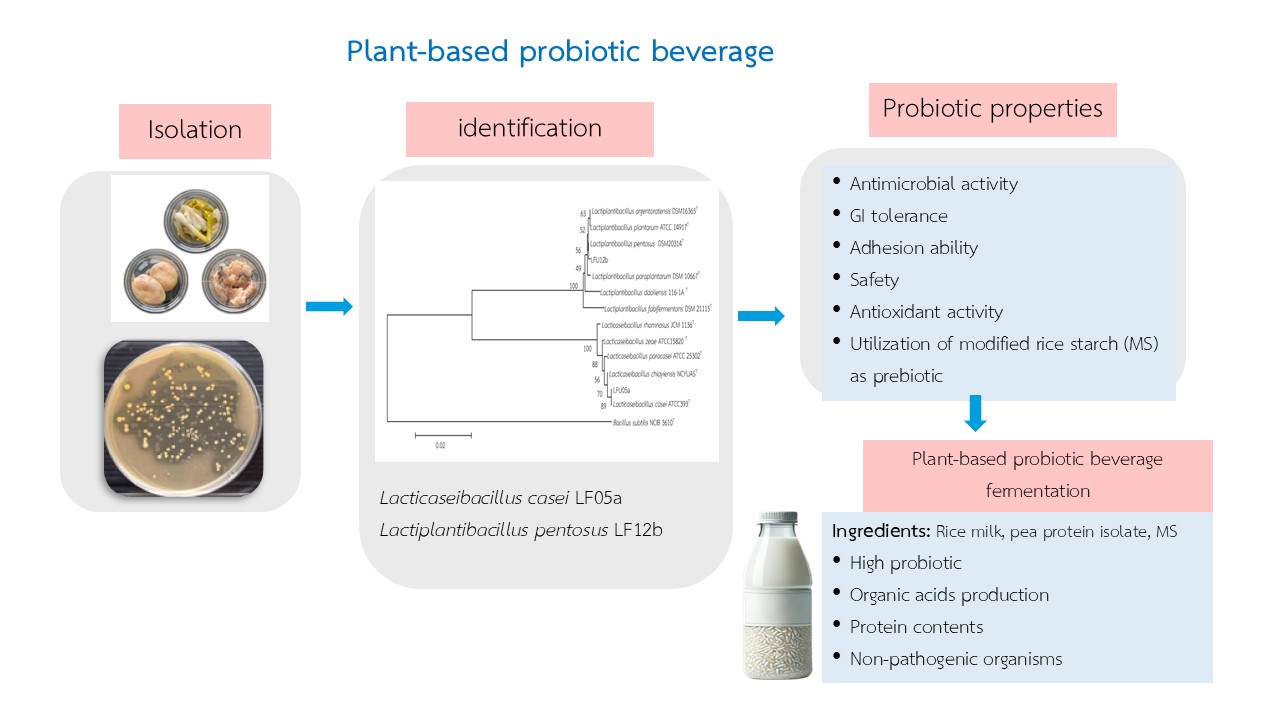
Plant-based probiotic products are a type of functional food. The objectives of this study were to screen lactic acid bacteria (LAB) and evaluatetheir probiotic properties foruseas starter cultures in producing plant-based fermented beverages. Isolates LFU05a and LFU12b were selected for further study based on their high antimicrobial activity against the tested bacterial pathogens, survival after exposure to simulated gastrointestinal tract conditions (67.54-73.83%), good adhesion ability, absence of hemolytic activity, antibiotic susceptibility, and antioxidant activity (64.23-83.26%). LFU05a and LFU12b were identified as Lacticaseibacillus casei and Lactiplantibacillus pentosus, respectively. For prebiotic selection, modified ricestarch(MS) demonstrated a prebiotic effect by enhancing the growth of L. casei LFU05a and L. pentosus LFU12b. Furthermore, plant-based fermented beverages made from rice supplemented with 10% of pea protein isolate (PPI) and 1% of MS exhibited high probiotic viability (8.45 log CFU/ml). The results indicated that L. casei LFU05a and L. pentosus LFU12b are effective starter cultures for the production of plant-based probiotic beverages.
Article Details
References
Dudek-Wicher, R., Junka, A., Paleczny, J. and Bartoszewicz, M., 2020, Clinical trials of probiotic strains in selected disease entities, Int. J. Microbiol. 2020: 8854119.
Ghosh, T., Beniwal, A., Semwal, A. and Navani, N.K., 2019, Mechanistic insights into probiotic properties of lactic acid bacteria associated with ethnic fermented dairy products, Front. Microbiol. 10: 502.
Deng, Z., Hou, K., Zhao, J. and Wang, H., 2021, The probiotic properties of lactic acid bacteria and their applications in animal husbandry, Curr. Microbiol. 79(1): 22.
Shen, F., Zhuang, J., Wang, Q., Zhang, J., Liu, T., Ruan, S., Du, J., Zhong, H., Zhao, M. and Feng, F., 2023, Screening of novel probiotics with intestinal peristalsis - promoting potential based on in vitro and in vivo investigations, Food Bios. 53:102681.
Gebre, T.S., Emire, S.A., Chelliah, R., Aloo, S.O. and Oh,D., 2023, Isolation, functional activity, and safety of probiotics from Ethiopian traditional cereal-based fermented beverage,“Borde”, LWT.184:115076.
Gibson, G.R., Hutkins, R., Sanders, M.E., Prescott, S.L., Reimer, R.A., Salminen, S.J., Scott, K., Stanton, C., Swanson, K.S., Cani, P.D., Verbeke, K. and Reid, G., 2017, Expert consensus document: The International Scientific Association for Probiotics and Prebiotics (ISAPP) consensus statement on the definition and scope of prebiotics, Nat. Rev. Gastroenterol. Hepatol. 14:491-502.
Ashwar, B.A., Gani, A., Ashraf, Z., Jhan, F., Shah, A., Gani, A. and Wani, T.A., 2021, Prebiotic potential and characterization of resistant starch developed from four Himalayan rice cultivars using β -amylase and transglucosidase enzymes, LWT. 143:111085.
Meidong, R., Seangkaew, B., Thammaporn, R. and Thipsing, S., 2023, Effect of modified ice starch on enhancing survival of probiotic Lactiplantibacillus plantarum BL60a in synbiotic gummy candy supplemented with khao-mak, Thai Sci. Technol. J. 31(3): 105-118 (in Thai).
Verduci, E., D'Elios, S., Cerrato, L., Comberiati, P., Calvani, M., Palazzo, S., Martelli, A., Landi, M., Trikamjee, T. and Peroni, D.G., 2019, Cow's milk substitutes for children: nutritional aspects of milk from different mammalian species, special formula and plant-based beverages, Nutrients. 11(8): 1739.
Escobar-Sáez, D., Montero-Jiménez, L., García-Herrera, P. and Sánchez-Mata, M.C., 2022, Plant-based drinks for vegetarian or vegan toddlers: nutritional evaluation of commercial products, and review of health benefits and potential concerns, Food Res. Int. 160:111646.
Haas, R., Schnepps, A., Pichler, A. and Meixner, O., 2019, Cow milk versus plant - based milk substitutes: a comparison of product image and motivational structure of consumption, Sustainability. 11(8):5046.
Verma, D.K. and Srivastav, P.P., 2020, Bioactive compounds of rice (Oryza sativa L.): Review on paradigm and its potential benefit in human health, Trends Food Sci. Technol. 97: 355-365.
Wu, D. T., Li, W. X., Wan, J. J., Hu, Y. C., Gan, R . Y . and Zou, L., 2023, Comprehensive review of pea (Pisum sativum L.): chemical composition, processing, health benefits, and food applications, Foods. 12(13): 2527.
Meidong, R., Khotchanalekha, K., Doolgindachbaporn, S., Nagasawa, T., Nakao, M., Sakai, K. and Tongpim, S., 2018, Evaluation of probiotic Bacillus aerius B81e isolated from healthy hybrid catfish on growth, disease resistance and innate immunityofPla-mong Pangasius bocourti, Fish Shellfish Immunol. 73: 1-10.
Huang, Y. and Adams, M.C., 2004, In vitro assessment of the upper gastrointestinal tolerance of potential probiotic dairy propionibacteria, Int. J. Food Microbiol. 91(3):253-260.
Tallon, R., Arias, S., Bressollier, P. and Urdaci, M.C., 2007, Strain- and matrix - dependent adhesion of Lactobacillus plantarum is mediated by proteinaceous bacterial compounds, J. Appl. Microbiol. 102(2): 442-451.
Selvin, J., Maity, D., Sajayan, A. and Kiran, G.S., 2020, Revealing antibiotic resistance in therapeutic and dietary probiotic supplements, J. Glob. Antimicrob.Resist. 22: 202-205.
Jang, H.J., Song, M.W., Lee, N.K. and Paik, H.D., 2018, Antioxidant effects of live and heat-killed probiotic Lactobacillus plantarum Ln1 isolated from kimchi, J. Food Sci. Technol. 55(8): 3174-3180.
Safronova, L.S., Skorochod, I.A. and Ilyash, V.M., 2021, Antioxidant and antiradical properties of probiotic strains Bacillus amyloliquefaciens ssp. plantarum, Probiotics Antimicro. Prot.13:1585-1597.
Tamura, K., Stecher, G. and Kumar, S., 2021, MEGA11: Molecular evolutionary genetics analysis version 11, Mol. Biol. Evol. 38(7): 3022-3027.
Wang, S., Chelikani, V. and Serventi, L., 2018, Evaluation of chickpea as alternative to soy in plant-based beverages, fresh and fermented, LWT. 97: 570-572.
Mazlumi, A., Panahi, B., Hejazi, M.A. and Nami, Y., 2022, Probiotic potential characterization and clustering using unsupervised algorithms of lactic acid bacteria from saltwater fish samples, Sci. Rep. 12: 11952.
EFSA Panel on Biological Hazards, 2017, Scientific opinion on the maintenance of the list of QPS biological agents intentionally added to food and feed, EFSA J. 15(3): e04664.
Jang, W. J., Kim, C. E., Jeon, M., Lee, S., Lee, J. M., Lee, E. and Hasan, T., 2021, Characterization of Pediococcus acidilactici FS2 isolated from Korean traditional fermented seafood and its blood cholesterol reduction effect in mice, J. Funct. Foods. 87: 104847.
Dinev,T., Rusenova, N., Velichkova, K. and Beev, G., 2022, Antimicrobial potential of eleven Lacticaseibacillus paracasei strains isolated from mountain anthills, Bulg. J. Agric. Sci. 28: 949-955.
Nishiyama, K., Takaki, T., Sugiyama, M., Fukuda, I., Aiso, M., Mukai, T., Odamaki, T., Xiao, J. Z., Osawa, R. and Okada, N., 2020, Extracellular vesicles produced by bifidobacterium longum export mucin - binding proteins, Appl.Environ. Microbiol. 86(19): e01464-20.
Hoffmann, A., Kleniewska, P. and Pawliczak, R., 2019, Antioxidative activity of probiotics, Arch. Med. Sci. 17(3): 792-804.
Zheng, Y., Wang, Q., Li, B., Lin, L.,Tundis, R., Loizzo, M. R., Zheng, B. and Xiao, J., 2016, Characterization and prebiotic effect of the resistant starch from purple sweet potato, Molecules. 21(7): 932.
Arshad, N. H., Zaman,S. A., Rawi, M.H. and Sarbini, S. R., 2018, Resistant starch evaluation and in vitro fermentation of Lemantak (native sago starch), for prebiotic assessment, Int. Food Res. J. 25(3): 951-957.
Ja iturong, P., Laosirisathian, N., irithunyalug, B., Eitssayeam, S., Sirilun, S., Chaiyana, W. and Sirithunyalug, J., 2020, Physicochemical and prebiotic properties of resistant starch from Musa sapientum Linn., ABB group, cv. Kluai Namwa Luang, Heliyon. 6(12): e05789.
Hettige, K.D.T., Jayarathna, G.E.D.A.M. and Wijewardane, R.M.N.A., 2020, Prebiotic potential of resistant starchesand dietary fibers of Sri Lankan traditional rice varieties and its application in the food industry, J. Dry Zone Agr. 6(2): 60-67.
Rathore, S., Salmerón, I. and Pandiella, S.S., 2012, Production of potentially probiotic beverages using single and mixed cereal substrates fermented with lactic acid bacteria cultures, Food Microbiol. 30: 239-244.
