
Development of Blast Disease Resistance in Khao Dawk Mali 105 Plus IV Rice Variety Using all Four Alleles (Pi2, Pi9, Piz and Piz-t) of Pi9 Gene
Article Sidebar
Main Article Content
Abstract
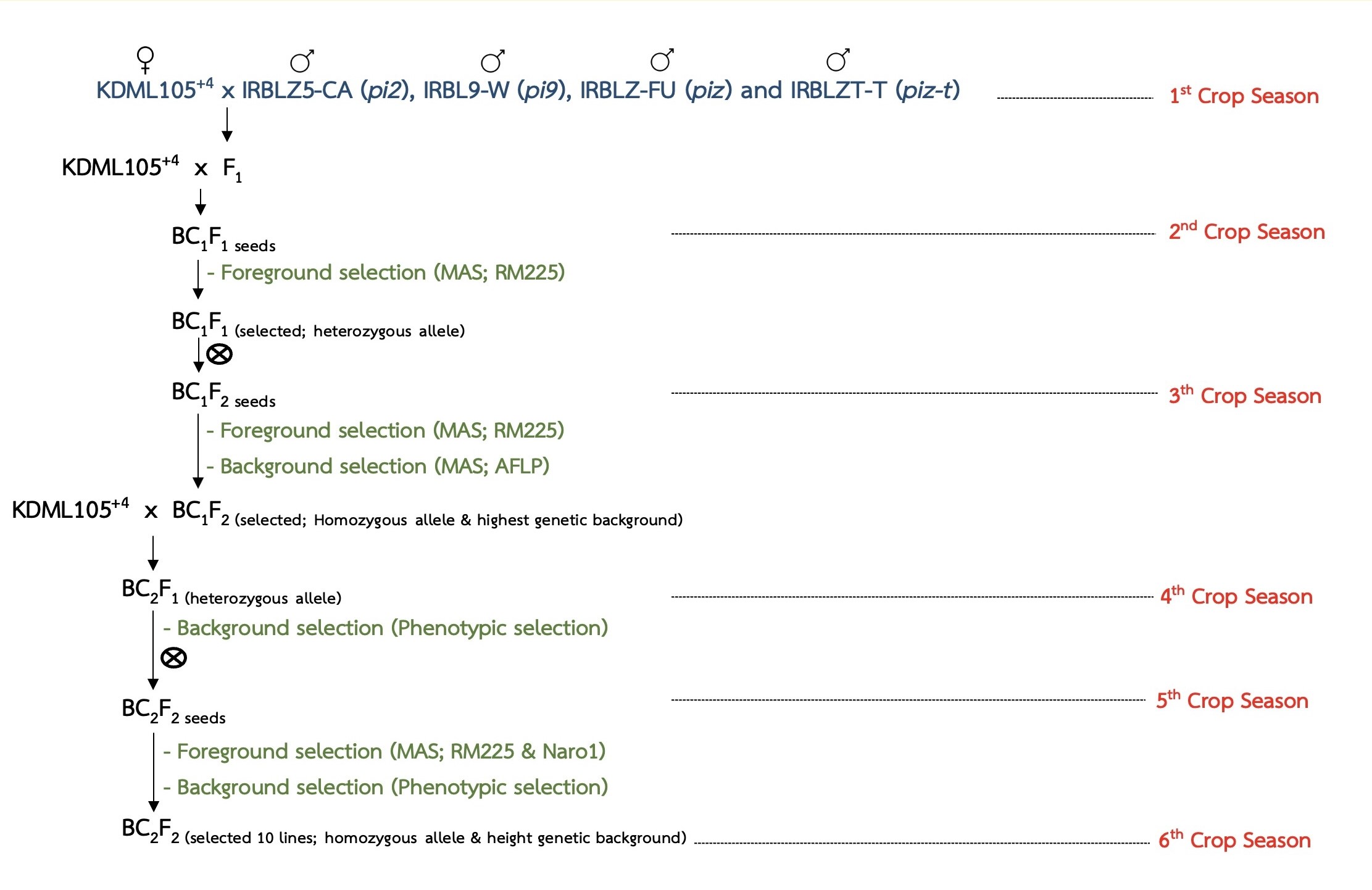
Khao Dawk Mali 105 (KDML105) is a premium Thai rice variety widely favored for consumption; however, it is highly susceptible to blast disease. This study aimed to introgress four alleles of the Pi9 gene group—Pi2, Pi9, Piz, and Piz-t—from resistant donor lines IRBLZ5-CA, IRBL9-W, IRBLZ-FU, and IRBLZT-T, respectively, into the improved KDML105+4 variety through marker-assisted backcrossing. Simple sequence repeat (SSR) markers RM225 and Naro1 were used to detect the presence of blast resistance genes and the fragrance gene, respectively. Additionally, amplified fragment length polymorphism (AFLP) markers were employed to identify individuals with genetic backgrounds closely resembling that of the recurrent parent. Phenotypic traits were also evaluated to support the selection process. The results successfully identified 10 BC2F2 lines per cross that carried the targeted resistance genes and exhibited the desired phenotypic traits, resulting in a total of 40 selected lines. These lines are recommended for further evaluation under field conditions to assess the stability of blast resistance and yield performance. Moreover, future studies should examine their resistance against diverse blast pathogen races under real-world growing environments, particularly in high-risk areas. The ultimate goal is to develop new rice lines suitable for cultivation in areas vulnerable to blast outbreaks and capable of meeting the practical needs of local farmers.
Article Details
References
Sriboonjit, S. and Viboonpong, A., 2000, Evaluation of neck blast disease affected to KDML rice production by stochastic frontier method, Econ. J. 3: 39-52. (in Thai)
Rice Science Center 2019, Hommali 4 (KDML105+4) Rice Variety, Available Source: https://dna.kps.ku.ac.th/index.php/news-articles-rice-rsc-rgdu-knowledge/rice-breeding-lab/hommali4-rice-variety, January 18, 2019. (in Thai)
Sirithunya, P., Sreewongchai, T., Sriprakhon, S., Toojinda, T., Pimpisithavorn, S., Kosawang, C. and Smitamana, P., 2007, Assessment of genetic diversity in Thai isolates of Pyricularia grisea by random amplification of polymorphic DNA, J. Phytopathol. 156: 196-204.
Tian, D., Yun. D., Xiaoshuang, Y., Gang L., Qixiang, L., Haiying, Z., Ziqiang, C., Xinrui, G., Yan, S., Yuming, L. and Liming, Y., 2022, Association analysis of rice resistance genes and blast fungal avirulence genes for effective breeding resistance cultivars, Front. Microbiol. 13:1-11.
Chaipanya, C., Telebanco-Yanoria, M.J., Quime, B., Longya, A., Korinsak, S., Korinsak, S., Toojinda, T., Vanavichit, A., Jantasuriyarat, C. and Zhou, B., 2017, Dissection of broad-spectrum resistance of the Thai rice variety Jao Hom Nin conferred by two resistance genes against rice blast, Rice. 10(18): 1-11.
Liu, G., Lu, G., Zen, L. and Wang, G.L., 2002, Two broad-spectrum blast resistance genes, Pi9(t) and Pi2(t), are physically linked on rice chromosome 6, Mol. Genet. Genomics. 267: 472-480.
Allard, R.W., 1999, Principle of Plant Breeding, 2nd Ed., Wiley, Inc., New York.
Collard, B. and Mackill, D., 2010, Marker-assisted breeding for rice improvement, Euphytica. 142: 123-146.
Hasan, M.M., Rafii, M.Y., Ismail, M.R., Mahmood, M., Rahim, H.A., Alam, M.A., Ashkani, S., Malek, M.A. and Latif, M.A., 2015, Marker-assisted backcrossing: A useful method for rice improvement, Biotechnol. Biotechnol. Equip. 29(2): 237-254.
Melaku, G., Zhang, S. and Haileselassie, T., 2018, Comparative evaluation of rice SSR markers on different oryza species, J. Rice. Res. Dev. 1(1): 38-48.
Rattanapol, P., Sripichitt, P. and Sreewongchai, T., 2011, Development of Functional DNA Marker Specific to Aromatic Gene in Rice, The Proceeding of 49th Kasetsart University Annual Conference, 1-4 February, 2011. Kasetsart University, Bangkok, Thailand, pp. 574-580. (in Thai)
Benbouza, H., Jacquemin, J.M., Baudoin, J.P. and Mergeai, G., 2006, Optimization of a reliable, fast, cheap and sensitive silver staining method to detect SSR markers in polyacrylamide gels, Biotechnol. Agron. Soc. Environ. 10(2): 77-81.
Vos, P., Hogers, R., Bleeker, M., Reijans, M., Van de Lee, T., Hornes, M., Frijters, A., Pot, J., Peleman, J., Kuiper, M. and Zabeau, M., 1995, AFLP: A new technique for DNA fingerprinting, Nucl. Acids. Res. 23: 4407- 4414.
Pricharoen, M., Sreewongchai, T. and Sripichitt, P., 2018, Improvement of 2 Rice (Oryza sativa L.) Cultivars by Marker Assisted Backcrossing to Accelerate Generations, The Proceeding of 56th Kasetsart University Annual Conference, 6-9 February, 2018, Kasetsart University, Bangkok, Thailand, pp. 207-213. (in Thai)
Collard, B.C.Y., Jahufer, M.Z.Z., Brouwer, J.B. and Pang, E.C.K., 2005, An introduction to markers, quantitative trait loci (QTL) mapping and marker-assisted selection for crop improvement: the basic concepts, Euphytica. 142: 169-196.
Sreewongchai, T., Toojinda, T., Thanintorn, N., Kosawang, C., Vanavichit, A., Tharreau, D. and Sirithunya, P., 2010, Development of elite indica rice lines with wide spectrum of resistance to Thai blast isolates by pyramiding multiple resistance QTLs, Plant Breed. 129: 176-180.
Jitbumrong, N. and Kongprakhon, P., 2016, Marker assisted selection (MAS): A viable tool for developing blast resistance in glutinous rice, Khon Kaen Agr. J. 44(1): 265-271. (in Thai)
