
Calibration and Field Testing of a PM2.5 Monitoring Station Utilizing an Electrostatic Sensor with Real-time, Continuous Online Reporting
Article Sidebar
Main Article Content
Abstract
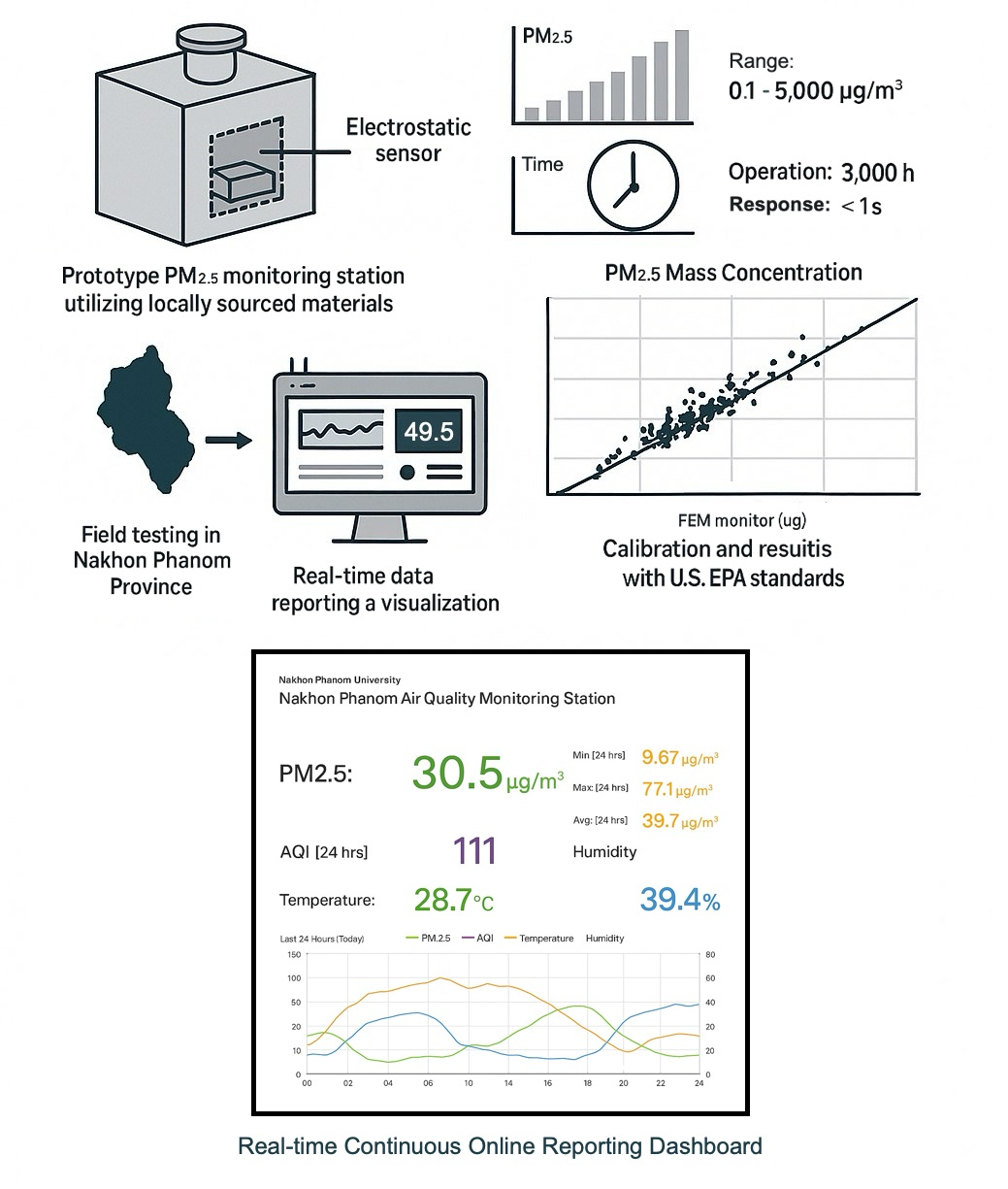
This research aims to calibrate and field-test a PM2.5 dust measurement station that operates using an electrostatic sensor. The system is capable of measuring, recording, and displaying data online through a web browser. The developed prototype utilizes locally sourced materials and equipment, replacing imported components. The system can measure and collect dust samples within a range of 0.1 to 5,000 µg/m³, with a processing time of less than 1 second. It is capable of continuous operation for up to 3,000 hours without maintenance or component replacement. The study focused on calibrating dust mass concentration measurements. The measurements were validated against a standard PM2.5 monitor using the Federal Equivalent Method (FEM) Group 3, as specified by the United States Environmental Protection Agency in 40 CFR Part 50, under laboratory conditions. Field tests were also performed under real-world conditions in Nakhon Phanom Province. The results from both laboratory and field tests showed that the measured dust concentration trends were consistent and comparable to those obtained using the standard method (40 CFR Part 50, U.S. EPA). Additionally, the system is capable of continuously reporting real-time data via the MQTT protocol, with data accurately stored in a time-series database (TSDB) without loss. The system enables rapid querying and retrieval of historical data, and the dashboard loads data from the TSDB in less than 1 second, demonstrating its efficiency in data processing and visualization.
Article Details
References
Winijkhetkhamnuen, U., Chiwonarin, T., Taneyhill, K. and Chunram, N., 2007, Oxidation-Induced DNA Damage of Alveolar Cells by PM2.5 and PM10 Dust Extracts in Chiang Mai and Lamphun Air, Research Report, Thailand Research Fund, 270 p. (in Thai)
USEPA, 1998, PM 2.5 General Information, Office of Air Quality Planning and Standards, United States Environmental Protection Agency.
Pollution Control Department, 2010, Pollution Control Department Announcement on Measuring the Average Value of Dust Particles Not Exceeding 2.5 Microns, Gov. Gaz., 98(127), Special Issue 84. (July 9, 2010) (in Thai)
Intha, P., Yaowutthi, A., Winijkhetkhamnuen, U. and Thipyawong, N., 2010, Development of an Analyzer and Sampler for Air and Small Floating Dust PM 2.5, Research Report, National Science and Technology Development Agency, Northern Network, 360 p. (in Thai)
Intha, P., 2010, Development of a Quantitative Concentration Analyzer for Nanoparticles Using Electrostatic Charge Measurement Principle, Research Report, Office of the Higher Education Commission and the Thailand Research Fund, 419 p. (in Thai)
Intha, P., 2013, Development and Improvement of Electromagnetic Nanoparticle Quantitative Concentration Detector, Research Report, Office of the Higher Education Commission, Thailand Research Fund, and Rajamangala University of Technology Lanna, 267 p. (in Thai)
Intha, P. and Yaowutthi, A., 2012, Air Dust Measurement and Analysis Device, Research Report, Investment Center, National Science and Technology Development Agency, 310 p. (in Thai)
Intha, P., Yaowutthi, A. and Thipphayawong, N., 2013, Improvement, Calibration, and Field Testing of the Commercialization of an Electromagnetic Atmospheric Particulate Matter Analyzer (Phase 1), Research Report, Cluster and Research Program Management, Research Management Division, National Science and Technology Development Agency, 391 p. (in Thai)
Intha, P. and Yaowutthi, A., 2013, Field Test of Dust Detec (DustDETEC), Research Report, Technology Rights Management Office, National Science and Technology Development Agency, 370 p. (in Thai)
Intha, P., Yaowutthi, A., Lacharoen, K., Petchkong, P. and Wongchankaew, N., 2016, Improvement, Calibration, and Field Testing of the Commercialization of Electrically Based Atmospheric Particulate Matter Analyzer (Phase 2), Research Report, National Science and Technology Development Agency, 382 p. (in Thai)
Intha, P., 2018, Development of an Online Dust Measurement System Prototype for Different Sizes in Deep Mine Pits, Research Report, Electricity Generating Authority of Thailand, 270 p. (in Thai)
Intha, P., 2020, Study and Development of a System for Measuring Small Dust Parameters (PM10, PM2.5, and PM1.0) That Affect the Efficiency of the Filter and the Air Quality of the Phra Nakhon South Power Plant, Research Report, Phra Nakhon South Power Plant, Electricity Generating Authority of Thailand, 391 p. (in Thai)
Intha, P., 2020, Development, Improvement, Calibration and Testing of Prototype Standards of Airborne Dust Measuring Devices Using Electrostatic Principles to Meet the International Measuring Instrument Standards of US EPA, Research Report, Research Project Type 4, Fiscal Year 2017, Rajamangala University of Technology Lanna, 320 p. (in Thai)
Wang, Y., Li, J., Jing, H., Zhang, Q., Jiang, J. and Biswas, P., 2015, Laboratory evaluation and calibration of three low-cost particle sensors for particulate matter measurement, Aerosol Sci. Technol. 49(11):1063–1077.
Zheng, T., Bergin, M., Johnson, K., Tripathi, S. N., Shirodkar, S., Landis, M. S., Carlson, D.E. and Russell, A. G., 2018, Field evaluation of low-cost particulate matter sensors in high- and low-concentration environments, Atmos Meas Tech. 11(8):4823-4846
Johnson, K. K., Bergin, M. H., Russell, A. G. and Hagler, G. S. W. 2018, Field test of several low-cost particulate matter sensors in high and low concentration urban environments, Aerosol Air Qual. Res. 18(3):565–578.
Datta, A., Saha, A., Zamora, M. Levy., Buehler, C., Hao, L., Xiong, F., Gentner, D.R. and Koehler, K., 2020, Statistical field calibration of a low-cost PM2.5 monitoring network in Baltimore, Atmos. Environ. 242(12):117761
Stavroulas, I., Grivas, G., Liakakou, E., Bougiatioti, A., Michalopoulos, P., Kalkavouras, P., Fameli, K.M., Hatzianastassiou, N., Mihalopoulos, N. and Gerasopoulos, E., 2020, Field evaluation of low-cost PM sensors (PurpleAir PA-II) under variable urban air quality conditions in Greece, Atmosphere. 11(9): 926.
Ngo, N.D., Lee, J., Kim, W.K. and Jang, J., 2019, Measurement of PM 2.5 mass concentration using an electrostatic particle concentrator-based quartz crystal microbalance, IEEE Access. 7:170640-170647
Ngo, N. and Jang, J., 2021, Long-Term measurement of PM2.5 mass concentration using an electrostatic particle concentrator-based quartz crystal microbalance integrated with carbon dioxide aerosol jets for PM sensing in remote areas, IEEE Access. 9: 90715 - 90726
Chang, J., Kelly, A.J. and Crowley, J.M., 1995, Handbook of Electrostatic Processes, Marcel Dekker, Inc., New York, 780 p.
Willeke, K., and Baron, P.A., 1993, Aerosol Measurement: Principles, Techniques, and Applications, John Wiley and Sons, New York, 896 p.
Tooltham, A., Khummanee, S., Jareanpon, C. and Nonphayom, M., 2024, Ladybug: an automated cultivation robot for addressing the manpower shortage in the agricultural industry, ECTI Trans. Comput. Inf. Technol. 18(2): 119–135.
EMQ Technologies, 2024, Mastering MQTT: Your Ultimate Tutorial for MQTT, 144 p.
Ronquillo Japón, B., 2022, Learn IoT Programming Using Node-RED, BPB Publications, 335 p.
Influx Data 2025, Influx DB OSS v2, Available Source: https://docs.influxdata.com/influxdb/v2/, March 20, 2025.
Chapman, R. and Holmes, P., 2023, Observability with Grafana, Packt Publishing, Birmingham, 333 p.
Thermo Fisher Scientific 2025, TEOM1405 Model 1405 TEOM Ambient Air Monitor, Available Source: https://www.thermofisher .com/order/catalog/product/TEOM1405F, March 20, 2025.
Thai Industrial Standards Institute (TISI), 2022, TIS 3030-2020: Electrostatic Precipitator, Industrial Product Standard, Thai Industrial Standards Institute. (in Thai)
