
Chemical Constituents, Total Phenolic Content and Total Flavonoid Content in Thai Cinnamon Bark Ethanol Extract
Article Sidebar
Main Article Content
Abstract
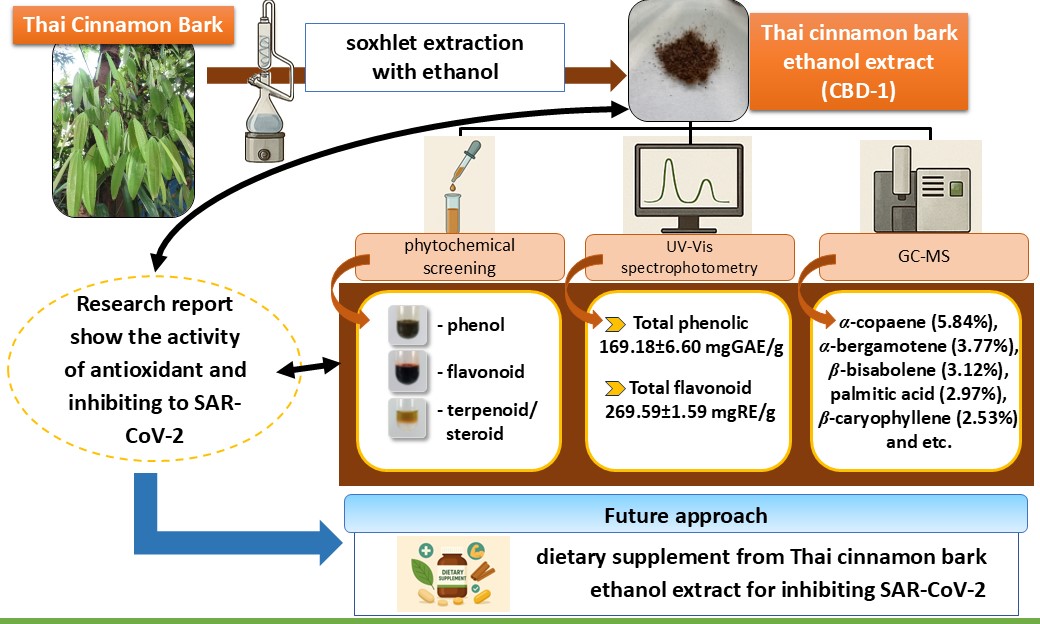
Thai cinnamon (Cinnamomum bejolghota (Buch. Ham.) Sweet) is an aromatic wood tree. It possesses medicinal properties such as relieving dizziness, nourishing the heart, promoting digestion, inducing sweating, treating fever, and alleviating diarrhea. The bark is an ingredient in several traditional medicine formulations, including Ya-hom Thiphosot, Ya-hom Navakot, Ya-hom Inthachak, Ya Manthathaat, Ya Wisamphaya Yai, Ya Mahakan hemorrhoid, and Ya Suksaiyat, all of which are listed on the National List of Essential Medicines. It is also used as an ingredient in decoctions for treating colds and relieving symptoms associated with COVID-19. The ethanol extract of Thai cinnamon bark (CBD-1) has an inhibitory effect on the growth of the SARS-CoV-2 Omicron variant. To support the development of Thai herbal products, this study aimed to investigate the phytochemical groups, chemical constituents, and active compound content of CBD-1. The results showed that CBD-1 contains phenols, flavonoids, and terpenoids/steroids. GC-MS analysis of CBD-1 identified α-copaene (5.84%), α-bergamotene (3.77%), β-bisabolene (3.12%), palmitic acid (2.97%), β-caryophyllene (2.53%), α-muurolene (2.47%), (+)-d-cadinene (2.40%), (-)-α-amorphene (2.38%), (+)-cyclosativen (1.88%), ethyl linoleate (1.71%), and (+)-g gurjunene (1.67%). UV-Vis spectrophotometry revealed a total phenolic content of 169.18±6.60 mgGAE/g and a total flavonoid content of 269.59±1.59 mgRE/g. CBD-1 contains phytochemical compounds and bioactive constituents at levels that warrant consideration for further development into health supplements with potential activity against free radicals and viruses such as SARS-CoV-2.
Article Details
References
Veesommai, U., 2009, Wild Trees in Thailand I, 2nd Ed., H.N. GROUP, Bangkok, 566 p. (in Thai)
Ruangrungsi, N., Chansriniyom, C. and Vipunngoun, N., (n.d.), Research on Thai Cinnamon to Assess Its Value and Significance for Consideration in the Declaration as a Controlled Herb, Research Report, Department of Thai Traditional and Alternative Medicine, 38 p. (in Thai)
Herbal Products Division, Food and Drug Administration, 2023, National List of Essential Herbal Medicines 2023, Minnie group, Pathum Thani, 132 p. (in Thai)
Center for Evidence-Based Thai Traditional Medicine and Herbal Medicine Pharmacy Division and Thai Traditional and Alternative Medicine Division Chao Phraya Abhaibhubejhr Hospital Prachinburi 2021, Healthcare Guide for the Public in the 3rd Wave of the COVID-19 Pandemic Using Thai Traditional Medicine and Herbal Remedies, Available Source: https://www.dop.go.th/download/knowledge/th1623742646919_0.pdf, February 15, 2025. (in Thai)
Atiphasaworn, P., Monggoot, S. and Pripdeevech P., 2017, Chemical composition, antibacterial and antifungal activities of Cinamomum bejolghota bark oil from Thailand, J. Appl. Pharm. Sci. 7(04): 69-73.
Kittiwattanokhun, A., Innajak, S., Tashiro, E., Imoto, M. and Watanapokasin, R., 2022, Cinnamomum bejolghota extract inhibits colorectal cancer cell metastasis and TGF-1-induced epithelial-mesenchymal transition via smad and non-smad signaling pathway, Sci. Pharm. 90(30): 1-18.
Quality Development and Academic Affairs Division, Medicinal Plant Research Institute, Department of Medical Science, 2022, Annual Report 2022 Medicinal Plant Research Institute, Department of Medical Science, Nonthaburi, 121 p. (in Thai)
Gogoi, B., Tamuli, K. J., Neipihoi., Bordoloi, M. and Sharma, H. K., 2021, Isolation and characterization of chemical constituents with in vitro anti-hypertensive and anthelmintic activities of Cinnamomum bejolghota (Buch.-Ham.) sweet leaves: An ethnomedicinal plant of North East India, S. Afr. J. Bot. 140: 161-166.
Le, T. P., Truong, B. N., Litaudon, M., Nguyen, T. L., Doan, T. M. H. and Pham, V. C., 2023, New alkaloids from the stem bark of Cinnamomum bejolghota, Phytochem. Lett. 55: 164-168.
Wang, J., Su, B., Jiang, H., Cui, N., Yu, Z., Yang, Y. and Sun, Y., 2020, Traditional uses, phytochemistry and pharmacological activities of the genus Cinnamomum (Lauraceae): A review, Fitoterapia. 146: 1-24.
Prasad, K. N., Yang, B., Dong, X., Jiang, G., Zhang, H., Xie, H. and Jiang, Y., 2009, Flavonoid contents and antioxidant activities from Cinnamomum species, Innov. Food Sci. Emerg. Technol. 10: 627 632.
Medicinal Research Institute, Department of Medical Sciences, Ministry of Public Health, 2007, Chemical Quality of Medicinal Plants (Volume 1), Printing House of National Office of Buddhism, Nakhon Pathom, 150 p.
Hazarika, A. and Saha, D., 2017, Preliminary phytochemical screening and evaluation of anti-diarrhoeal activity of ethanolic extract of leaves of Clerodendrum infortunatum, Int. J. Curr. Pharm. Res. 9(4): 143-146.
Sengul, M., Yildiz, H., Gungor, N., Cetin, B., Eser, Z. and Ercisli, S., 2009, Total phenolic content, antioxidant and antimicrobial activities of some medical plants, Pak. J. Pharm. Sci. 22(1): 102-106.
Madaan, R., Bansal, G., Kumar, S. and Sharma, A., 2011, Estimation of total phenols and flavonoids in extracts of Actaea spicata roots and antioxidant activity studies, Indian J. Pharm. Sci. 73(6): 666-669.
Gogoi, B., Kakoti, B. B., Sharma, N. and Borah, S., 2016, Pharmacognostic and preliminary phytochemical evaluation of Cinnmomum bejolghota (Buch.-Ham.) sweet bark, Indian J. Nat. Prod. Resour. 7(1): 59-64.
Sulastri, E., Zubair, M. S., Anas, N. I., Abidin, S., Hardani, R., Yulianti, R. and Aliyah., 2018, Total phenolic, total flavonoid, quercetin content and antioxidant activity of standardized extract of Moringa oleifera leaf from regions with different elevation, Pharmacogn. J. 10(6) Suppl: s104-s108.
Tiranakwit, T., Puangpun, W., Tamprasit, K., Wichai, N., Siriamornpun, S., Srisongkram, T. and Weerapreeyakul, N., 2023, Phytochemical screening on phenolic, flavonoid contents, and antioxidant activities of six indigenous plants used in Traditional Thai Medicine, Int. J. Mol. Sci. 24: 1-20.
Kowalczyk, M., Golonko, A., Swisłocka R., Kalinowska, M., Parcheta, M., Swiergiel A. and Lewandowski, W., 2021, Drug design strategies for the treatment of viral disease. plant phenolic compounds and their derivatives, Front. Pharmacol. 12: 1-21.
Tirado-Kulieva V, A., Hernández-Martínez, E. and Choque-Rivera, T. J., 2022, Phenolic compounds versus SARS-CoV-2: An update on the main findings against COVID-19, Heliyon. 8: 1-16.
Alzaabi, M.M., Hamdy, R., Ashmawy S, N., Hamoda, M. A., Alkhayat, F., Khademi, N. N., Joud, S.M.A.A., AEl-Keblawy, A. A. and Soliman, S. S. M., 2022, Flavonoids are promising safe therapy against COVID-19, Phytochem. Rev. 21: 291-312.
Antonio, A. da. S., Wiedemann, L. S. M. and Veiga-Junior, V. F., 2020, Natural products’ role against COVID-19, RSC Adv. 10: 23379-23393.
Souza, M. R. R., Droppa-Almeida, D., Kodel, H. A. C., Santos, T. B., Moraes, A. S., Krause L, C. and Bjerk T, R., 2025, In silico therapeutic potential of phytochemical from Commiphora leptophloeos Mart. - J. B. Gillett leaves essential oil against COVID-19, J. Braz. Chem. Soc. 36(2): 1-13.
Yabrir, B., Belhassan, A., Lakhlifi, T., Salgado, M. G., Bouachrine, M., Munoz, C. P., Gerli, C. L. and Ramirez, T. R., 2021, Minor composition compounds of Algarian herbal medicines as inhibitors of SARS-CoV-2 main protease: molecular docking and ADMET properties prediction, J. Chil. Chem. Soc. 66: 5067-5074.
Goyal, H.,Rana, D., Sharma, R., Lamba, D. and Kaur, J., 2023, Current perspective on vitamins and SARS-CoV-2 disease (COVID-19), Ann. Natl. Acad. Med. Sci. (India). 59: 186-195.
Duru, C. E., Duru, I. A. and Adegboyega, A. E., 2021, In silico identification of compounds from Nigella sativa seed oil as potential inhibitors of SARS-CoV-2 targets, Bull. Natl. Res. Cent. 45(57): 1-13.
National Library of Medicine 2025, Pubchem, Available Source: https://pubchem.ncbi.nlm.nih.gov/, August 11, 2025.
