
Predicting Air Quality in Pathum Thani, Thailand, Based on Meteorological Data Using Statistical and Machine Learning Methods
Article Sidebar
Main Article Content
Abstract
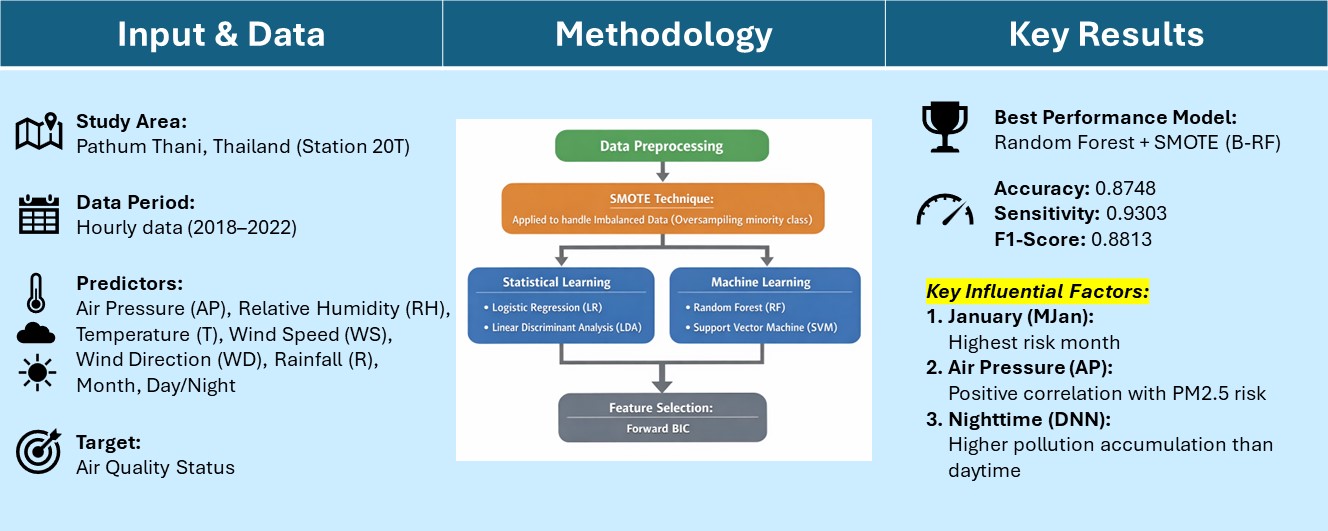
Air pollution, particularly fine particulate matter (PM2.5), is a significant environmental issue affecting Thailand. This study compares the effectiveness of various air quality prediction methods in Pathum Thani Province and investigates the factors influencing local air quality forecasts. Statistical and machine learning methods, including binary logistic regression, linear discriminant analysis, random forest, and support vector machine, are employed. The models are evaluated using performance metrics such as accuracy, sensitivity, specificity, precision, and F1-score. The results indicate that the random forest model, using data balanced with the synthetic minority over-sampling technique (SMOTE), achieves the best performance, with an accuracy of 0.8748, sensitivity of 0.9303, precision of 0.8373, and an F1-score of 0.8813. The most influential factors in predicting air quality are the month of January, atmospheric pressure, and nighttime intervals, followed by relative humidity, temperature, and wind speed, in decreasing order of importance.
Article Details
References
Hardini, M., Sunarjo, R. A., Asfi, M. and Riza Chakim, M. H., Ayu Sanjaya, Y. P., 2023, Predicting air quality index using ensemble machine learning, ADI J. Recent. Innov (AJRI). 5 (1Sp): 78-86.
Yang, H., Wang, W. and Li, G., 202, Prediction method of PM2.5 concentration based on decomposition and integration, Measurement. 216(8): 112954.
Fang, Z., Yang, H., Li, C., Cheng, L., Zhao, M. and Xie, C., 2021, Prediction of PM2.5 hourly concentrations in Beijing based on machine learning algorithm and ground-based LiDAR, Arch. Environ. Prot. 47(3): 98–107.
Makhdoomi, A., Sarkhosh, M. and Ziaei, S., 2025, PM2.5 concentration prediction using machine learning algorithms: an approach to virtual monitoring stations, Sci. Rep. 15: 8076.
Warangkhana, R., 2023, A study of the effectiveness of model selection criteria for multiple regression model, Rajamangala Univ. Technol. Srivijaya Res. J (RST). 15(1), 198–212. (in Thai).
Pollution Control Department, 2024, Regional Air Quality and Situation Reports, Available Source: http://air4thai.pcd.go.th/webV3/#/StationDetail, Feb 2, 2024. (in Thai).
Pollution Control Department, 2025, “Pollution Control Department announces Thailand’s 2023 Air Quality Index.”, Available Source: https://www.pcd.go.th/laws/29909, Jan 25, 2025. (in Thai).
Cox, D. R., 1958, The regression analysis of binary sequences, J. R. Stat. Soc. Ser. B Methodol. 20(2): 215–232.
Choi, J., Gu, B., Chin, S. and Lee, J.-S., 2020, Machine learning predictive model based on national data for fatal accidents of construction workers, Autom. Constr. 110(3): 102974.
Adebiyi, M.O., Arowolo, M.O., Mshelia, M.D. and Olugbara, O.O., 2022, A linear discriminant analysis and classification model for breast cancer diagnosis, Appl. Sci. 12(22): 11455.
Breiman L., 2001, Random forests, Mach. Learn. 45: 5–32.
Ali, Y., Hussain, F. and Haque, M. M., 2024, Advances, challenges, and future research needs in machine learning-based crash prediction models: A systematic review, Accid. Anal. Prev. 194: 107378.
Liu, W., Guo, G., Chen, F. and Chen, Y., 2019, Meteorological pattern analysis assisted daily PM2.5 grades prediction using SVM optimized by PSO algorithm, Atmos. Pollut. Res. 10(5): 1482–1491.
Fiorentini, N. and Losa, M., 2020, Handling imbalanced data in road crash severity prediction by machine learning algorithms, Infrastructures. 5(7): 61.
