
Factors Influencing the Acceptance of RDF Waste-to-Energy Plant in the Context of Community Waste Management
Article Sidebar
Main Article Content
Abstract
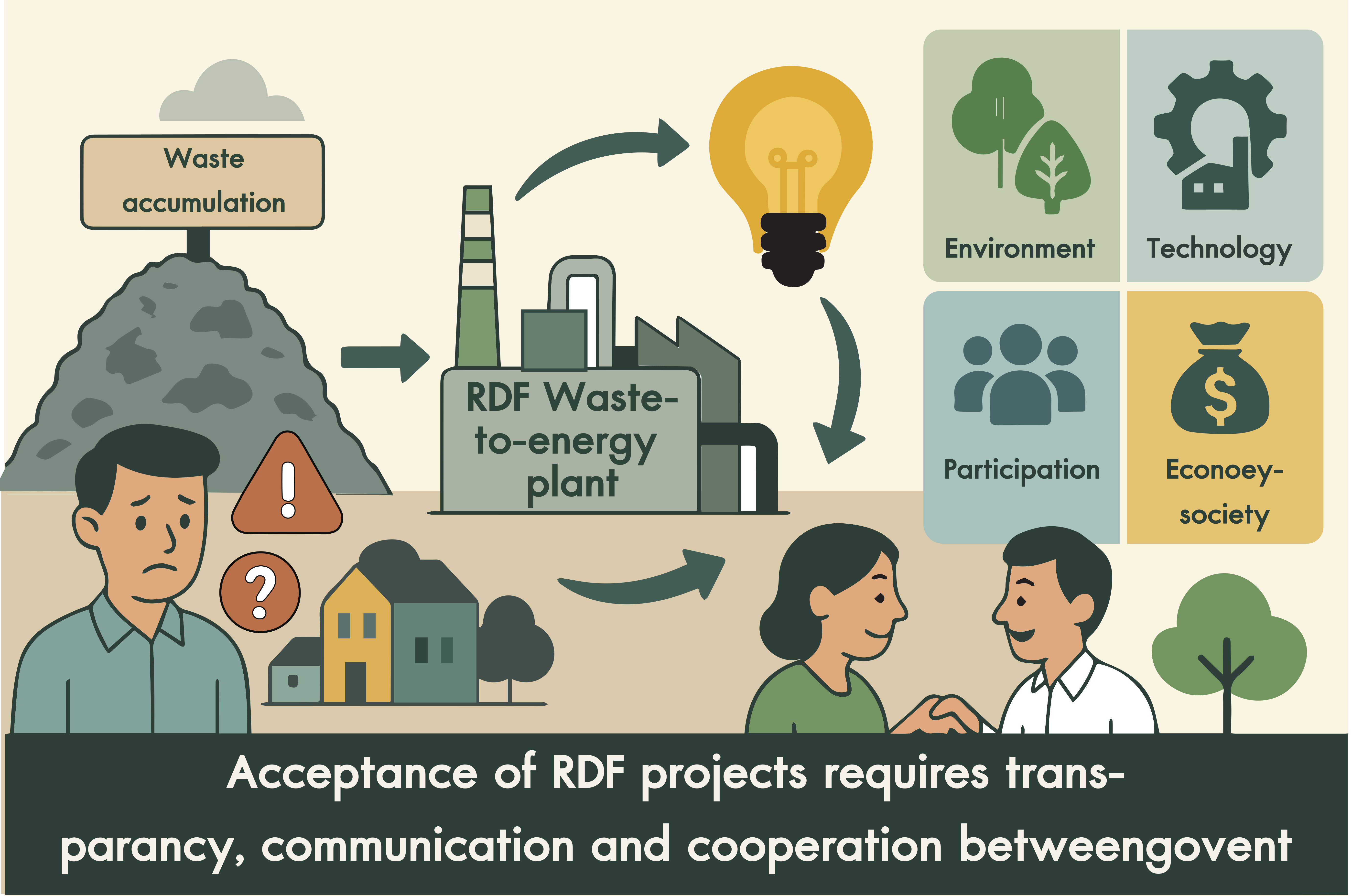
Community solid waste management, together with the transition toward clean energy, has become a major challenge faced by many countries worldwide. Although refuse-derived fuel (RDF) technology is widely regarded as a practical approach to waste management under the circular economy concept, its implementation continues to encounter significant difficulties. One of the key challenges is public and community acceptance, which remains a common issue in many regions around the world. This study therefore aims to examine the factors influencing public attitudes and decision-making, shifting the perspective from viewing the issue as a localized conflict to a broader consideration of the relationship between technology and society.
The results indicate that trust in the institutions responsible for project management, along with access to clear and transparent information, has a greater influence on public acceptance than economic incentives. These findings suggest that local opposition to such projects is not driven solely by economic concerns, but is also closely linked to policy gaps and shortcomings in government communication. Consequently, this study not only provides recommendations for the case study area but also offers broader insights into conflict management and stakeholder collaboration among government agencies, the private sector, and local communities. These insights can support the implementation of clean energy projects and the achievement of the Sustainable Development Goals (SDGs), and may be applied to other contexts, particularly in developing countries
Article Details
References
Pollution Control Department 2024, Report on the Situation of Community Waste Disposal Sites in Thailand in 2023, Available Source: https://www.pcd.go.th/publication/31985/, May 9, 2024. (in Thai)
United Nations Development Programmer 2023, Sustainable Development Goals, Available Source: https://www.undp.org/sustainable-development-goals, April 16, 2023.
Nakhon Sawan Municipality 2023, 5-Year Development Plan (2023–2027) of Nakhon Sawan Municipality, 1st review/2023, Available Source: http://www.nsm.go.th/plan/plan5y/plan2566-2570-review-1.pdf, February 24, 2023. (in Thai)
Ministry of Energy 2018, Alternative Energy Development Plan B.E. 2561–2580 (2018–2037) (AEDP 2018), Energy Policy and Planning Office (EPPO), Available Source: https://www.eppo.go.th/index.php/th/eppo-intranet/item/541-aedp, February 24, 2023. (in Thai)
Department of Provincial Administration 2023, Official Registration Statistics System, Available Source: https://stat.bora.dopa.go.th/new_stat/webPage/statByYear.php, May 12, 2023. (in Thai)
Naresuan University, 2023, Project to Hire Consultants to Study the Feasibility and Analysis of the Fuel-Based Electricity Generation Project, Research Report, Naresuan University, Phitsanulok, 337 p. (in Thai)
Creswell, J.W., 2014, Research Design: Qualitative, Quantitative, and Mixed Methods Approaches, 4th Ed., Sage Publications., Thousand Oaks, 304 p.
Johnson, R.B. and Onwuegbuzie, A.J., 2004, Mixed methods research: A paradigm whose time has come, Educ. Res. 33(7): 14–26.
Office of Natural Resources and Environmental Policy and Planning 2023, Guidelines for Public Participation in the Environmental Impact Assessment Report Preparation Process, Available Source: https://eiathailand.onep.go.th/Show_Detail.aspx?DetailId=146, August 31, 2023. (in Thai)
Yamane, T., 1967, Statistics: An Introductory Analysis, 2nd Ed., Harper and Row, New York, 919 p.
Roddis, P., Pye, S. and Sharp, L., 2018, Identifying factors influencing local acceptance of renewable energy projects: A systematic review, Energy Policy, 123: 396–412.
Likert, R., 1967, The Human Organization: Its Management and Value, McGraw-Hill, New York, 258 p.
Moore, D.S., McCabe, G.P. and Craig, B.A., 2017, Introduction to the Practice of Statistics, 9th Ed., W.H. Freeman and Company, New York, 814 p.
Krippendorff, K., 2018, Content Analysis: An Introduction to Its Methodology, 4th Ed., Sage Publications, Thousand Oaks, CA, 472 p.
Chen, S.H., Huang, G.H. and Chen, C.W., 2005, A dynamic strategy planning theory and system for sustainable river basin land use management, J Environ. Manag. 75(1): 1–14.
United Nations, 2015, Transforming Our World: The 2030 Agenda for Sustainable Development, A/RES/70/1, United Nations, New York, 35 p.
Glasson, J., Therivel, R. and Chadwick, A., 2013, Introduction to Environmental Impact Assessment: Process, Practice and Prospects, 4th Ed., Routledge, London, 392 p.
Carroll, A.B., 1991, The pyramid of corporate social responsibility: Toward the moral management of organizational stakeholders, Bus. Horiz. 34(4): 39–48.
International Organization for Standardization, 2015, ISO 14001:2015 – Environmental Management Systems: Requirements with Guidance for Use., Geneva, 35 p.
Wongprayoon, A., 2023, Factors Affecting Public Acceptance of Waste-to-Energy Power Plants in Pathum Thani Province, Master Thesis, Thammasat University, Pathum Thani, 84 p. (in Thai)
Wüstenhagen, R., Wolsink, M. and Bürer, M.J., 2007, Social acceptance of renewable energy innovation: An introduction to the concept, Energy Policy, 35(5): 2683–2691.
Devine-Wright, P., 2007, Non-political associations and decision-making on energy, Energy Policy, 35(5): 2824–2831.
Sterman, J., 2000, Business Dynamics: Systems Thinking and Modeling for a Complex World, Irwin/McGraw-Hill, Boston, 982 p.
Sjostedt, H., Vulturius, G. and Eklöf, J., 2018, The acceptability of bioenergy projects: Exploring the influence of procedural and distributional justice, Energy Policy, 120: 246–254.
Garmendia, E. and Stagl, S., 2010, Public participation and the social acceptability of waste management plans: Lessons from Spain, J. Clean. Prod. 18(1): 81–94.
