
Effect of Yoghurt and Glucose Syrup on Physical and Sensorial Properties of Low-Sugar Gummy Jelly
Article Sidebar
Main Article Content
Abstract
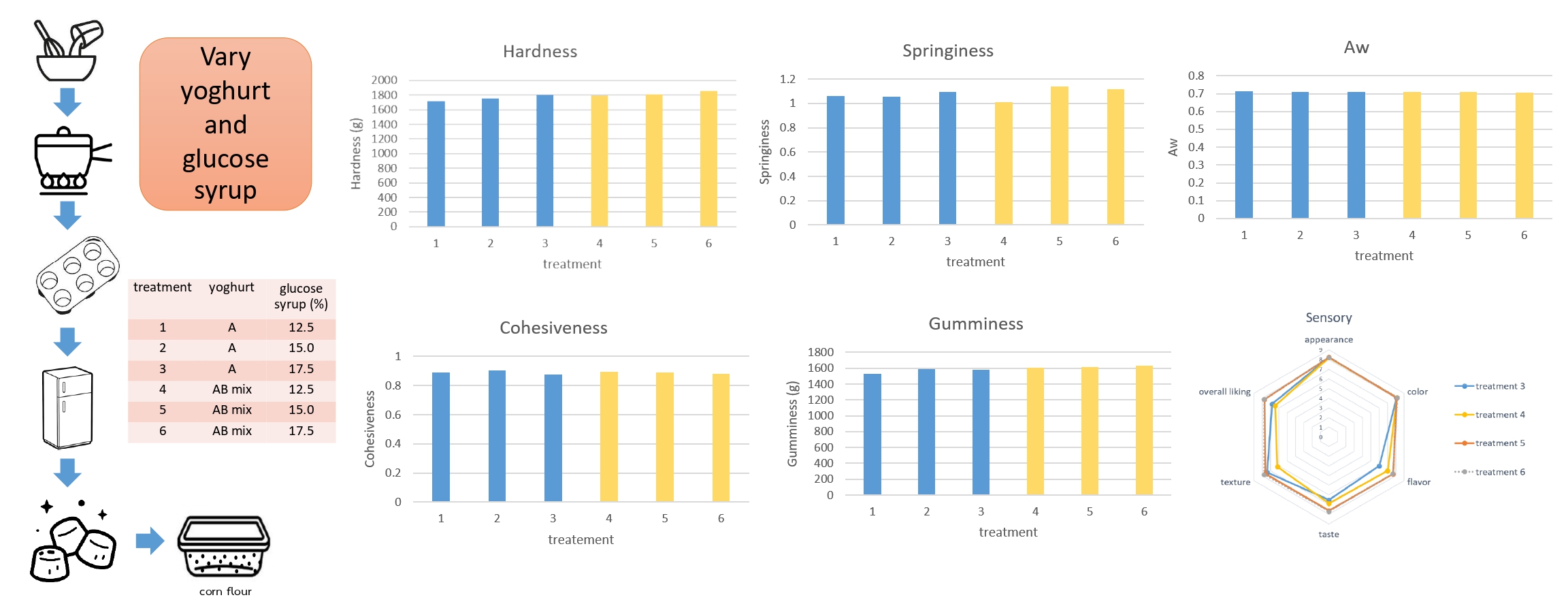
The objective of this research was to study the effect of yoghurt and glucose syrup on the physical and sensory properties of low-sugar gummy jelly. Two types of yoghurt were investigated: commercial yoghurt A and a mixture of commercial yoghurt A and commercial drinking yoghurt B (AB mix), in combination with three levels of glucose syrup. The results showed that the combined effect of the main factors significantly influenced the pH, cohesiveness, and color values (L*, a*, and b*) of the yoghurt gummy jelly (p<0.05). The use of the yoghurt AB mix in combination with increasing levels of glucose syrup resulted in decreases in pH, cohesiveness, and L* value (p<0.05), while the a* and b* values increased (p<0.05). When considering the individual effects of the main factors, the type of yoghurt affected hardness and gumminess, whereas the amount of glucose syrup affected hardness and springiness (p<0.05). The use of the yoghurt AB mix resulted in increases in both hardness and gumminess values (p<0.05). Increasing the concentration of glucose syrup led to increases in hardness and springiness (p<0.05). Sensory evaluation revealed that yoghurt gummy jelly prepared using the yoghurt AB mix and glucose syrup at 15% and 17.5% received the highest scores for flavor, taste, texture, and overall liking (p<0.05). This research is the first to report the use of at least 50% yogurt in the production of low-sugar gummy jelly.
Article Details
References
Thai Industrial Standards Institute, 2004, Thai Community Product Standard for Frozen Dried Jelly (No. 520/2547), Available Source: https://tcps.tisi.go.th/pub/tcps520_47.pdf, October 27, 2025. (in Thai)
Rivero, R., Archaina, D., Sosa, N. and Schebor, C., 2021, Development and characterization of two gelatin candies with alternative sweeteners and fruit bioactive compounds, LWT-Food Sci. Technol. 141: 110894.
Marfil, P.H.M., Anhê, A.C.B.M. and Telis, V.R.N., 2012, Texture and microstructure of gelatin/corn starch-based gummy confections, Food Biophys. 7: 236-243.
Tjuradi, P. and Hartel, R.W., 1995, Corn syrup oligosaccharide effects on sucrose crystallization, J. Food Sci. 60(6): 1353-1356.
Gabarra, P. and Hartel, R.W., 1998, Corn syrup solids and their saccharide fractions affect crystallization of amorphous sucrose, J. Food Sci. 63(3): 523-528.
Wang, R., Hartel, R.W., Wu, J., Liu, Q., Wang, J. and Wang, S., 2024, Phase separation phenomena in gelatin-glucose syrup mixtures: microstructures and gel characterization, Food Hydrocolloids. 148: 109378.
Hull, P., 2010, Glucose Syrup: Technology and Applications, Wiley-Blackwell, United Kingdom, 392 p.
Meesang, S., Wuttijumnong, P., Pongsawatmanit, R. and Chenputhi, S., 2003, Effect of Gelatin Sucrose/Glucose Syrup Ratio and Citric Acid on Physical Properties and Sensory
Quality of Gummy Jelly Product, Proceedings of 41th Kasetsart University Annual Conference: Agro-Industry, Thailand Research Fund, Bangkok, 20-27 pp. (in Thai)
Tamime, A.Y. and Deeth, H.C., 1980, Yoghurt: technology and biochemistry, J. Food Prot. 43(12): 939-977.
Tamime, A.Y., Marshall, V.M.E. and Robinson, R.K., 1995, Microbiological and technological aspects of milks fermented by bifidobacteria, J. Dairy Res. 62(1): 151-187.
Aljawad, A., Morgan, M.Z., Fairchild, R. and Rees, J.S., 2017, Investigation of the erosive potential of sour novelty sweets, Br. Dent. J. 222(8): 613–620.
Alani, B.W., Qasim, A.A. and Mohammad, F.A., 2024, Effect of different chocolate and candy in enamel surface loss of human permanent and primary teeth, an in vitro study, Rom. J. Stomatol. 70(3): 263-271.
Kaya, I.H., 2019, Confectionery and child consumers: situation and solution proposals, Food Nutr. Sci. 10: 893-899.
Damodaran, S. and Paraf, A., 1997, Food Proteins and Their Applications, Marcel Dekker Inc., New York, 694 p.
Delgado, P. and Bañón, S., 2015, Determining the minimum drying time of gummy confections based on their mechanical properties, CyTA-J. Food 13(3): 329–335.
Rivero, R., Archaina, D., Sosa, N., Leiva, G., Coronel, B.B. and Schebor, C., 2019, Development of healthy gummy jellies containing honey and propolis, J. Sci. Food Agric. 100: 1030-1037.
Kaewpetch, K., Yolsuriyan, S., Disayathanoowat, T., Phokadem, P., Jannu, T., Renaldi, G., Samakradhamrongthai, R.S., 2024, Influence of gelatin and propolis extract on honey gummy jelly properties: optimization using d-optimal mixture design, Gels 10(4): 282.
Folk, J.E. and Finlayson, J.S., 1977, The ɛ-(γ-glutamyl)lysine crosslink and the catalytic role of transglutaminases, Adv. Protein Chem. 31: 1-133.
Kasapis, S., Al-Marhoobi, I.M., Deszczynski, M., Mitchell, J.R. and Abeysekera, R., 2003, Galatin vs polysaccharide in mixture with sugar, Biomacromolecules 4(5): 1142-1149.
Szczesniak, A.S., 2002, Texture is a sensory property, Food Qual. Prefer. 13(4): 215-225.
