
Elevator Regenerative Function Systems towards Green Building
Article Sidebar
Main Article Content
Abstract
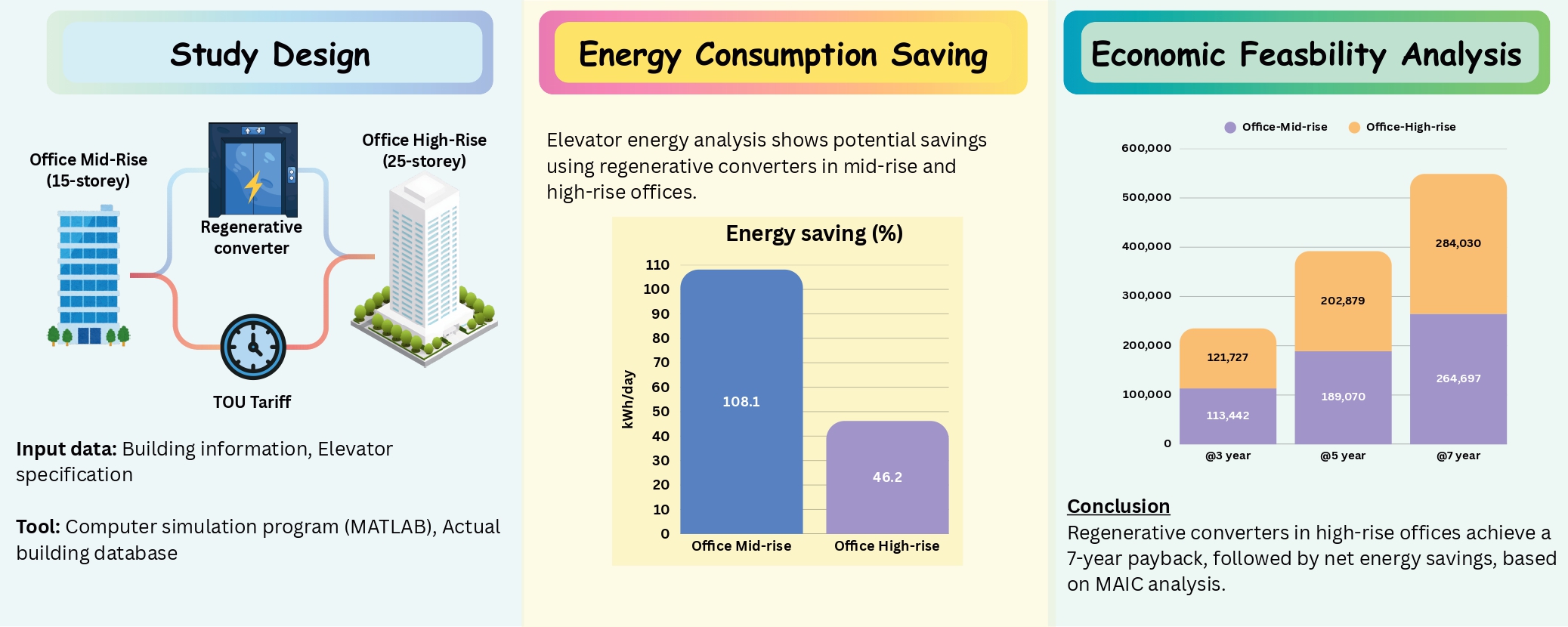
The Elevator Regenerative Function System is an energy-saving technology that converts kinetic and potential energy generated during elevator movement into electrical power for building recirculation, aligning with green building standards. This study analyzes the energy consumption and generation of passenger elevators to determine the Maximum Allowable Incremental Cost (MAIC), serving as an economic benchmark for investment decisions. Two office building models—a 15-story mid-rise and a 25-story high-rise equipped with gearless traction elevators—were utilized as case studies. Results indicate that during peak traffic periods, the mid-rise model achieved an energy recovery proportion of 108.1% relative to its motoring energy consumption, surpassing the 46.2% recorded for the high-rise model. However, in terms of absolute daily cumulative energy recovered, building height and higher traffic volume were key factors allowing the high-rise model to return more electricity to the building grid. Consequently, the economic evaluation via MAIC demonstrates that high-rise buildings possess greater investment potential and higher budget ceilings. A sensitivity analysis regarding occupancy density, building height, and electricity tariffs was also conducted to support decision-making.
Article Details
References
United Nations Environment Programส and Global Alliance for Buildings and Construction, 2024, Global Status Report for Buildings and Construction: Beyond foundations: Mainstreaming Sustainable Solutions to Cut Emissions from the Buildings Sector, United Nations Environment Programme, Nairobi.
Ministry of Energy, 2018, Energy Efficiency Plan: EEP 2018 (2018–2037), Department of Alternative Energy Development and Efficiency, Thailand. (in Thai)
Tukia, T., Uimonen, S., Siikonen, M. L., Donghi, C. and Lehtonen, M., 2018, High-resolution modeling of elevator power consumption, J. Build. Eng. 18: 210-219.
Rashed, A. N. Z., Yarrarapu, M., Prabu, R. T., Antony, G. S. R., Edeswaran, L., Kumar, E. S., Aswitha, K., Snehith, N. and Shaik, H. A., 2024, Connected smart elevator systems for smart power and time saving, Sci. Rep. 14(1): Article 19330.
Cao, Y. and Ming, X., 2025, Digital twin-driven low-carbon service design and modularization in central air conditioning ecosystems: A multi-criteria and co-intelligence approach, Sustainability. 17(21): 9877.
Rahman, A., Aziz, T., Masood, N. A. and Deeba, S. R., 2021, A time of use tariff scheme for demand side management of residential energy consumers in Bangladesh, Energy Rep. 7: 3189-3198.
Tang, H., Zhang, Y. and Zheng, Z., 2025, How time-of-use tariffs and storage costs shape optimal hybrid storage portfolio in buildings, Buildings. 16(1): 42.
Dambrauskas, K., Vanagas, J., Zimnickas, T., Kalvaitis, A. and Ažubalis, M., 2020, A method for efficiency determination of permanent magnet synchronous motor, Energies. 13(4): 1004.
Fernández V., J. R., Cortés, P. and Aparicio, P., 2008, Fuzzy Logic-Based Elevator Group Control System for Energy Optimization Purpose, In 2008 International Conference on Information Technology and Applications pp. 439-444.
Zrnić, N., Dragović, A., Kosanić, N. and Milovanović, V., 2023, Development and state-of-the art in green elevators technologies: A survey, Engineering TODAY. 2(3): 7-24
Ikhe, Y., Hajare, A., Pandey, D., Lichade, J., Jain, K., Mate, M. and Dahiwade, S., 2025, Regenerative braking in elevators with BESS, Int. J. Multidiscip. Res. (IJFMR). 7(6).
Venizelou, V., Philippou, N., Hadjipanayi, M., Makrides, G., Efthymiou, V. and Georghiou, G. E., 2018, Development of a novel time-of-use tariff algorithm for residential prosumer price-based demand side management, Energy. 142: 633-646.
Badruddin, S., Robertson-Gillis, C. R., Ashworth, J. and Wright, D., 2020, Impact of tariff structure on the economics of behind-the-meter solar microgrids, Clean. Eng. Technol. 2: 100039.
Kantawong, S., 2013, Modelling of Power Generation Controller for Permanent Magnet Motor Elevator by Energy Regenerative Unit (ERU), Master Thesis, Rajamangala University of Technology Thanyaburi, Pathum Thani, 171 p. (in Thai)
Uimonen, S., Tukia, T., Donghi, C. and Lehtonen, M., 2020, Analysis of elevator energy efficiency and regenerative potential in tall buildings, Energy Build. 210: 109743.
