
Optimization of Mycelial Growth and Fruiting Body Formation of Auricularia polytricha Isolated from a Community Forest
Article Sidebar
Main Article Content
Abstract
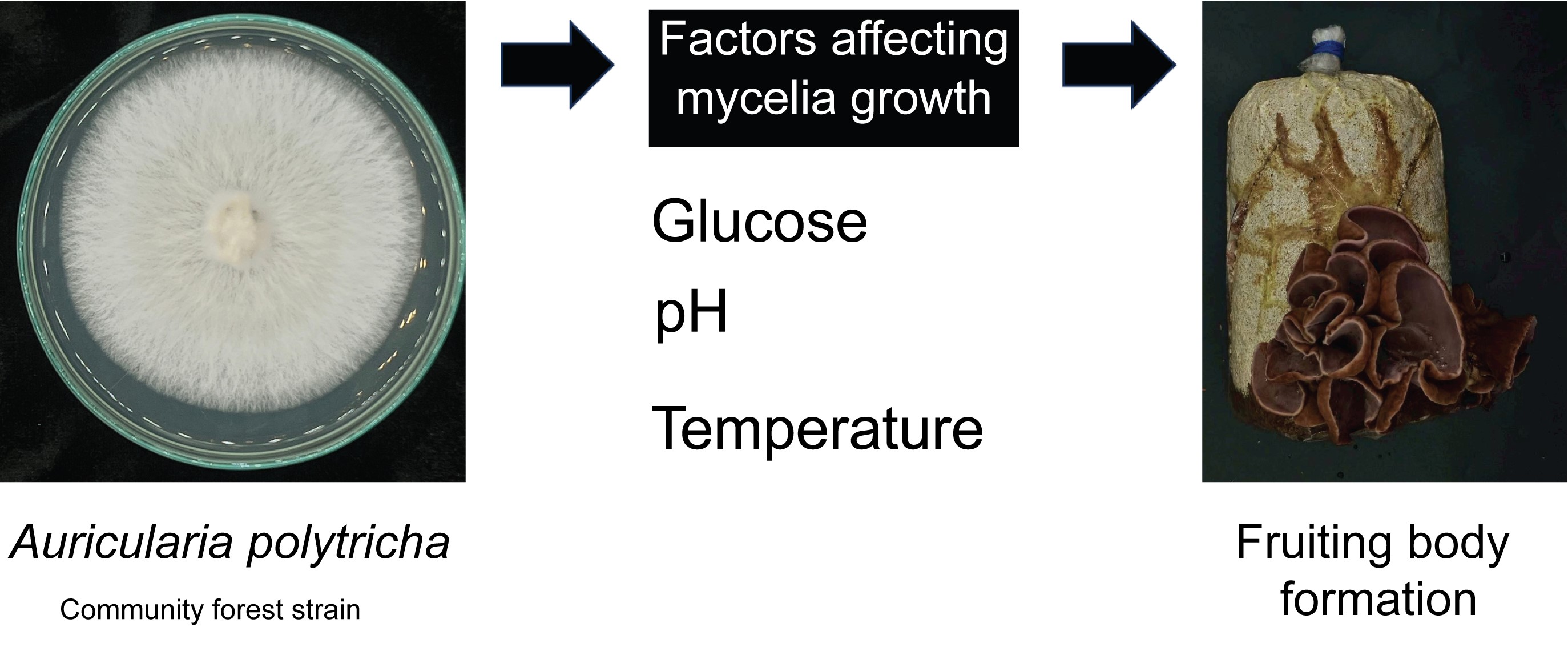
This research aimed to determine the optimal conditions for mycelial growth and fruiting body formation of Auricularia polytricha, using a strain isolated from the community forest of Khao Noi Sam Phan Temple, Song Phi Nong Subdistrict, Tha Mai District, Chanthaburi Province. The effects of nutritional and environmental factors on mycelial growth on potato dextrose agar (PDA), including glucose concentration, pH, and incubation temperature, were investigated. The cultures were grown on PDA under various conditions, and colony diameters were measured. The results showed that the strain exhibited the best growth on PDA containing 2% glucose at pH 6 and incubated at 30°C, producing the largest colony diameter with a statistically significant difference (p < 0.05). Under these optimal conditions, fruiting body formation was subsequently evaluated using bag cultivation. The community forest strain produced an average fruiting body weight of 63.71±17.8 g per bag, a yield of 53.09 g/kg of substrate, and a biological efficiency of 6.93%.
Article Details
References
Bandara, A.R., Karunarathna, S.C., Phillips, A.Jl., Mortimer, P.E., Xu, J., Kakumyan, P. and Hyde, K.D., 2017, Diversity of auricularia (auriculariaceae, auriculariales) in Thailand, Phytotaxa. 292(1):19–34.
Thongklang, N., Keokanngeun, L., Taliam, W. and Hyde, K.D., 2020, Cultivation of a wild strain of Auricularia cornea from Thailand, Curr. Res. Environm. Appl. Mycol. 10(1): 120-130.
Bandara, A.R., Rapior, S., Mortimer, P.E., Kakumyan, P., Hyde, K.D. and Xu, J., 2019, A review of the polysaccharide, protein and selected nutrient content of Auricularia, and their potential pharmacological value, Mycosphere. 10(1): 579-607.
Yu, J., Sun, R., Zhao, Z. and Wang, Y., 2014, Auricularia polytricha polysaccharides induce cell cycle arrest and apoptosis in human lung cancer A549 cells, Int. J. Biol Macromol. 68: 67-71.
Zhao, S., Rong, C., Liu, Y., Xu, F., Wang, S., Duan, C., Chen, J. and Wu, X., 2015, Extraction of a soluble polysaccharide from Auricularia polytricha and evaluation of its anti-hypercholesterolemic effect in rats, Carbohydr. Polym. 122: 39-45.
Jonathan, G., 2005, Antimicrobial activities of some selected Nigerian mushrooms, Afr. J. Biomed. Res. 8: 83-87.
Sun, Y-X., Liu, J-C. and Kennedy, J.F., 2010, Purification, composition analysis and antioxidant activity of different polysaccharide conjugates (APPs) from the fruiting bodies of Auricularia polytricha, Carbohydr. Polym. 82(2): 299-304.
Yu, M., Xu, X., Qing, Y., Luo, X., Yang, Z. and Zheng, L., 2009, Isolation of an anti-tumor polysaccharide from Auricularia polytricha (jew’s ear) and its effects on macrophage activation, Eur. Food Res. Technol. 228(3): 477-485.
Wanich, U., Kunsook, C., Kanjanavas, P., Thanyaponl, P., Boonmee, O., Apinansawat, N., Panisan, T. and Surawut, S., 2024, Edible macrofungi in Plant Genetic Conservation Area, Chanthaburi Province: Auricularia cornea strain RSPG5 fruiting body formation and nutritional value, Sci. Technol. Asia. 29(4): 247-256. (in Thai)
Hoa, H.T. and Wang, C.L., 2015, The effects of temperature and nutritional conditions on mycelium growth of two Oyster mushrooms (Pleurotus ostreatus and Pleurotus cystidiosus), Mycobiol. 43(1): 14-23.
Jonathan, S. G., Bawo, D. D. S., Adejoye, D. O. and Briyai, O. F., 2009, Studies on biomass production in Auricularia polytricha collected from Wilberforce Island, Bayelsa State, Nigeria, Am. J. Appl. Sci. 6(1): 182-186.
Yottakot, S. and Wongjiratthiti, A., 2018, Factors affecting on the growth of Volvariella volvacea mycelium on taro dextrose agar, Khon Kaen Agr. 46: 1109-1114. (in Thai)
Nguyen, L.T., Van, Le. V., Nguyen, B.T.T., Nguyen, H.T.T., Tran, A.D. and Ngo, N.X., 2023, Optimization of mycelial growth and cultivation of wild Ganoderma sinense, BioTechnologia. 104(1): 65-74.
Walker, A., Wannasawang, N., Taliam, W., Keokanngeun, L., Luangharn, T. and
Thongklang, N., 2023, Optimal conditions for mycelial growth and nutritional values of the Auricularia cornea, Stud. Fungi. 8(1): 1-10.
Gonkhom, D., Luangharn, T., Hyde, K.D., Stadler, M. and Thongklang, N., 2022, Optimal conditions for mycelial growth of medicinal mushrooms belonging to the genus Hericium, Mycol. Prog. 21(9): 1-12.
Krupodorova, T., Barshteyn, V., and Sekan, A., 2021, Review of the basic cultivation conditions influence on the growth of basidiomycetes, Curr. Res. Environ. Appl. Mycol. 11(1): 494-531.
Woo-Sik, J., Dong-Geun, K., Soon-Ja, S., Hee-Young, J. and Seung-Chun, P., 2014, The culture conditions for the mycelial growth of Auricularia auricula-judae, J. Mushrooms. 12(2): 88-95.
Drewinski, M.P., Zied, D.C., Gomes, E.P.C. and Menolli, N. Jr., 2024, Cultivation of a wild strain of Wood Ear Auricularia cornea from Brazil, Curr. Microbiol. 81(11): 1-11
Regis, J., Geösel, A. and Geösel, R. M., 2024, Cultivation of Auricularia species: a review of the history, health benefits, principles, practices, environmental conditions, research methods, and recent trends, Sydowia. 76: 21-33.
Irawati, D., Hayashi, C., Takashima, Wedatama, Ishiguri, F., Iizuka, Yoshizawa, Yokota, S. and Yokota, S., 2012, Cultivation of the edible mushroom Auricularia polytricha using sawdust based substrate made of three indonesian commercial plantation species, Falcataria moluccana, Shorea sp., and Tectona grandis, Micol. Apl. Int. 24(2): 33-41.
Abd Razak, D. L., Abdullah, N., Khir Johari, N. M. and Sabaratnam, V., 2013, Comparative study of mycelia growth and sporophore yield of Auricularia polytricha (Mont.) Sacc on selected palm oil wastes as fruiting substrate, Appl. Microbiol. Biotechnol. 97(7): 3207-3213.
