
การศึกษาสภาวะที่เหมาะสมต่อการเจริญของเส้นใยและการสร้างดอกของเห็ดหูหนู (Auricularia polytricha) ที่แยกได้จากป่าชุมชน
Article Sidebar
Main Article Content
บทคัดย่อ
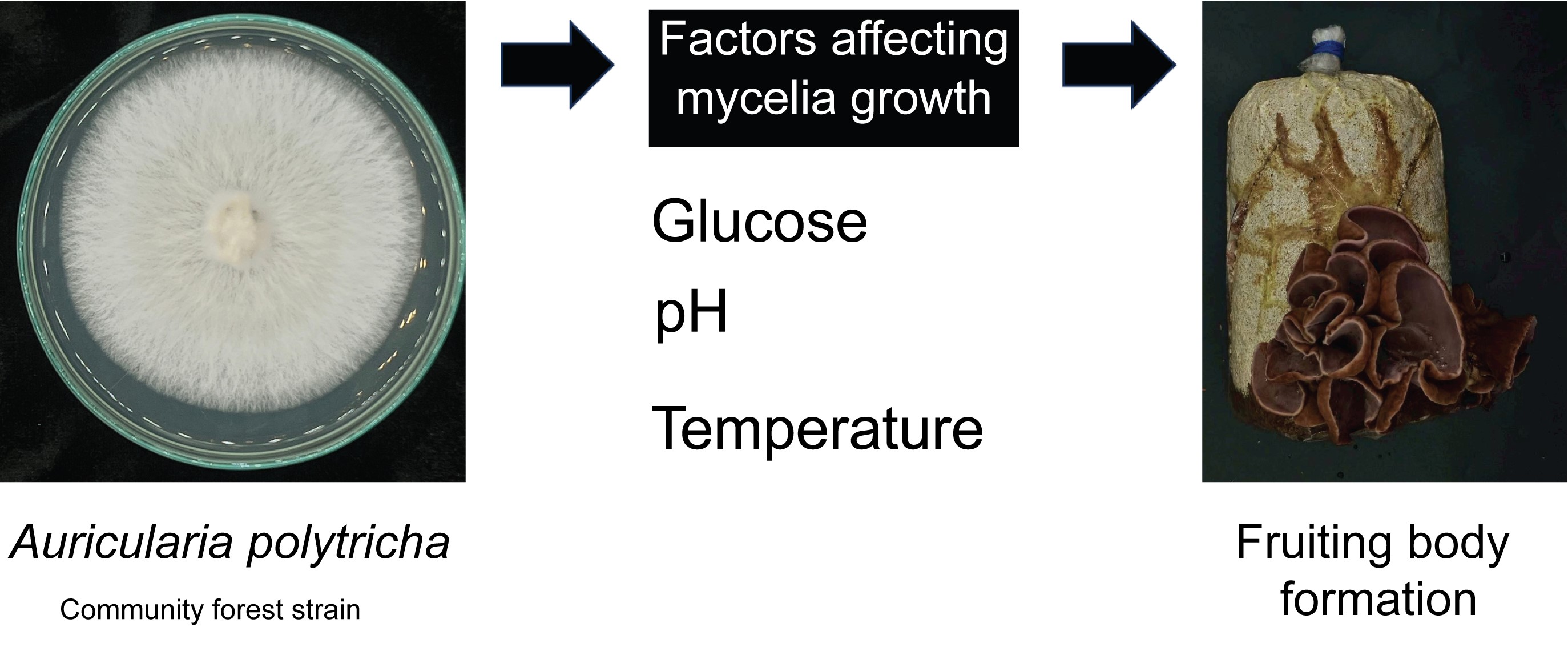
งานวิจัยครั้งนี้มีวัตถุประสงค์เพื่อศึกษาสภาวะที่เหมาะสมต่อการเจริญเติบโตของเส้นใยและการสร้างดอกของเห็ดหูหนู (Auricularia polytricha) สายพันธุ์ที่แยกได้จากป่าชุมชน ในพื้นที่ของวัดเขาน้อยสามผาน ตำบลสองพี่น้อง อำเภอท่าใหม่ จังหวัดจันทบุรี โดยทำการศึกษาปัจจัยด้านอาหารและสภาพแวดล้อมที่ส่งผลต่อการเจริญเติบโตของเส้นใยเห็ดบนอาหาร Potato Dextrose Agar (PDA) ประกอบด้วย ความเข้มข้นของน้ำตาลกลูโคส, ค่าความเป็นกรด-ด่าง และอุณหภูมิในการบ่มเชื้อ โดยทำการเพาะเชื้อบนอาหาร PDA ในสภาวะต่าง ๆ แล้ววัดขนาดเส้นผ่านศูนย์กลางโคโลนี ผลการศึกษาพบว่า เห็ดหูหนูสายพันธุ์นี้เจริญเติบโตได้ดีที่สุดบนอาหาร PDA ที่มีน้ำตาลกลูโคส 2% ที่ pH 6 และบ่มที่อุณหภูมิ 30 องศาเซลเซียส โดยมีขนาดเส้นผ่านศูนย์กลางของโคโลนีมากที่สุดอย่างมีนัยสำคัญทางสถิติ (p-value < 0.05) เมื่อทำการเพาะเลี้ยงเส้นใยในสภาวะที่เหมาะสมดังกล่าว แล้วนำมาทำการเพาะให้เกิดดอกในถุงพลาสติก (Bag cultivation) พบว่าเห็ดหูหนูสายพันธุ์ป่าชุมชน มีค่าเฉลี่ยน้ำหนักดอกเห็ด (Average weight) เท่ากับ 63.71±17.8 กรัม/ถุง ค่าผลผลิต (Yield data) เท่ากับ 53.09 กรัม/กิโลกรัมของวัสดุเพาะ และค่าประสิทธิภาพทางชีวภาพ (Biological efficiency) เท่ากับ 6.93%
Article Details
เอกสารอ้างอิง
Bandara, A.R., Karunarathna, S.C., Phillips, A.Jl., Mortimer, P.E., Xu, J., Kakumyan, P. and Hyde, K.D., 2017, Diversity of auricularia (auriculariaceae, auriculariales) in Thailand, Phytotaxa. 292(1):19–34.
Thongklang, N., Keokanngeun, L., Taliam, W. and Hyde, K.D., 2020, Cultivation of a wild strain of Auricularia cornea from Thailand, Curr. Res. Environm. Appl. Mycol. 10(1): 120-130.
Bandara, A.R., Rapior, S., Mortimer, P.E., Kakumyan, P., Hyde, K.D. and Xu, J., 2019, A review of the polysaccharide, protein and selected nutrient content of Auricularia, and their potential pharmacological value, Mycosphere. 10(1): 579-607.
Yu, J., Sun, R., Zhao, Z. and Wang, Y., 2014, Auricularia polytricha polysaccharides induce cell cycle arrest and apoptosis in human lung cancer A549 cells, Int. J. Biol Macromol. 68: 67-71.
Zhao, S., Rong, C., Liu, Y., Xu, F., Wang, S., Duan, C., Chen, J. and Wu, X., 2015, Extraction of a soluble polysaccharide from Auricularia polytricha and evaluation of its anti-hypercholesterolemic effect in rats, Carbohydr. Polym. 122: 39-45.
Jonathan, G., 2005, Antimicrobial activities of some selected Nigerian mushrooms, Afr. J. Biomed. Res. 8: 83-87.
Sun, Y-X., Liu, J-C. and Kennedy, J.F., 2010, Purification, composition analysis and antioxidant activity of different polysaccharide conjugates (APPs) from the fruiting bodies of Auricularia polytricha, Carbohydr. Polym. 82(2): 299-304.
Yu, M., Xu, X., Qing, Y., Luo, X., Yang, Z. and Zheng, L., 2009, Isolation of an anti-tumor polysaccharide from Auricularia polytricha (jew’s ear) and its effects on macrophage activation, Eur. Food Res. Technol. 228(3): 477-485.
Wanich, U., Kunsook, C., Kanjanavas, P., Thanyaponl, P., Boonmee, O., Apinansawat, N., Panisan, T. and Surawut, S., 2024, Edible macrofungi in Plant Genetic Conservation Area, Chanthaburi Province: Auricularia cornea strain RSPG5 fruiting body formation and nutritional value, Sci. Technol. Asia. 29(4): 247-256. (in Thai)
Hoa, H.T. and Wang, C.L., 2015, The effects of temperature and nutritional conditions on mycelium growth of two Oyster mushrooms (Pleurotus ostreatus and Pleurotus cystidiosus), Mycobiol. 43(1): 14-23.
Jonathan, S. G., Bawo, D. D. S., Adejoye, D. O. and Briyai, O. F., 2009, Studies on biomass production in Auricularia polytricha collected from Wilberforce Island, Bayelsa State, Nigeria, Am. J. Appl. Sci. 6(1): 182-186.
Yottakot, S. and Wongjiratthiti, A., 2018, Factors affecting on the growth of Volvariella volvacea mycelium on taro dextrose agar, Khon Kaen Agr. 46: 1109-1114. (in Thai)
Nguyen, L.T., Van, Le. V., Nguyen, B.T.T., Nguyen, H.T.T., Tran, A.D. and Ngo, N.X., 2023, Optimization of mycelial growth and cultivation of wild Ganoderma sinense, BioTechnologia. 104(1): 65-74.
Walker, A., Wannasawang, N., Taliam, W., Keokanngeun, L., Luangharn, T. and
Thongklang, N., 2023, Optimal conditions for mycelial growth and nutritional values of the Auricularia cornea, Stud. Fungi. 8(1): 1-10.
Gonkhom, D., Luangharn, T., Hyde, K.D., Stadler, M. and Thongklang, N., 2022, Optimal conditions for mycelial growth of medicinal mushrooms belonging to the genus Hericium, Mycol. Prog. 21(9): 1-12.
Krupodorova, T., Barshteyn, V., and Sekan, A., 2021, Review of the basic cultivation conditions influence on the growth of basidiomycetes, Curr. Res. Environ. Appl. Mycol. 11(1): 494-531.
Woo-Sik, J., Dong-Geun, K., Soon-Ja, S., Hee-Young, J. and Seung-Chun, P., 2014, The culture conditions for the mycelial growth of Auricularia auricula-judae, J. Mushrooms. 12(2): 88-95.
Drewinski, M.P., Zied, D.C., Gomes, E.P.C. and Menolli, N. Jr., 2024, Cultivation of a wild strain of Wood Ear Auricularia cornea from Brazil, Curr. Microbiol. 81(11): 1-11
Regis, J., Geösel, A. and Geösel, R. M., 2024, Cultivation of Auricularia species: a review of the history, health benefits, principles, practices, environmental conditions, research methods, and recent trends, Sydowia. 76: 21-33.
Irawati, D., Hayashi, C., Takashima, Wedatama, Ishiguri, F., Iizuka, Yoshizawa, Yokota, S. and Yokota, S., 2012, Cultivation of the edible mushroom Auricularia polytricha using sawdust based substrate made of three indonesian commercial plantation species, Falcataria moluccana, Shorea sp., and Tectona grandis, Micol. Apl. Int. 24(2): 33-41.
Abd Razak, D. L., Abdullah, N., Khir Johari, N. M. and Sabaratnam, V., 2013, Comparative study of mycelia growth and sporophore yield of Auricularia polytricha (Mont.) Sacc on selected palm oil wastes as fruiting substrate, Appl. Microbiol. Biotechnol. 97(7): 3207-3213.
