
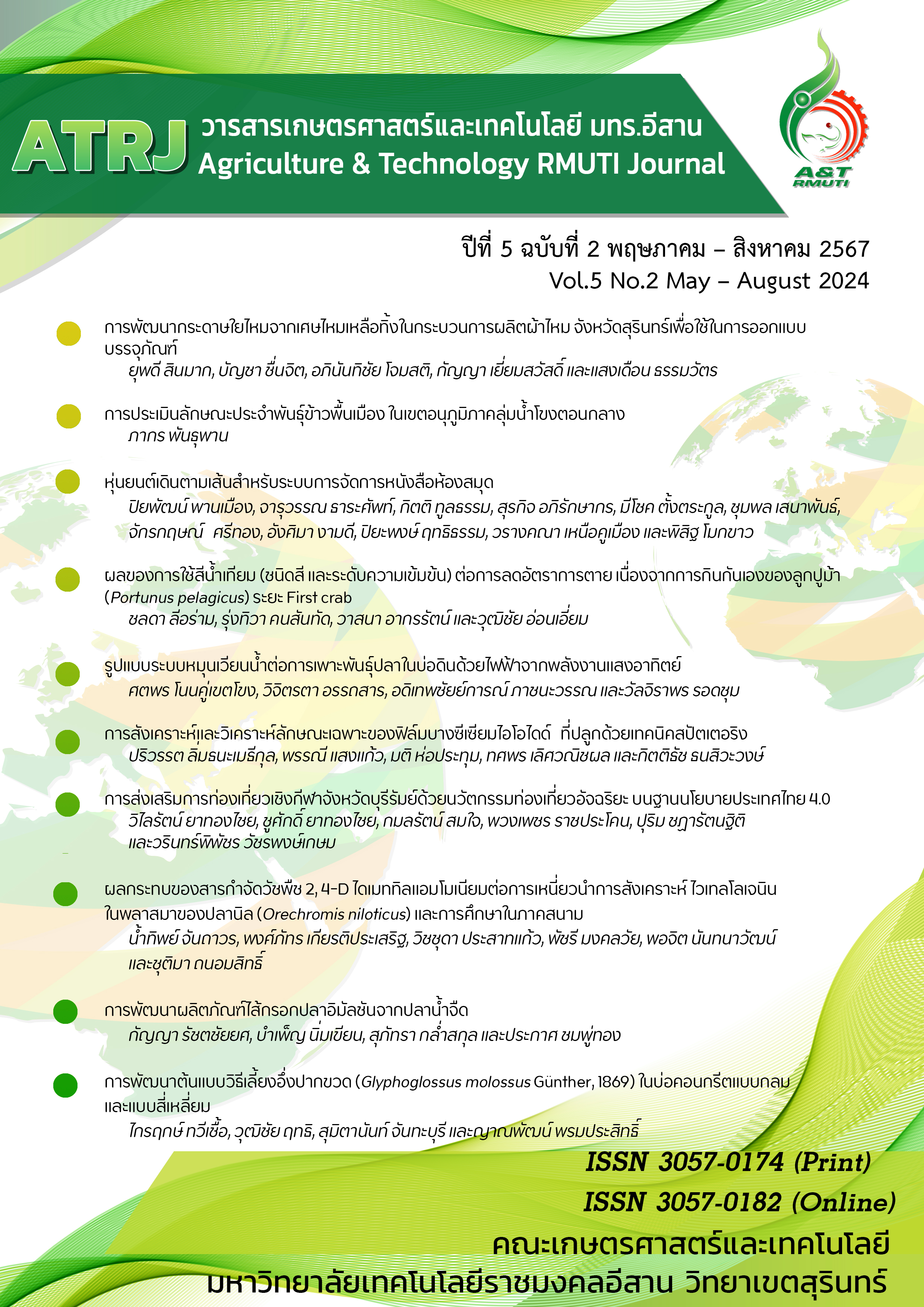
ผลกระทบของสารกำจัดวัชพืช 2, 4-D ไดเมททิลแอมโมเนียมต่อการเหนี่ยวนำการสังเคราะห์ไวเทลโลเจนินในพลาสมาของปลานิล (Orechromis niloticus) และการศึกษาในภาคสนาม
คำสำคัญ:
ไวเทลโลเจนิน , สารกำจัดวัชพืช , การปนเปื้อน , 2,4-D ไดเมททิลแอมโมเนียมบทคัดย่อ
สารกำจัดวัชพืชที่ปนเปื้อนในแหล่งน้ำ สามารถรบกวนการทำงานของต่อมไร้ท่อ โดยชักนำให้ปลาเพศผู้หรือปลาวัยอ่อนสังเคราะห์ไวเทลโลเจนิน งานวิจัยนี้จึงได้ทำการศึกษาการเหนี่ยวนำไวเทลโลเจนินในพลาสมาของปลานิล (Oreochromis niloticus) โดยใช้สารกำจัดวัชพืช 2,4-D ไดเมททิลแอมโมเนียม โดยแบ่งออกเป็น 2 การทดลอง คือ 1) การศึกษาในห้องปฏิบัติการด้วยการเหนี่ยวนำไวเทลโลเจนินด้วยฮอร์โมนเอสโตรเจน (E2) และสารกำจัดวัชพืช 2,4-D ระดับความเข้มข้นที่ไม่ก่อให้เกิดการตาย (2.5 ไมโคลิตรต่อลิตร) โดยวิเคราะห์ปริมาณโปรตีนรวมในพลาสมา ศึกษารูปแบบของโปรตีนด้วยเทคนิค SDS-PAGE และการแสดงออกของไวเทลโลเจนินด้วยเทคนิคทางแอนติบอดี คือ เวสเทิร์นบลอทและดอทบลอท ร่วมกับการศึกษาภาคสนาม โดยเก็บตัวอย่างปลาจากแหล่งน้ำธรรมชาติ คือ อ่างเก็บน้ำห้วยเสนง จังหวัดสุรินทร์ และฟาร์มปลาเอกชนที่ใช้น้ำจากอ่างเก็บน้ำห้วยเสนงในระบบเพาะเลี้ยง โดยนำมาศึกษาปริมาณโปรตีน การแสดงออกของโปรตีน และการแสดงออกของไวเทลโลเจนิน ร่วมกับการตรวจสอบการปนเปื้อนสารกำจัดศัตรูพืชในน้ำด้วยชุดทดสอบอย่างง่าย GT test kit ผลการศึกษาพบว่า ปลานิลที่ได้รับสัมผัสสารกำจัดวัชพืช 2,4-D สามารถเหนี่ยวนำให้มีการสังเคราะห์ไวเทลโลเจนินได้เช่นเดียวกับ E2 โดยไวเทลโลเจนินที่พบมีขนาด 250 และ 220 กิโลดาลตัน ส่วนปลาธรรมชาติจากอ่างเก็บน้ำห้วยเสนง 4 ชนิด ที่ทำการศึกษา คือ ปลาช่อน ปลาดุกรัสเซีย ปลาบู่ และปลาดุกลูกผสม ไม่พบการแสดงออกของไวเทลโลเจนิน ส่วนปลานิลจากฟาร์มเอกชน พบการแสดงออกของไวเทลโลเจนินในทุกตัวอย่างที่ศึกษา สอดคล้องกับผลการตรวจสอบการปนเปื้อนของสารกำจัดวัชพืชในน้ำให้ผลบวกเช่นเดียวกัน ผลการศึกษาชี้ให้เห็นว่าสารกำจัดศัตรูพืช 2,4-D มีผลต่อการทำงานของต่อมไร้ท่อ โดยตรวจสอบได้จากการใช้ไวเทลโลเจนินเป็นตัวชี้วัดทางชีวภาพ ซึ่งการบริโภคปลาที่ได้รับสารเหล่านี้อาจส่งผลให้เกิดการสะสมสารกำจัดวัชพืชเพิ่มขึ้นตามลำดับห่วงโซ่อาหารและเป็นอันตรายกับมนุษย์ได้
เอกสารอ้างอิง
ไชยวัฒน์ นวลขาว, พัชรี มงคลวัย, สำเนาว์ เสาวกูล, พอจิต นันทนาวัฒน์, จันทร์พิมพ์ กังพานิช, อำนวย วัฒนกรสิริ และชุติมา ถนอมสิทธิ์. (2564). ผลกระทบของพาราควอตต่อการเปลี่ยนแปลงทางสรีรวิทยา การแสดงออกของอะซิทิลโคลีนเอสเทอเรสและการเปลี่ยนแปลงเนื้อเยื่อวิทยาของปลานิล. ใน การประชุมวิชาการระดับชาติ “ราชมงคลสุรินทร์ ครั้งที่ 12 วิจัยและนวัตกรรมเพื่อพัฒนาเศรษฐกิจวิถีใหม่” 16-17 กันยายน 2564. มหาวิทยาลัยเทคโนโลยีราชมงคลอีสาน วิทยาเขตสุรินทร์. สุรินทร์. F20 – F32.
พอจิต นันทนาวัฒน์. (2558). ไวเทลโลเจนิน : ตัวชี้วัดทางชีวภาพสำหรับการปนเปื้อนสารรบกวนการทำงานของต่อมไร้ท่อในแหล่งน้ำ. วารสารวิทยาศาสตร์บูรพา. 20(1): 201-208.
พอจิต นันทนาวัฒน์, นันทิกา คงเจริญพร และศุภกิจ ศรีสวัสดิ์. (2559). การพัฒนาโมโคนอลแอนติบอดีจำเพาะต่อไวเทลโลเจนินในปลากระพงขาว (Lates calcarifer Bloch). รายงานการวิจัยฉบับสมบูรณ์. คณะวิทยาศาสตร์ มหาวิทยาลัยบูรพา ชลบุรี.
วิชาดา จงมีวาสนา และรัติยากร ไชยพลงาม. (2548). การปนเปื้อนของสารเคมีกำจัดแมลงเอนซัลแผนในน้ำประปา. วารสารกรมวิทยาศาสตร์การแพทย์. 47(3): 202-212.
วิชชุดา ประสาทแก้ว และพอจิต นันทนาวัฒน์. (2561). การพัฒนาเทคนิคดอทบลอทเพื่อตรวจสอบไวเทลโลเจนินสำหรับใช้เป็นตัวชี้วัดทางชีวภาพของสารรบกวนการทำงานของต่อมไร้ท่อ. วารสารวิทยาศาสตร์บูรพา. 23(3): 1448-1457.
สำนักควบคุมพืชและวัสดุการเกษตร. (2567). สรุปการนำเข้าวัตถุอันตรายทางการเกษตร ปี 2566 10 อันดับ. กรม วิชาการเกษตร กระทรวงเกษตรและสหกรณ์. ค้นเมื่อ 4 มิถุนายน 2567. https://www.doa.go.th/ard/wp-content/uploads/2024/04/5-รายงานสรุปการนำเข้าวัตถุอันตรายทางการเกษตร-ปี-พ.ศ.-2566-ประเภท.pdf.
สุรัสวดี แพทย์รังษี, วิชชุดา ประสาทแก้ว และพอจิต นันทนาวัฒน์. (2560). ผลของโนนิลฟีนอลต่อการชักนำไวเทลโลเจนิน ในปลากะพงขาววัยอ่อน. วารสารวิทยาศาสตร์บูรพา. 22(ฉบับพิเศษ): 195-202.
อุไรวรรณ อินทร์ม่วง. (2545). มลพิษทางน้ำ. พิมพ์ครั้งที่ 1. สำนักพิมพ์มหาวิทยาลัยขอนแก่น: ขอนแก่น.
อุทุมพร สมพงษ์. (2564). การศึกษาชนิดและปริมาณสารกำจัดศัตรูพืชตกค้างในน้ำบริเวณพื้นที่เกษตรกรรมของกรุงเทพมหานครฝั่งธนบุรี. วารสารวิชาการซายน์เทค มรภ.ภูเก็ต. 5(2): 17-30.
Akers J.T., Johnston M.F. and Haasch M.L. (2000). Immunodetection of hepatic peroxisomal PMP70 as an indicator of peroxisomal proliferation in the ummichog, Fundulus heteroclitus. Marine Environmental Research. 50: 361-365.
Atecq B., Farah M.A. and Ahmad W. (2006). Evidence of apoptic of 2,4-D and butachlor on walking catfish, Clarias batrachus, by transmission electron microscopy and DNA degradation studies. Lift Sciences. 78: 977-986.
Campbell D.G., Borglin S.E., Green F.B., Grayson A., Wozei E. and Stringfellow W.T. (2006). Biologically directed environmental monitoring, fate, and transport of estrogenic endocrine disrupting compounds in water: A review. Chemosphere. 65(8): 1265-1280.
Garnayak S.K., Mohanty J., Rao T.V., Sahoo S.K. and Sahoo P.K. (2013). Vitellogenin in Asian catfish, Clarias batrachus: Purification, partial characterization and quantification during the reproductive cycle by ELISA. Aquaculture. 392-395: 148–155.
Gupta P. and Verma S.K. (2020). Impacts of herbicide pendimethalin on sex steroid level, plasma vitellogenin concentration and aromatase activity in teleost Clarias batrachus Linnaeus. Environmental Toxicology and Pharmacology. 75(3): 103324.
Hock B., Marx A., Sherry J. and Hansen P.D. (2001). A new monoclonal antibody against vitellogenin from rainbow trout(Oncorhychus mykiss). Chemoshere. 44: 393-399.
Ishibashi H., Tachibana K., Tsuchomoto M., Soyano K., Ishibashi Y., Tominaga N. and Arizono K. (2001). In vivo testing system for determining the estrogenic activity of endocrine-disrupting chemicals (EDCs) in goldfish (Carassius auratus). Journal of Health Science. 47(2): 213-218.
Mahapatra S., Kabita S.K., Bhattacharya D., Sarkar S., Juin S.K., Maitra S. and Nath P. (2017). Purification and development of ELISAs for two forms of vitellogenin in Indian walking catfish, Clarias batrachus (L.). Fish Physiology and Biochemistry. 43: 477-491.
Marin M.G.M. and Matozzo V. (2004). Vitellogenin induction as a biomarker of exposure estrogenic compounds in aquatic environmental. Marine Pollution Bulletin. 48: 835-839.
Nicolas J.M. (1999). Vitellogenin in fish and the effects of PAH contaminants. Aquatic Toxicology. 45: 77-90.
Norberg B. and Haux C. (1988). A homologous radioimmunoassay for rainbow trout (Salmo trutto) vitellogenin. Fish Physiology and Biochemistry. 5(2): 59-68.
Okoumassoun L.E., Brochu C., Deblois C., Akponan S., Marion M., Averill-Bates D. and Denizeau F. (2002). Vitellogenin in tilapia male fishes exposed to organochlorine pesticides in Ouémé River in Republic of Benin. Science of The Total Environment. 299: 163-172.
Prasatkaew W., Nanthanawat P. and Thanomsit C. (2019). Assessment of endocrine disrupthing chemicals ezposure in Sea Bass (Lates calcarifer) and wild fishes using vitellogenin as a biomarker. Environment Asia. 12(2): 69-78.
Sarikaya R. and Yilmaz M. (2003). Investigation of acute toxicity and the effect of 2,4-D (2,4-D dichlorophenoxyacetic acid) herbicide on the behavior of the common carp (Cyprinus carpio L., 1758; Pisces, Cyprinidae). Chemosphere. 52: 195-201.
Thanomsit C., Wattanakornsiiri A. and Nanthanawat P. (2016a). Effect of glyphosate on fish behavior and histological alteration of gills in Asian Sea bass (Lates calcarifer). Burapha Science Journal. 21(2): 204-215.
Thanomsit C., Wattanakornsiiri A. and Nanthanawat P. (2016b). Toxicity evaluation of glyphosate on mortality rate and histological alteration in Black Rice crab. Burapha Science Journal. 21(3): 151-165.
Thanomsit C., Saowakoon S., Wattanakornsiri A., Nanuam J., Prasatkaew W., Nanthanawat P., Monkolvai P. and Chalorcharoenying W. (2020a). Glyphosate (Roundup) : fate, toxicity assessment and adverse effect on aquatic environment. Naresuan University Journal: Science and Technology. 28(1): 65-81.
Thanomsit C., Nuankaew C., Prasatkaew W., Wattanakornsiri A., Nanuam J., Nanthanawat P., and Kiaprasert P. (2020b). Adverse effects of chlorpyrifos and cypermethrin mixture on physiological alterations and cholinesterase on Nile tilapia (Oreochromis niloticus). Thai Journal of Agricultural Science. 53(3): 134-148.
Thanomsit C., Saetiew J. and Meemon P. (2022). Optical coherence tomography as an alternative tool for evaluating the effects of glyphosate on hybrid catfish (Clarias gariepinus × Clarias macrocephalus). Toxicology Reports. 9: 181-190.
Walker C.H., Hopkin S.P. and Peakall D.B. (2006). Principle of ecotoxicology. Publisher: USA.
Wang J., Bing X., Yu K., Tian H., Wang W. and Ru S. (2015). Preparation of a polyclonal antibody against goldfish (Carassius auratus) vitellogenin and its application to detect the estrogenic effects of monocrotophos pesticide. Ecotoxicology and Environmental Safety. 11: 109-116.
ดาวน์โหลด
เผยแพร่แล้ว
รูปแบบการอ้างอิง
ฉบับ
ประเภทบทความ
สัญญาอนุญาต
ลิขสิทธิ์ (c) 2024 วารสารเกษตรศาสตร์และเทคโนโลยี

อนุญาตภายใต้เงื่อนไข Creative Commons Attribution-NonCommercial-NoDerivatives 4.0 International License.
เนื้อหาและข้อมูลในบทความที่ลงตีพิมพ์ในวารสารทดสอบระบบ ThaiJo2 ถือเป็นข้อคิดเห็นและความรับผิดชอบของผู้เขียนบทความโดยตรงซึ่งกองบรรณาธิการวารสาร ไม่จำเป็นต้องเห็นด้วย หรือร่วมรับผิดชอบใดๆ
บทความ ข้อมูล เนื่อหา รูปภาพ ฯลฯ ที่ได้รับการดีพิมพ์ในวารสารทดสอบระบบ ThaiJo2 ถือเป็นลิขสิทธิ์ของวารสารทดสอบระบบ ThaiJo2 หากบุคคลหรือหน่วยงานใดต้องการนำทั้งหมดหรือส่วนหนึ่งส่วนใดไปเผยแพร่หรือเพื่อกระทำการใดๆ จะต้องได้รับอนุญาตเป็นลายลักอักษรณ์จากวารสารทดสอบระบบ ThaiJo2 ก่อนเท่านั้น