Effect of dietary supplementation of Perilla Mint (Perilla frutescens) oil on growth performances and enrichment of omega-3 fatty acid in Rosy Danio (Danio roseus)
Keywords:
Rosy Danio, Perilla mint oil, Growth performances, Omega-3 fatty acidAbstract
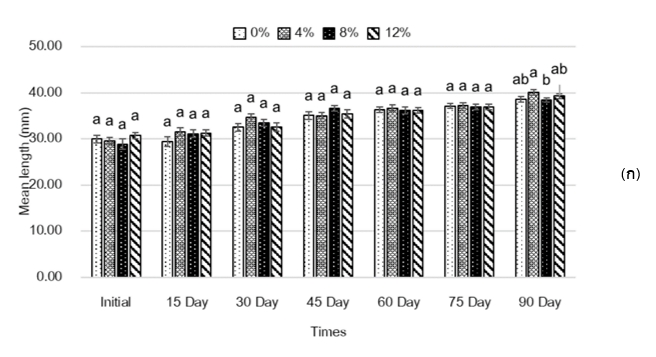
Rosy Danio (Danio roesus) are freshwater fish with high nutritional values but low in essential fatty acids when compared to marine fish. However, these essential fatty acids are found in many oil plants especially perilla. Therefore, this study aimed to examine the effects of perilla oil supplements on growth and the accumulation of omega-3 fatty acids in the Rosy Danio. The completely randomized design (CRD) trial was divided into 4 treatments with 3 replications, consisting of food with different concentrations of perilla oil at 0 (control), 4, 8, and 12%. Before the experiment started, the average weight of fish was at 0.22±0.01 g. One hundred fish/pond were cultured in a cement pond (diameter 1 m) for 90 days. At the end of the experiment, Rosy Danio in the group fed a diet with perilla oil at 4% had length gain, specific growth rate, and feed conversation ratio significantly higher (p < 0.05) than those fed a diet with perilla oil at 12%, but were not significantly different (p > 0.05) from those fed a diet with perilla oil at 0% and 8%. Weight gain and rate of B/C ratio of Rosy Danio fed a diet with perilla oil 4% had the highest value, significantly different (p < 0.05) from all treatment. The survival rate of fish fed a diet with perilla oil at 4% was significantly higher (p < 0.05) than those fed a diet with perilla oil at 8 and 12%. Omega-3 accumulated in the fish at the end of the experiment all trials were significantly different (p < 0.05), with a tendency to increase with the amount of perilla oil mixed in the food. Therefore, our results suggest that dietary supplementation with 4 % perilla oil would be suitable for Rosy Danio feeding. However, the knowledge gained can be applied to other fish species in the future.
References
Cengiz E, Ünlü E, BaŞhan M. Fatty acid composition of total lipids in muscle tissues of nine freshwater fish from the River Tigris (Turkey). Turk J Biol. 2010;34:433-438.
Shahidi F, Ambigaipalan P. Omega-3 polyunsaturated fatty acids and their health benefits. Annu. rev. food sci. technol. 2018;25(9):345-381. DOI: 10.1146/annurev-food-111317-095850.
Abouel-Yazeed AM. Fatty acids profile of some marine water and freshwater fish. J. Arab. Aquacult. Soc. 2013;8(2):283-292.
Justi KC, Hayashi C, Visentainer JV, Souza NE, Matsushita M. The influence of feed supply time on the fatty acid profile of Nile tilapia (Oreochromis niloticus) fed on a diet enriched with n-3 fatty acids. Food Chem. 2003;80:489-493.
Ayisi CL, Zhao Jl, Apraku A. Consequences of replacing fish oil with vegetable oils in fish. J. Anim. Res. Nutr. 2019;4(1-3):1-11. DOI: 10.21767/2572-5459.100053.
Suttajit M, Khanaree C, Tantipaiboonwong P, Pintha K. Omega-3, omega-6 fatty acids and nutrients of Nga-mon seeds in Northern Thailand. Naresaun Phayao J. 2015;8(2):80-86.
Siriamornpun S, Li D, Yang L, Suttajit S, Suttajit M. Variation of lipid and fatty acid compositions in Thai perilla seeds grown at different locations. Songklanakarin. J. Sci. Technol. 2006;28(1):17-21.
Asif M. Health effects of omega-3, 6, 9 fatty acids: Perilla frutescens is a good example of plant oils. OPEM. 2011;11:51-59. DOI: 10.1007/s13596-011-0002-x.
Bondioli A, Folegatti L, Rovellini P. Oils rich in alpha linolenic acid: chemical composition of perilla (Perilla frutescens) seed oil. OCL. 2020;27(67):1-5. DOI: 10.1051/ocl/2020066.
Carbonera F, Bonafe EG, Martin CA, Montanher PF, Ribeiro RP, Figueiredo LC, et al. Effect of dietary replacement of sunflower oil with perilla oil on the absolute fatty acid composition in Nile tilapia (GIFT). Food Chem. 2014;148:230-234.
Bahurmiz OM, Ng WK. Effect of dietary plam oil source on growth, tissue fatty acid composition and nutrient digestibility of red hybrid tilapia, Oreochromis sp., raised from stocking to marketable size. Aquac. 2007;262(2-4):382-392.
AOAC.Official methods of analysis of AOAC international.19th edition.Association of Analytical Communities: Maryland. 2012.
Bligh EG, Dyer WJ. A rapid method of total lipid extraction and purification. Can J Biochem. 1959;37:911-917.
Glencross BD, Smith DM, Thomas MR, Williams KC. The effects of dietary lipid amount and fatty acid composition on the digestibility of lipids by the prawn, Penaeus monodon. Aquac. 2002;205:157-169.
Wang JT, Liu YJ, Tian LX, Mai KS, Du ZY, Wang Y, et al. Effect of dietary lipid level on growth performance, lipid deposition, hepatic lipogenesis in juvenile cobia (Rachycentron canadum). Aquac. 2005;249:439-447.
Kikuchi K, Furuta T, Iwata N, Onuki K, Noguchi T. Effect of dietary lipid levels on the growth, feed utilization, body composition and blood characteristics of tiger puffer Takifugu rubripes. Aquac. 2009;298;111-117.
Xu JH, Qin J, Yan BL, Zhu M, Luo G. Effects of dietary lipid levels on growth performance, feed utilization and fatty acid composition of juvenile Japanese seabass (Lateolabrax japonicus) reared in seawater. Aquac. Int. 2011;19(1):79-89. DOI: 10.1007/s10499-010-9342-7.
Wang A, Han G, Lv F, Yang W, Huang J, Yin X. Effects of dietary lipid levels on growth performance, apparent digestibility coefficients of nutrients, and blood characteristics of juvenile crucian carp (Carassius auratus gibelio) Turk. J. Fish. Aquat. Sci. 2014;14:1-10. DOI: 10.4194/1303-2712-v14_1_01.
Tocher DR, Glencross BD. Lipids and fatty acids. In: Lee C-S, Lim C, Gatlin III D, Webster C D, editors. Dietary Nutrients, Additives and Fish Health, 1st ed. Hoboken, NJ: John Wiley & Sons, Inc.; 2015. 384 p.
Paul BN, Datta AK, Das S, Chattopadhyay DN, Giri SS, Mohanty SN. Effect of dietary lipid levels on growth and carcass composition of Ompok pabda (Siluridae) fry. Indian J. Anim. Nutr. 2011;28(2):198-202.
Raj AJA, Haniffa MA, Seetharaman S, Appelbaum S. Effect of dietary lipid levels on survival and growth of the threatened freshwater catfish Mystus montanus. J. Fish. Aquat. Sci. 2007;24(1-2):51-54.
Jin Y, Tian LX, Zeng SL, Xie SW, Yang HJ, Liang GY, et al. Dietary lipid requirement on non-specific immune responses in juvenile grass carp (Ctenopharyngodon idella). Fish Shellfish Immunol. 2013;34(5):1202-1208. DOI: 10.1016/j.fsi.2013.01.008.
Choi J, Aminikhoei Z, Kim YO, Lee SM. Effects of dietary pro¬tein and lipid levels on growth and body composition of juvenile Fancy carp (Cyprinus carpio. Var.) Koi. IJABE. 2015;9(1):31-37.
Paul BN, Chowdhury D, Das A, Mandal RN, Singh P, Adhikari S, et al. Effect of dietary lipid levels on growth, body composition, and enzyme activities of larvae of butter catfish, Ompok bimaculatus (Actinopterygii: Siluriformes: Siluridae). Acta Ichthyol Piscat. 2021;51(3):289-298. DOI: 10.3897/aiep.51.67079.
Lim C, MYildirim-Aksoy M, Klesius P. Lipid and fatty acid requirements of tilapias. N. Am. J. Aquac. 2011;73(2):188-193. DOI: 10.1080/15222055.2011.579032.
Turchini GM, Torstensen BE, Ng WK. Fish oil replacement in finfish nutrition. Rev. Aquac. 2009;1(1):10-57. DOI: 10.1111/j.1753-5131.2008.01001.x.
Sales J, Glencross B. A meta-analysis of the effects of dietary marine oil replacement with vegetable oils on growth, feed conversion and muscle fatty acid composition of fish species. Aquac. Nutr. 2011;17(2):e271-e287. DOI: 10.1111/j.1365-2095.2010.00761.x.
You C, Lu F, Wang S, Chen C, Li Y. Comparison of the growth performance and long-chain PUFA biosynthetic ability of the genetically improved farmed tilapia (Oreochromis niloticus) reared in different salinities. Br. J. Nutr. 2019;121(4):374-383. DOI: 10.1017/S0007114518003471.
Ai QH, Zhao JZ, Mai KS, Xu W, Tan BP, Ma HM, et al. Optimal dietary lipid levels for large yellow croaker (Pseudosciaema crocea) larvae. Aquac. Nutr. 2008;14:515-522. DOI: 10.1111/j.1365-2095.2007.00557.x.
Olsen RE, Henderson RJ. Muscle fatty acid composition and oxidative stress indices of Arctic charr, Salvelinus alpinus (L.), in relation to dietary polyunsaturated fatty acid levels and temperature. Aquac. Nutr. 1997;3(4):227-238. DOI: 10.1046/j.1365-2095.1997.00091.x.
Portz DE, Woodley CM, Cech JJ. Stress-associated impacts of short-term holding on fishes. Rev. Fish Biol. Fish. 2006;16:125-170. DOI: 10.1007/s11160-006-9012-z.
Salikara P, Bejranonda S. Commercial investment of Nile tilapia (Oreochromis niloticus Linn.) culture in Nakhon Pathom Province. J. Econ. Manag. Strategy. 2016;3(1):40-54.
Teoh CY, Ng WK. The implications of substituting dietary fish oil with vegetable oils on the growth performance, fillet fatty acid profile and modulation of the fatty acid elongase, desaturase and oxidation activities of red hybrid tilapia, Oreochromis sp. Aquac. 2016;465:311-322. DOI: 10.1016/j.aquaculture.2016.09.023.
Karapanagiotidis IT, Bell MV, Little DC, Yakupitiyage A. Replacement of dietary fish oils by alpha-linolenic acid-rich oils lowers omega 3 content in tilapia flesh. Lipids. 2007;42(6):547-559. DOI: 10.1007/s11745-007-3057-1.
. Tocher DR, Agaba M, Hastings N, Teale AJ. Nutritional regulation of hepatocyte fatty acid desaturation and polyunsaturated fatty acid composition in zebrafish (Danio rerio) and tilapia (Oreochromis niloticus). Fish Physiol. Biochem. 2001;24:309-320.
Ackman RG, Mcleod C. Lipids and fatty acid of five freshwater food fishes of India. J. Food Lipids. 2002;9:127-145. DOI: 10.1111/j.1745-4522.2002.tb00214.x.
Fernandes CE, Vasconcelos MADS, De Almeida Ribeiro M, Sarubbo LA, Andrade SAC, Filho ABDM. Nutritional and lipid profiles in marine fish species from Brazil. Food Chem. 2014;160:67-71. DOI: 10.1016/j.foodchem.2014.03.055.
Zula AT, Desta DT. Fatty acid-related health lipid index of raw and fried Nile tilapia (Oreochromis niloticus) fish muscle. J. Food Qual. 2021:1-9. DOI: 10.1155/2021/6676528.
Boyd CE. Water Quality in Pond for Aquaculture. Alabama: Birmingham Publishing; 1990. 482 p.
Downloads
Published
How to Cite
Issue
Section
License
Copyright (c) 2023 University of Phayao

This work is licensed under a Creative Commons Attribution-NonCommercial-NoDerivatives 4.0 International License.
ผู้นิพนธ์ต้องรับผิดชอบข้อความในบทนิพนธ์ของตน มหาวิทยาลัยพะเยาไม่จำเป็นต้องเห็นด้วยกับบทความที่ตีพิมพ์เสมอไป ผู้สนใจสามารถคัดลอก และนำไปใช้ได้ แต่จะต้องขออนุมัติเจ้าของ และได้รับการอนุมัติเป็นลายลักษณ์อักษรก่อน พร้อมกับมีการอ้างอิงและกล่าวคำขอบคุณให้ถูกต้องด้วย
The authors are themselves responsible for their contents. Signed articles may not always reflect the opinion of University of Phayao. The articles can be reproduced and reprinted, provided that permission is given by the authors and acknowledgement must be given.